In what has been described as “the most important development in Southampton for a generation,” a new museum to celebrate Southampton’s maritime past has been constructed by Kier Construction. The museum’s first temporary exhibition – ‘Titanic, the Legend’ – opened on the 100th anniversary of the Titanic disaster on April 10th 2012.
Councillor John Hannides, Cabinet Member for Leisure, Culture and Heritage, commented:
“More than 550 people from Southampton lost their lives and the vast majority were crew, so the theme we have adopted is very close to the hearts of the people of Southampton.

“The attraction will not only bring together the city’s heritage, it will attract thousands of visitors and create many new jobs. This investment demonstrates our ongoing plans to develop Southampton as the capital of the south.”
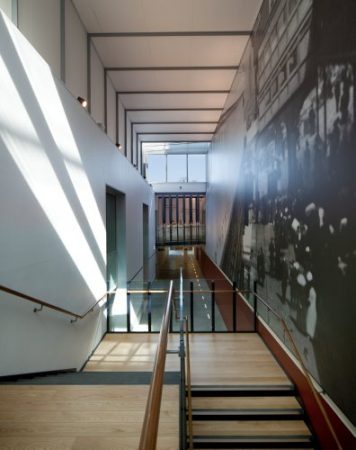
The £15 million Sea City Museum is situated in the Grade II listed former magistrates court, which adjoins the Civic Centre. The existing two-storey building has been converted and a one-storey extension has been added, bringing the total floor area to 3257m².
Sea City Museum was designed by Wilkinson Eyre Architects and features a steel-frame structure with precast reconstituted concrete cladding and translucent glazing. Interestingly, the museum extension has incorporated raked precast concrete panels in order to create a contemporary interpretation of the existing rusticated Portland stone building.

Under the project, the police cells have been converted into toilets and the court rooms into an impressive exhibition space. Additional facilities include a shop and a cafe.
The requirement for a highly mechanised solution to create the necessary conditions for the exhibition led to the incorporation of internal wall panels and suspended ceilings within the existing shell. Whilst the existing features have been retained where possible, a large part of the refurbishment phase involved enabling level access and upgrading facilities for disabled people. This involved the demolition of an external flight of stairs and substantial negotiations with English Heritage.
The existing building has been insulated and secondary glazed in order to improve thermal performance, whilst the extension is a highly insulated shell with minimum glazing. In addition, the plant is very efficient with a sophisticated BMS system to support the internal operation of the spaces.

External works have included hard landscaping and planting for the public realm outside the museum. This included modifying an existing road and linking the building to a previously walled area of park.
Funding for the project has been provided by a £4.9 million investment by the Heritage Lottery Fund (HLF) and a DCMS/Wolfson Fund grant of £200,000.
Sea City Museum is expected to attract up to 150,000 annual visitors.
RMS Titanic
The RMS Titanic struck an iceberg on her maiden voyage from Southampton to New York City and sank on 15th April 1912 with 2223 people on board. Of these passengers 1517 would lose their lives, in part due to the inadequate provision of lifeboats.
Built at the Harland and Wolff shipyard in Belfast in order to compete with the rival Cunard Line’s ‘Lusitiana’ and ‘Mauretania’, RMS Titanic was intended to be the largest and most luxurious ship to ever set sail. Construction began on 31st March 1909 and was funded by the American J.P Morgan and his international Mercantile Marine Co. The hull was launched on 31st May 1911, and the outfitting was complete by 31st March the following year.
RMS Titanic was equipped with two reciprocating four-cylinder triple-expansion steam engines and one low-pressure Parsons turbine, each driving a propeller. There were 29 boilers fired by 159 coal-burning furnaces that made a top speed of 23 knots (43km/h) possible.
The overall length of RMS Titanic was 882 feet and 9 inches (269.1m) and the height 59 feet (18m), whilst the ship had a breadth of 92 feet (28m) and a tonnage of 46,328 GRT.