Starting life in 1967, Chapman Ventilation has established a reputation as one of the leading heating, ventilation and air conditioning contractors in the restaurant industry.
Supplying bespoke, energy-efficient systems to restaurants across the UK, Chapman Ventilation specialises in delivering entire HVAC solutions often in particularly challenging circumstances, overseeing the project from concept to completion.
With over forty years’ experience working hand-in-hand with restaurants and businesses it’s easy to see how Chapman Ventilation has amassed such a high-profile client base. From flame-grilled PERi-PERi chicken specialists Nando’s and fast-casual chain The Restaurant Group, to some of London’s premier meaty monoliths Hawksmoor, Pitt Cue and Barbecoa, Chapman Ventilation’s work can be seen in restaurants across the UK.
Most recently, however, Chapman Ventilation has been working on an altogether different kind of project: a bespoke converted shipping container for former butcher and street food connoisseur Mark Gevaux. Mark, aka. The Ribman, is a stalwart of the London street food scene, and is renowned for his succulent baby back rib meat rolls and stupidly spicy – and aptly named – Holy Fuck hot sauce.
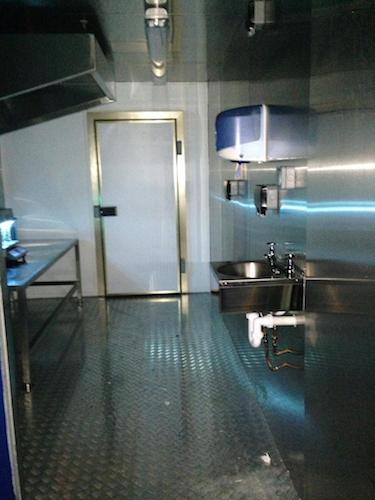
Work began on the The Ribman’s shipping container in June 2013 and reached completion in September. Part kitchen, part fridge and part retail unit, the container is designed to provide Mark with a much-needed base in which to cook and store his produce – up to a ton of ribs at any one time and several litres of sauce.
As London’s street food scene continues to gain momentum, demand for Mark’s hot sauce has grown rapidly, and he now has a devoted cult following. In fact, the entire container project was funded through Kickstarter – the world’s largest funding platform for creative projects – and has already proved to be a fantastic success.
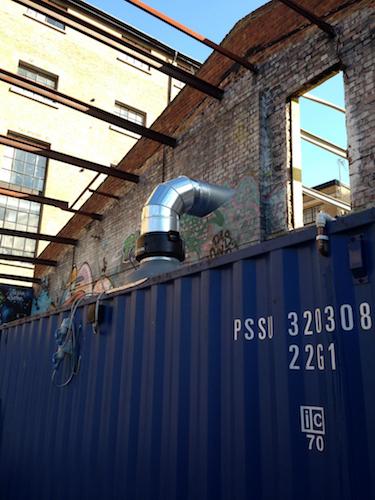
Roughly one third of the container is taken up by an insulated cold room, whilst the rest forms the kitchen. Ventilated via a bespoke reduced front canopy and fully clad in stainless steel, the kitchen features two induction hobs, a work surface, and both handwash and dishwash sinks. Critically, the entire container needed to be fully portable, meaning that it had to be completely self-contained, lightweight and easy to connect to both power and water supplies.
Discussing the development of the new kitchen, Mark said:
“I’m a butcher by trade, but following an accident a few years ago I was unable to continue down this particular path, so instead I started selling racks of ribs on a farmers market. Over time I began cooking up samples for people to try and soon this developed to the point where I became part of the street food scene.
“With the ribs and the sauces that I began selling becoming very popular, word soon spread and it reached a point where I couldn’t keep up with demand. I had a number of offers for pop-up locations or to take up a short term residency in an existing venue, but none of these seemed quite right for me.
“Then a few years ago I met David Chapman, the Commercial Director of Chapman Ventilation, who showed an interest in what I was doing. When I first met David my initial thought was how impressed I was with the work that was being conducted by Chapman Ventilation. So as soon as I had the idea of converting a shipping container into a kitchen, Chapman Ventilation was my first and only choice for helping me reach my goal.”
Mark added:
“The creation of The Ribman container is fantastic and it has really transformed the way I work. With an on-site kitchen and fridge I am now able to take delivery of ribs which I can then spend the next three days cooking, taking away so much of the previously time consuming preparation work. It is fantastic!”

For Chapman Ventilation, this project was a welcome and challenging step into the unknown. Jenny Handy, Marketing Manager for Chapman’s, said:
“We’ve been running this project alongside our normal, pretty hectic workload, so it’s safe to say that it’s been a busy couple of months for us. Everything about Mark’s shipping container was a learning curve: from where to fit the fan in such a space-limited project, to how exactly do you get an eight foot high, three tonne shipping container through an eight foot two inch high gap? It’s not been easy, but the completed container looks fantastic, and it’s great to be able to help Mark to reach his Kickstarter goal.”
Chapman Ventilation has a packed portfolio of projects, which continues to expand as it takes on more and more varied projects. For more information about Chapman Ventilation and their current client portfolio, please visit: www.chapmanventilation.co.uk