
The Old Court House
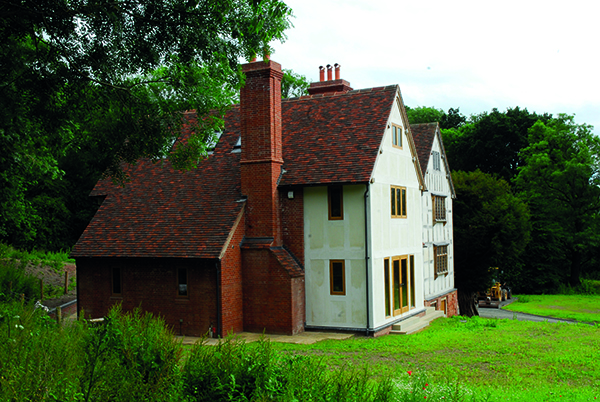
A historic building that had been left derelict for 30 years and was on the verge of collapse has been brought back to its former glory thanks to a major restoration project spearheaded by Speller Metcalfe.
The Old Court House forms part of a much larger farm complex, which was purchased along with 20 other buildings on the site by the current owner in 2011. The perilous state of the Old Court House suggested work on it was a priority, and a Section 106 agreement meant all other work on the site was subject to its restoration.
Cut off from the rest of the site with no vehicle or services access, it was clear from the beginning that the restoration of the Old Court House would be time consuming, highly specialised and labour intensive. With work now complete, however, the time and effort is receiving widespread industry recognition. The project was most recently shortlisted for a RIBA West Midlands Award 2018.
The daunting task of planning and overseeing the work was undertaken by Harrison Brookes Architects. Premier Construction recently caught up with Rhys Brookes, co-founder of the practice, to find out more about the work. He began by outlining his impressions of the building:
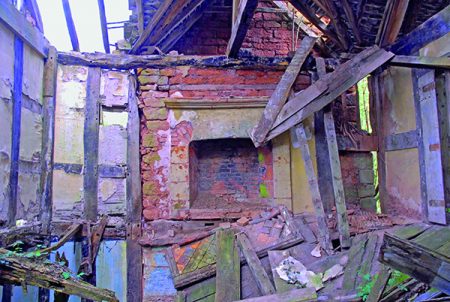
“The building was mobile, and when I say it was mobile you could actually push it with your hand and it was rocking in the wind. Every aspect we looked at, we knew it was going to be a problem. To put it into perspective we had to have 2km of water pipes to get water to the site (actually 7 on total but this included other buildings on the site). It needed a lot of careful thinking about how to solve it. My first impression was ‘How the hell do I deal with this?’
“We had to break it down into little bits so the first thing was to stabilise the building, that was the priority. The whole process really was about not rushing it and buying thinking time. It had been derelict for 30 years. Rain had been pouring into it and it was absolutely saturated. The building was dictating to us rather than the other way round.
“On a new build project, the client is everything. The client says what they want and you produce it. With a historic building, the building effectively becomes the client. The building will tell you what can and cannot be done.”
Having secured the building, the restoration could begin. A number of considerations had to be made to balance the requirements of modern living with the reality of what the building could provide. For example, a brand new roof and the use of hempcrete to insulate the structure made a significant impact on its environmental viability.
Central to the project was the use of materials and a desire to retain as much of the historic fabric as possible. Where elements had been lost or needed replacing, the team went right back to the original source material. This extended to using traditional and sustainable skills when rebuilding certain areas of the property. Rhys explained:
“The use of materials was a very interesting aspect of the project. Historic building materials are nearly always used in there primary or secondary state. For example, a piece of stone may get used as found or dressed but it doesn’t really change and you can still identify it as a piece of stone. A piece of concrete is completely different, that can be made of up 50 different things. The key in this instance was to really understand the primary state of the materials, to really think about where it’s come from and how it has changed from its raw state. Thinking about these things was important because that’s where the skill comes in.
“Having to go back to first principals of how something was done by hand was what made this project really interesting. We didn’t want the materials to be finished so they looked like they had come out of a factory. We wanted them to have some life and character.
“The guys on site were very keen to do everything by hand. Obviously all the boards were rough cut by machine and large pieces of timber were cut by the sawmill but generally speaking every single piece of timber or stone was finished by hand on site. That meant that the apprentices who worked on the job were dealing with materials in a different way to normal. It was going back to the way it was done historically. That enabled the guys on site to see a different aspect of how to build.”
Timber was supplied by Timbersource. Given the nature of the work and the commitment to original materials described above, there were a considerable number of specialist sub contract items on the project, not least the joinery and glazing. Oakwrights Bath Ltd, specialists in quality, bespoke and traditional joinery, were responsible for the joinery on the project. Director Peter Love commented:
“We already knew Rhys and had worked with him on other projects. When he contacted us to have a look at the Old Court House, the building at that stage was shrouded in scaffolding but Speller Metcalfe had already done a reasonable amount of work.
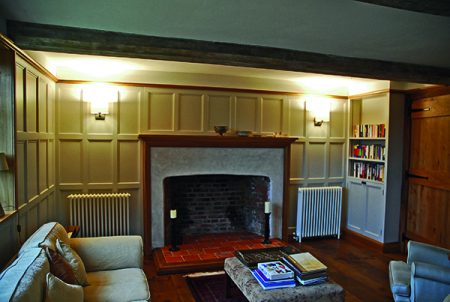
“Initially, the main elements of our work were the external joinery on the original parts of the building. We provided the windows at the front and there were renovation, replacement type windows in other parts of the original structure. Later on, we got involved in producing windows and doors for the new build extension. Internally we did a panelled room with units, replicating samples of panelling from the original building. We also provided some cupboard fronts, various trims and pieces for the loft area.
“Normally on a project like this, the challenge would be trying to understand what was required by the architect or client. However, conservation work such as this really is Rhys’ thing and the level of detail he provided was very good. There were minimal challenges because Rhys had already done the legwork. Rhys is a man of detail and as a joiner that is something we really like. Our whole being revolves around detail.”
From near ruin, the transformation of the Old Court House has been a remarkable turnaround. The dedicated and patient work of everyone involved in the project, led by Rhys’ detailed direction, has not only resulted in a stunning restoration but also provided an opportunity for workers on site to develop and enhance their skills.
Reflecting on the recent RIBA recognition, Rhys concluded:
“It was surprising to get the nomination. It’s not about the design; it’s about the guys on the site who actually did the work. At the end of the day, they spent days and days at the coalface. We’re really pleased for all concerned that it’s got this far.”