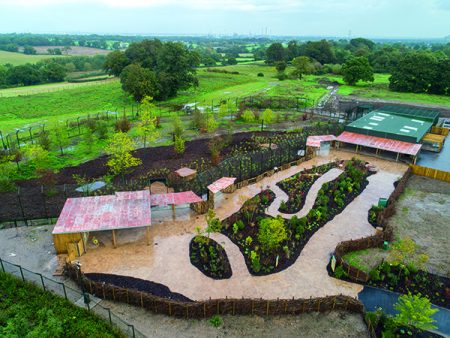
Chester Zoo Asiatic Lion Exhibit
- Conservationists celebrate completion of important breeding habitat for world’s rarest lion species.
- Major 5,000 square metre zone recreates India’s Gir Forest region where the last surviving Asiatic lions live.
- Species survives in just 0.1% of its former range in the wild.
A pride of Asiatic lions – the world’s rarest lion species – have taken their first steps into a specially-created new home at Chester Zoo.
The zoo’s new conservation area is the UK’s largest habitat for Asiatic lions and has been designed to recreate the environment of the Gir Forest region of India, where the last few hundred Asiatic lions live in the wild.
The zoo hopes a new visitor zone will raise awareness of the threats faced by Asiatic lions in the wild, including human-wildlife conflict and the conservation action needed to protect the species.
Dave Hall, Team Manager of Carnivores at Chester Zoo, said: “Asiatic lions are impressively built animals, with compact bodies, powerful legs and strong jaws and teeth, making them superb hunters. Their retractable claws, which they use for gripping tightly on to prey, can be up to 38mm long and they have rough tongues, like sandpaper, for scraping meat from bones. They are truly majestic animals. This brand new habitat at the zoo – the largest in the UK – really is a fitting new home for them.”
The area – which has been specially created by the zoo’s carnivore experts – spans 4,780 square metres in total.
Dan Sparks, Project Manager at Harry Fairclough, the principal contractors on the project, said: “When works commenced on site our first job was to set up our site compound. The site was then stripped to our formation levels and then we moved onto the installation of a new drainage system for both foul and surface water. That was then tied into the existing zoo drainage system. Two head walls were constructed before we had to cross an existing brook to create a culvert with concrete filled sand bags. We used that technique to give the culvert a more rustic look to fit in with the site.”
Recreating the scrubland savannahs of India’s Gir Forest region, the dry forest habitat contains raised hilltop viewing points for the pride, as well as heated rocks and a water hole. The habitat is also complete with heated indoor dens, which zoo experts hope will one day be the perfect environment for cubs. The state-of-the-art facility could be a major boost to the European breeding programme for the species, which is teetering on the brink of extinction in the wild.
The new habitat – which has been created using environmentally friendly considerate construction techniques – has been constructed using the latest sustainable construction standards. Climate controlled dens, heated by sustainable ‘green’ energy and supported by fully insulated walls and roofs will minimise power consumption in order to create year-round optimum conditions for big cats.
Dan added: “We are proud to have been involved in this major conservation project for Chester Zoo and to have played a part in securing a future for this endangered species. As principal contractor on site it was our job to plan, manage and co-ordinate all work during the construction phase and ensure that any hazards were identified and risks controlled. We liaised closely with all other contractors and the consultant design team on a daily basis, enabling us to keep the client constantly updated with progress on-site. It’s not every day you get to build a Lion’s Den and for us as a business it’s a very exciting project for us to be a part of.”