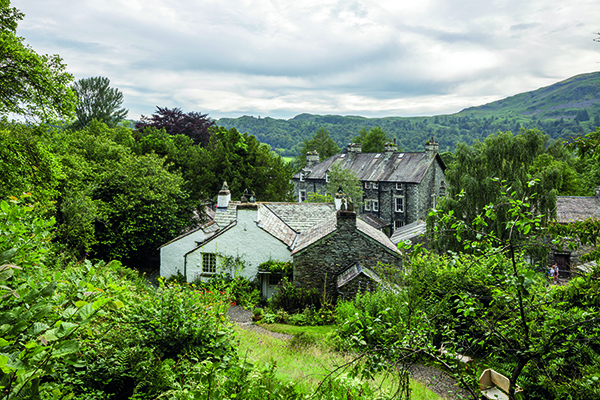

Dove Cottage and the Museum at Wordsworth Grasmere
As part of Reimagining Wordsworth, the 2020 celebrations of the 250th anniversary of the birth of the great English Romantic poet, William Wordsworth, Wordsworth Grasmere has unveiled the first phase of a re-imagined visitor journey at Dove Cottage, Wordsworth’s former Lake District home. The newly-expanded Museum on the site, showcasing many of Wordsworth’s original manuscripts, will open in spring 2021 in a second phase of the project. Exhibition design and interpretative overview throughout is by Nissen Richards Studio whilst, in a separate commission, Nissen Richards Studio has also created a new Wordsworth Grasmere identity, encompassing all aspects of the site under the aegis of its governing charitable body, The Wordsworth Trust.
The scope of works
When Dove Cottage was originally purchased, the on-site museum was located within a single room of the cottage. More land and buildings were subsequently acquired and the site now encompasses Dove Cottage, the Museum and the Jerwood Centre, created at the turn of the millennium and housing a world-class collection of Wordsworth manuscripts – as well as a number of supporting buildings, gardens and a car park.
The overall brief to Nissen Richards Studio was to create Wordsworth Grasmere’s new exhibition design and interpretation, wayfinding and signage, including some elements of interior design, as well as branding, graphics and the art-direction of most of the project’s AV elements, including films by renowned documentary-maker Nick Street and sound designs by specialist sound designer Carolyn Downing.
The new wayfinding system devised by Nissen Richards Studio for the site uses panels of local slate, with slate-clad metal frames for larger, freestanding pieces. The wayfinding wording is an etched and ink-filled graphic in a Soleil Regular typeface, accompanied where necessary by images from a grid of consistent and easily-comprehensible pictograms. These will allow instant interpretation by the hugely-international range of visitors Wordsworth Grasmere attracts, with the pictograms indicating, for example, visiting times, walking distances, closed areas and rain- and sunshine-friendly paths.
The refurbishment of Dove Cottage
A number of changes had been made to Dove Cottage since Wordsworth’s time, incorporating both furniture from later in his life and a number of fitted fixtures from a later period. Part of the new project’s scope was to strip back any furniture that felt out of place in order to create a more honest treatment for the Grade-I-listed cottage.
“Our approach to the design was not to replicate the original state, but to evoke its past history,” Nissen Richards Studio Director Pippa Nissen explained.
“New furniture, commissioned from local craftsmen with specialist historic knowledge has been built in the style of the period and now sits alongside real, surviving furniture. An object-based treatment has been combined with film and sound design commissions to suggest a lived-in and humble home, where extraordinary writing took place.”
Nissen Richards Studio’s interpretational approach was to create a film that visitors see first, in which the cottage is full of life, working with film-maker Nick Street. This kicks off the visitor journey in the old stables, just before entry to the cottage, and sets the stage. The film ensures that visitors’ minds are full of images already as they explore the cottage further. The film also influenced the approach to the refurbishment of the cottage, which represents moments from another time, but has also been designed in fragments to allow the visitors’ imagination to fill the gaps.
The ground floor of the cottage is made up of three main rooms – the downstairs lodging room, back kitchen and the main kitchen, a busy and domestic family space, where, increasingly, thinking and writing happened as time went on, although Wordsworth wrote in the majority of rooms in the house at some stage. The back kitchen and pantry are filled with cooking jars and the kind of foods that would have been used at the time.
“The concept is for visitors to explore the cottage using all of their senses,” Elin Simonsson, Head of Interpretation at Nissen Richards Studio explained, “effectively becoming ‘Wordsworthian’ as they pass through the space, walking where William and Dorothy walked, sitting where they sat, ascending the same staircase, seeing through the same windows. The house doesn’t feel like a polished historic house setting, but rather a home that is lived in. All around are the traces of human life: a book left open on a table; an open journal; unfolded letters; a chair set at an angle; leftover crumbs on a plate – even dishes next to the sink. We really want visitors to feel a connection with the Wordsworths from the moment they enter Dove Cottage.”
Sound designer Carolyn Downing has created a soundscape for the scheme that reverberates all around the ground floor, breathing life into the home and creating a sense of the real lives lived here. As the visitor proceeds, they hear subtle snatched sounds, as if from the next room or coming in through the window, creating a rich picture of everyday life and including children playing and muffled conversations, utilising a variety of voices and local accents.
This impressionistic sense of the house and its history is built on further as visitors go upstairs and discover the first objects on display, including a journal belonging to William’s beloved sister, diarist, poet and writer Dorothy Wordsworth, in the sitting room. The objects were acquired by The Wordsworth Trust with Nissen Richards Studio working on their staging, creating ‘cluster stories’ to serve as conversation points for the Dove Cottage guides. Dorothy’s journal, for example, sits within a writing desk designed by Nissen Richards Studio, which opens to reveal the journal’s showcase.
The new Wordsworth Grasmere branding
The new logotype for Wordsworth Grasmere has been designed by Nissen Richards Studio with the purpose of preserving Wordsworth’s heritage and his innovative approach to poetry. The classic and the contemporary are brought together through bespoke characters initially inspired by Baskerville, the typeface designed by John Baskerville and used to print the first Wordsworth editions.
The unique ligature of the logo represents inspiration, connection and poetry and references the handwritten manuscripts and printed editions of the collection. The bespoke ligature is inspired by a set of glyphs taken from the first edition of Wordsworth and Coleridge’s Lyrical Ballads, forming part of an instruction from Wordsworth to his printer. The identity, which was designed to be as inclusive as possible and to appeal to a broad audience, also features a marque that suggests the stain of ink and the echo of handwriting. Bespoke ink shapes enrich the brand and introduce a sense of poetry, with a classic, handmade quality, as if belonging to a Wordsworth manuscript. Each shape has a unique feel and has been created especially for this identity.
The colours of the identity are inspired by the Lake District and paintings by English Romantic masters. The contrast between light and dark colours is a direct reference to the landscapes reflected in the lakes and the atmospheric paintings of Wordsworth’s period.
The tone of voice for the identity system was defined as ‘welcoming, passionate, ambitious and relevant’, whilst expressing the core mission of the site, which is to bring poetry to life, inspire an admiration of nature, evoke the power of human stories and the aspiration to be ‘Wordsworthian’, underlining the great poet’s revolutionary life and attitudes. The branding ties in with the graphic design throughout the Museum galleries, so that the approach to the interpretation and designs is seamlessly integrated.
‘The new brand that Nissen Richards Studio has designed for Wordsworth Grasmere perfectly captures the essence of Wordsworth’s legacy. It is contemporary and inspirational with a timeless feel and will be invaluable in helping us to shape a new identity for our organisation. We couldn’t be happier with it!’ said Emily Burnham, Marketing and Communications Manager at The Wordsworth Trust.