
Bear Wood at Wild Place
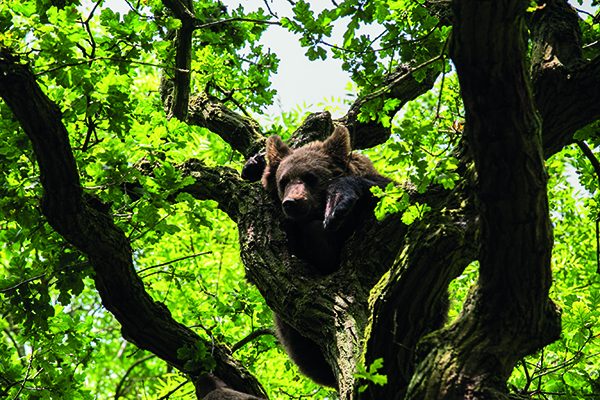
The UK’s largest and most ambitious brown bear exhibit, located at a popular South Gloucestershire attraction, has won a prestigious Royal Institution of Chartered Surveyors Social Impact Award. Bear Wood at the Wild Place is an immersive woodland exhibit home to brown bears, wolves, lynx and wolverine.
The multi-million pound, 7.5 acre woodland exhibit is the UK’s largest and most ambitious brown bear exhibit. It has been hugely popular with visitors since it officially opened in July 2019, with the exhibit attracting record numbers of visitors to Wild Place in 2019.
Bear Wood takes visitors on a time-travelling journey, back to a time when bears, wolves, lynx and wolverine roamed the UK countryside. Visitors follow a raised wooden walkway through the trees, at heights of up to several metres, offering a truly unique view down onto the animals.
Over the past 12 months, the animals have all settled in well to their new home. The lynx have successfully bred and Bear Wood is now home to two tiny lynx kittens, believed to be the first bred in a UK zoo this year.
Earlier this year, for the first time, the five European Grey wolves were introduced to the same large woodland exhibit as the four bears, and the two species began living side by side as they would have done in this country thousands of years ago. This as a huge milestone for Wild Place Project, and the first time these species have been mixed together in a UK zoo.
Dr Justin Morris, Chief Executive of Bristol Zoological Society, which operates Wild Place Project, said: “It is fantastic that Bear Wood continues to be so popular. A lot of time and energy went into creating this award-winning exhibit, to ensure it would be the best it possibly could be. To see it now, over one year on, bringing so much joy to so many people, is extremely rewarding.
“To now be able to see bears and wolves coexisting in the same woodland is another huge achievement. Whilst this isn’t a rewilding project, it is the first time European brown bears and European wolves have been together in ancient British woodland for more than 1,000 years. Bear Wood has opened up an interesting debate about rewilding, which could one day perhaps see animals such as these reintroduced to the UK countryside.”
As well as offering visitors the amazing opportunity to see these charismatic species in beautiful woodland setting as they would have once lived, Bear Wood also aims to inspire visitors to value and protect native woodland habitats and species.
Dr Morris added: “Bear Wood is most significant to Wild Place project in the seven years since we opened. The feedback we have received from our visitors and support has been tremendous and we can also now say with confidence that it inspired visitors about the woodland and wildlife we still have, encouraging visitors to protect what remains.”
Woodlands, similar to those at Wild Place Project, covered Britain thousands of years ago but have steadily been cut down for building, housing, fuel, growing crops and making paper. Today only 2% of Britain’s ancient woodland has not been destroyed. But Bear Wood isn’t just about what we’ve lost. It’s also about protecting what we have left. It inspired visitors to value and protect native woodland habitats and species. Woodland offers a vital habitat for threatened species such as tawny owls, dormice, bats, butterflies and hedgehogs.
Bristol Zoological Society has a dedicated UK Conservation team that runs a variety of UK-based conservation programmes including monitoring and protecting native species such as bats, badges, birds, invertebrates, reptiles and amphibians.
Wild Place Project is also home to species from across the world, including giraffes, cheetahs, lemurs, meerkats, geladas, okapis, red-river hogs and elands. It is also home to three zebras, including Vera, the attraction’s new zebra foal.
Bristol Zoological Society, which operates Bristol Zoo Gardens and Wild Place Project, is a conservation and education charity and relies on the generous support of the public, not only to fund its important work at Wild Place Project and Bristol Zoo, but also its vital conservation and research projects spanning five continents. The Society recently launched an appeal to ensure the future of its work ‘saving wildlife together.’ The Society, which is a registered charity, has the launched BZS Appeal following the temporary closure of both its sites in Bristol in the face of the Covid-19 pandemic.
To find out more or to make a donation, visit: https://bristolzoo.org.uk/bzsappeal
Bear Wood is kindly sponsored by Natracare, the Bristol-based, plastic-free and organic period product company. To find out more about Wild Place Project and Bear Wood visit: www.wildplace.org.uk/bearwood
GeMech
GeMech specialise in the design and build of foundations and substructures, predominantly for main contractors, developers and house-builders.
We were formed in the year 2000 by the current shareholders and many of the original members of staff are still with the Company. We take pride in providing in-house engineering solutions, particularly to difficult foundation projects where our skilled labour force and specialist plant equipment is able to get the job done.
For the RICS award-winning Bear Wood at Wild Place, we were involved in the design and build of the bored piles for the pile caps, which support the timber “legs” of the walkway. Due to the poor nature of the ground, piles were essential to guarantee the stability of the walkway. A particular problem that had to be overcome was how to get a piling rig in the location of each leg, on a steeply sloping, thickly wooded site. Fortunately we enjoy such a problem, and due to the range of machinery we have at our disposal we were able to come up with a successful solution.
It was great to be involved in such a unique project of international significance, assisting in some way towards the enabling and understanding of the re-wilding of parts of the planet.
We mainly work for developers and house-builders but have worked on more “outlandish” foundation projects such as for a building over a lake for the National Botanic Garden of Wales at Llanarthne, and a jetty at Stonehouse Quay in Plymouth.
To find out more, please visit www.gemech.co.uk.