
Paragon 700 Boutique Hotel & Spa
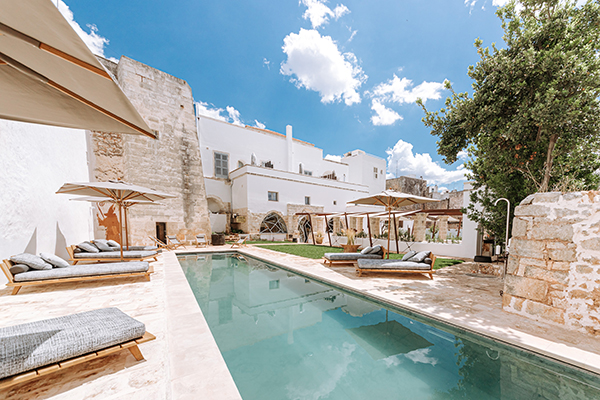
Located in the heart of Puglia’s ‘White City’, The Red Palace (now Paragon 700 Boutique Hotel & Spa) has opened its doors following a full restoration. Standing in contrast to the whitewashed buildings of Ostuni, the hotel’s red brick façade surrounds a garden and swimming pool.
All 11 rooms and suites have been finished with parquet flooring throughout, which is accompanied by stonewashed bed linens, cathedral ceilings, period frescos and fireplaces. Each guest room is different with some offering terraces or balconies or, in the case of the Paragon Suite, a sunken bathtub and private terrace with sun loungers.
Dining at the hotel comes in the form of Restaurant 700, which offers a menu that celebrates local ingredients and cuisine.
Regarding wellness, guests can enjoy personalised yoga or Pilates classes in a secluded corner of the garden. The palace’s former water chamber has been transformed into a spa offering Turkish bath, Himalayan salt wall, multisensory shower and a natural whirlpool dug into the ground.
PREMIER HOSPITLAITY INTERNATONAL MAGAZINE spoke to owners, designers and architects, Ulrike Bauschke and Pascale Lauber about the project in a bit more detail.
How did you get involved with this project?
“We first visited the Palazzo Rosso in 2016 at the invitation of an Ostunian friend. At the time we had no intention of taking on a new project and we were in Puglia to recharge. However, we agreed to visit to admire the architecture of the historic building and as soon as the red carriage door opened it was love at first sight. We knew instantly that we would not be able to resist. We were immediately drawn to the potential of the centuries-old gem; the height of its ceilings, its vaults, its frescoes and its red-stone. For us, it was unthinkable not to make it a hotel and accessible to the public; it really is just too beautiful to stay hidden!”
What did the project involve?
“The project was a complete and meticulous restoration of every inch of the former Italian palace that involved bringing the building back to its former glory using traditional handcrafted techniques, while injecting a splash of modern flair. We worked with conservator Maria Buongiorno to uncover the mysteries of the multi-secular Palazzo, which has so many stories to tell from the 17th Century to present day.”
What where the timescales of the project?
“The whole project took us three years and couple of months. We started on 27th January 2017 and we opened the doors to the hotel on 18th June 2020.”
Where you given a design brief for the project?
“We have shaken up the rules of real estate and interior design in projects all over the world, from Romont, Lausanne and Verbier, Switzerland; to Paris, New York and Cape Town. Each project is so different and distinct, but the thing that remains the same with them all is creating exquisite design in every detail with beautiful energy- that and the desire to preserve and celebrate the history of the building was the only brief we worked to.
“The creative association of old and new art, objects and furnishings in a head-spinning and yet personal mix is Pascale’s trademark. Her keen sense of observation was sharpened not only during a lifetime of travel and countless visits to international art/trade shows, but also at local flea-markets. Her vision of worldly elegance is multicultural and original down to the smallest detail. The unique result being coherent, deeply modern and stimulating at the same time is at the root of the exceptional atmosphere permeating every room at Paragon 700 Boutique Hotel & Spa.”
What are the most significant/stand out features?
“The obvious one is the colour of the building. This shade called Pompeii Red was named after the famous lost city because it was commonly found on residences as well as on the famous ruins. In the 18th century, right after the fabulous re-discovery of Pompeii, this particular red became a fashionable status symbol since the pigment was the most expensive on the market. Cladding an entire façade in Pompeii Red was therefore an ostentatious display of wealth and even more so amongst the white buildings of Ostuni.
“The most ancient parts of the building from the 1700s including fireplaces, stone vaults and also frescoes, like the magnificent “Jesus and the Samaritan” are also hugely significant. During the restoration several smaller details and treasures were discovered that are equally standout, such as a wooden door with peepholes typical of 17th century cloisters that suggest that the Palazzo once housed a convent. Equally the beautiful original majolica tiles, which have been brought to new life in Bar 700. On the back of some of those tiles, we found an M stamp, the brand of a famous workshop owned by the three Massa brothers, ceramics masters of early 18th century Naples, suggesting the building was once in Neapolitan hands. “
What has the feedback been like?
“Our guests have been absolutely enchanted and astonished. The feedback has really been amazing and we have been overwhelmed with compliments.”