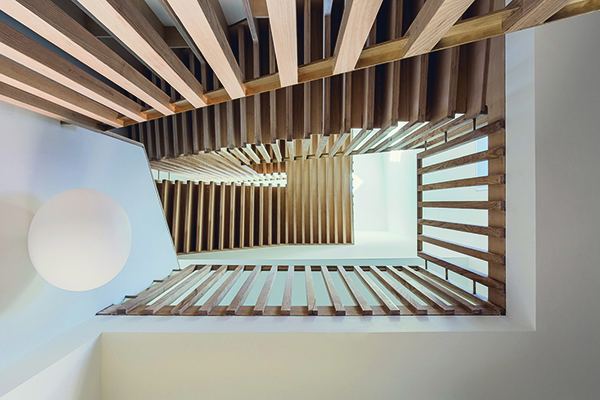

Brockeridge Stair
Stretching across three storeys, the Brockeridge Stair is a 2020 Wood Award winner that takes staircase design to a new level.
The prototype staircase, developed by Future Joinery Systems Ltd, was part of a UK government funded R&D project to enable digital fabrication directly from BIM modelling environments. It was recognised by the Wood Awards at the end of 2020 in the ‘Interiors’ category.
The stair rises three floors and is cantilevered from flush mounted stringers. The parts were CNC machined and assembled onsite using standard tools. The new platform developed during research allows designs to be defined parametrically, enabling the user to configure bespoke objects to specific requirements.
Parameters such as height, width, depth and material thickness can be user controlled. Digital manufacturing is enabled directly from CAD or BIM software via the platform which enables faster fabrication, better pricing information and reduces errors and waste. Items can be locally fabricated through a distributed manufacturing network model open to any CNC enabled workshop. The process greatly improves construction efficiency, supports COVID-19 social distancing restrictions, increases the type and complexity of work undertaken by smaller site-based joiners, and keeps the labour pool local.
The architects for the project were CaSA Architects, with Mann Williams acting as the structural engineer. The digital fabrication was provided by FabLab Cardiff, at Cardiff Metropolitan University’s School of Art & Design. The wood used on the project, ash and birch, was supplied by Hanson Plywood Limited.
The Wood Awards judges were impressed by the elegance with which the Brockeridge Stair’s ground-breaking digital fabrication process was executed. “Looked at from below, it is almost like an Escher drawing,” said judge Ruth Slavid. “It also forms the totally appropriate heart of a thorough-going and very successful refurbishment (for this, read ‘transformation’) of a tired infill house.”