
DBR Limited
DBR is a specialist conservation company dealing with the cleaning and repair of historic fabric and the regeneration of historic buildings. High-quality workmanship, expertise and a dedicated and sensitive approach to the care of buildings are the foundation of this thriving business. Well known for its exemplary in-house craft trades, DBR is one of the leading conservation specialists in London and the South East of England, working on some of the UK’s most notable landmarks, including Grade listed buildings, scheduled monuments and World Heritage Sites, as well as parochial churches, country estates and modest memorials. Every project DBR undertakes is treated with passion and enthusiasm that is unrivalled in the industry, leaving a lasting impression on its clients and the buildings it cares for.

Liberty London
Founded in 1875, Liberty London has been selling haberdashery, high-end fashion and other lifestyle products for almost a century-and-a-half. In 2020, the renowned Grade II* listed department store sought comprehensive external works to ensure its Tudor Revival architecture continued to thrive in the 21st century, while preserving the building’s unique heritage.
DBR, which has worked on major conservation projects such as the Palace of Westminster, Westminster Abbey, Royal Albert Hall and the Royal Pavilion, Brighton, was tasked with a wide range of conservation works at Liberty. This included: masonry, timber, roof, window and structural repairs, paint stripping and a new lighting scheme to enhance the façade.
The site-set, designed scaffold installation, paint stripping, facade repairs, lead works, and windows and frame restoration on the Carnaby façade has been completed, while work on the Kingly and Little Marlborough façades is ongoing, and work on the Great Marlborough façade has just begun. While these may sound like standard repairs, when it comes to heritage buildings, they are far from simple.
Although the works are not yet complete, good headway has been made on the project thanks to the leadership of Project/Design Manager, Bianca Buretea, as well as the dedication of her team and the processes DBR has put in place. The company’s workforce of skilled craftspeople and a skill set that covers all the historic trades, from stonemasons, restorers, lead workers and conservation specialists, allows it to take on any heritage project, large or small, and successfully deliver the renovations through to completion.
Royal Pavilion, Brighton
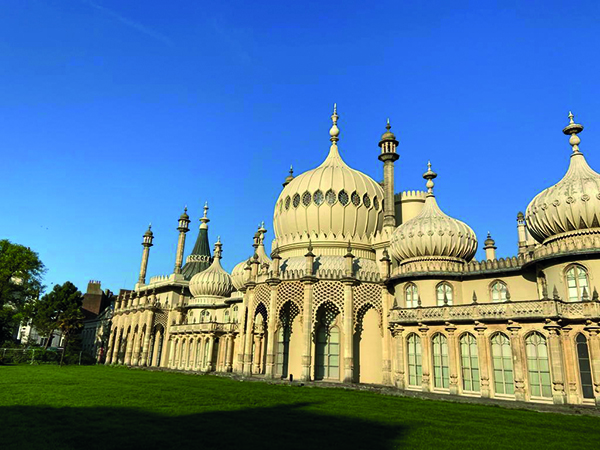
In its early days, Brighton was characterised by its striking Georgian architecture and, in 1787, under the supervision of George, Prince of Wales (later George IV) the Royal Pavilion was built. Serving as a seaside retreat for the hedonistic heir to the throne, it thrust Brighton into the forefront of British high-society.
Using a range of expert stonemasonry techniques, DBR was contracted to restore this awe-inspiring, historic building to its original splendour.
Stonework is the core activity of DBR’s London and Southern divisions. Having worked on many of the UK’s important heritage sites, such as Chichester Cathedral, Scotney Castle, Hampton Court Palace, Buckingham Palace and Westminster Abbey, the contractor was the go-to choice for Brighton & Hove City Council.
DBR’s masonry experts commenced work in February 2020, and are currently replacing the Pavilion’s iconic stone minarets, domes and façades.
Whilst the project team are no strangers to complex stonework, the roof’s tented structure and geometrically complicated, Eastern-inspired onion domes present a number of unique challenges.
For example, DBR is carving the structure’s required Bath Stone (oolithic limestone) by hand to achieve the detail and finesse required to match the building’s ornate architecture.
The conservation process has so far been successful. However, there have been a few challenges. First, as the roof and domes aren’t load-bearing, erecting the necessary scaffolding is an incredibly difficult and delicate task.
“Historically, the Royal Pavilion began as a guesthouse, which then morphed into a grand palace,” comments Adrian Attwood, Executive Director of DBR. “In this sense, it’s similar to a Russian doll: on top of the original structure, additional frameworks were built, and then on top of those, a more elaborate façade. This makes the roof and domes especially fragile as they are effectively fabric draped over layers of framework. The roofscape also has different levels, skylights and stained glass elements, which further make scaffolding tricky.”
Secondly, in addition to the minarets, roof and domes, DBR is replacing the Pavilion’s Jali screens, which bring their own set of challenges. “These latticed screens are also made of stone, which has significantly eroded,” continues Attwood. “In order to fix them, we’ve had to produce finely carved replacement stone which looks like a sheer curtain or tent. This is an incredibly difficult task, and one that requires great care and close attention to detail.”
The V&A Museum
The Victoria and Albert Museum (V&A) is one of the world’s leading museums of art, design and performance, and home to over 2.27 million historically significant objects.
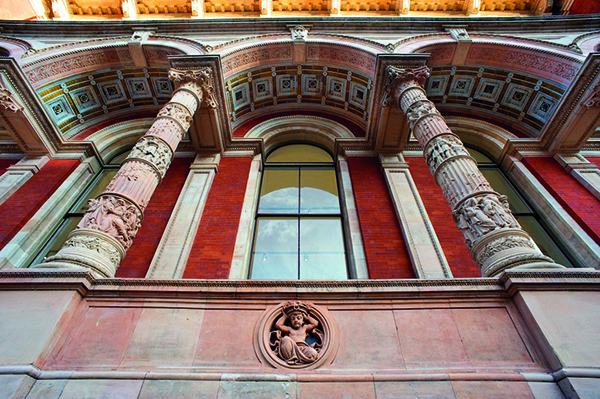
DBR was tasked with creating new, hand-carved terracotta units using a traditional manufacturing process. Initially, the balcony required extensive investigations to understand the cause of the decay, and planning for the deconstruction and reconstruction phases.
During this investigation phase, the terracotta was surveyed and detailed by specialist suppliers, Hathern Terra Cotta, with any required replacement material subsequently manufactured at their factory over a period of approximately 20 weeks.
The balcony was then meticulously deconstructed, and the embedded ironwork treated and strengthened. Finally, DBR reconstructed the balcony with a mix of salvaged and new terracotta.
DBR’s work has also improved the life safety of the building, which is an incredibly important consideration for any public institution when approaching the maintenance of its historic fabric.
Further, faithfully reconstructing the balcony using traditional methods has meant DBR was able to sustain the building’s original architecture for future generations of visitors to appreciate and enjoy.