
Grand Opera House
The most ambitious restoration and development project in 40 years has been completed at Belfast’s Grade A listed Grand Opera House, returning the beautiful 1895 auditorium to its original splendour, as well as telling the theatre’s fascinating history and improving customer facilities.
Thanks to the support of the National Lottery Heritage Fund, this £12.2 million project, completed in March 2021, has secured the future of the Grand Opera House for generations to come.
The project was delivered by specialist construction firm Tracey Brothers Ltd, and more than 60 sub-contractors. Project architects were Consarc Design Group and interior designers were Garuda Design.
The historic auditorium’s decorative features, elephant heads, ornate boxes and ceiling paintings have been repaired, repainted, and restored to their original splendour, and brand-new purpose-designed seats have replaced the cinema-style seats that had been there since the 1960s.
Carpets and auditorium drapes have also been replaced, and a new, much-needed air handling system keeps the temperature comfortable for everyone.
Suzanne Garuda of Garuda Design said: “In the main auditorium it was essential that the original design aesthetic was preserved and enhanced and the various years of patching were removed and re-invigorated – including the massive ceiling, columns, pilasters and panels. We sourced an archive block print wallpaper and used Lincrusta wall covering below the dado line.
“The carpet was designed to complement the various decorative motifs throughout the building, incorporating palmette designs and a palette of colours that tie in with the overall scheme.”
Other elements within the original theatre building worth noting are the Art Deco style bar with black and white marble chevron frontage, the crystal chandeliers and the brass hanging glass storage. Various areas of panelling in a deep Ink blue, brass wall lights and complimentary scaled design carpets, and Victorian patterned tiles complete the luxurious palette.
As the stage comes alive, shows will benefit from new state-of-the-art sound and lighting, and although hidden from view, the ‘fly tower’, where scenery and sets are hung, has been refurbished and upgraded.
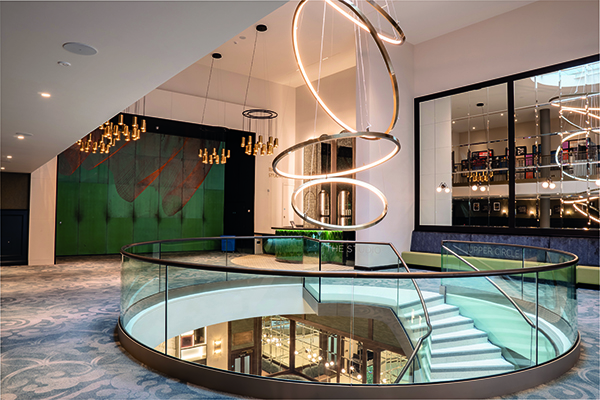
Suzanne Garuda commented: “Within the adjoining building, (known as Act 11), the space itself was impressive but was very brutal in its finishes, with exposed concrete ceilings and tubular steel stairs.
“The starting point for this space was to create a central focal point – a spiral stair, running up through the centre of the building. Simple and elegant, the staircase has a transparent glass balustrade which allows a vista through to the double height bar on the back wall of the space and up through the two floors to the open roof light above. A feature pendant of circular LED lights graduating upwards hangs below the rooflight, drawing the eye upwards.”
The main floor is formed of two colours of terrazzo tile in a contrasting soft black and grey design reflecting the circular stair, feature pendent and rooflight above, and creating a visually strong axis from floor to ceiling.
All around the building are a plethora of artefacts, pictures and information panels detailing the fascinating history of the Grand Opera House, and there’s also the theatre’s new first ever permanent exhibition, sharing the fascinating stories of the people who entertained audiences over the past 125 years.
Other facilities throughout the theatre have also been upgraded, including more toilets, better access into the auditorium, and improved wheelchair spaces.
The theatre re-opened to the public with bookable theatre tours in July, which precedes its full reopening for performances later this year, subject to the Covid-19 public health guidance at that time.

Decowell
With 25 years of experience, Decowell provides a full range of conservation, decorative and consultancy services within historic interiors. Furthermore, we specialise in the restoration of easel, wall paintings and frames, undertaken in situ or in our studio by highly skilled practitioners.
From our HQ in Belfast, we work throughout Ireland, the UK and have extensive international experience. Our small team of professional conservation specialists, trained in a variety of decorative and restorative craft techniques and conservation disciplines, work alongside notable clients such as the National Trust and Historic Royal Palaces.
One of our most recent projects was close to home at the Grand Opera House, Belfast. We were commissioned to undertake complete refurbishment of the decorative surfaces in the historic auditorium of the Grand Opera House. The aim of this project was to consolidate and preserve the painted and gilt surfaces in order to maintain the most recent decorative scheme. This involved the conservation, cleaning, retouching, and redecorating of architectural detailing, which is original to the building and part of Frank Matcham’s original design of 1895.
The auditorium had not been cleaned since the 1970s, the same time as Cherith McKinstry’s fine ceiling paintings were installed. The paintings and decorative embellishments throughout the auditorium were fully conserved and restored. It was an honour to work on this historic project.
To find out more, please visit www.decowell.co.uk.