
The Cornhill Quarter, Lincoln
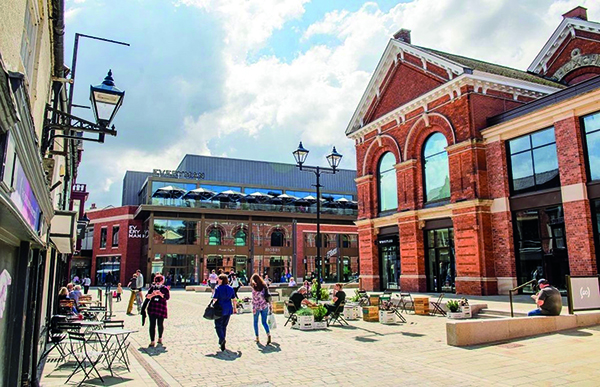
Rich in character, history and atmosphere, and incorporating a wealth of beautifully restored and re-purposed Victorian buildings, together with new shops cafes, restaurants, cinema, new transport interchange and much more, Lincoln’s new Cornhill Quarter, now entering its final development phase, is already the pride of the city.
Keith Neill-Smith of Clarity:NS, architectural advisors for the project, explained the background to the scheme: “Lincoln as we know it today is a three-age city: it began as a fortified Roman settlement on top of the hill then, over the centuries, it gradually expanded farther downwards, with the lower area around the river coming to prominence in the Victorian period. This is the location of the Cornhill Quarter, which is set around three city blocks bounded by the river to the north, the inner ring road to the east, the railway in the south and the High Street to the west.”
The area was opened up in the mid-19th Century due to the importance of the corn trade in which many towns competed. Originally the merchants were having to operate in the open air – which was not ideal – so it was decided to construct a corn exchange. This involved forming a new street, linking the High Street to the fledgling Sincil Street in the east, in order to accommodate the new building and associated market areas. Due to its success, this building quickly became too small and was converted into shops whilst a second, larger, corn exchange was built.
“Over the years, many of the main commercial areas on High Street and to the north of the river were redeveloped – but the markets area was spared.”
From the 60s and 70s onwards there were various proposals to redevelop this part of the city, but they met great resistance from various local groups and organisations including the Lincolnshire Co-operative Society. By the beginning of the 21st Century, changing shopping patterns meant that the area had lost its vitality, so Lincolnshire Co-op – who by then owned most of the buildings – decided to rejuvenate it whilst making the most of its wonderful Victorian character.
Keith Neill-Smith continued: “I became involved around the time when the Lincolnshire Co-op wanted to start the redevelopment. As well as a good range of shops and cafes, the main things that people are looking for is history and character – a unique blend which, with its sympathetic approach to the area, The Cornhill Quarter project could provide”.
“We therefore studied each building in relation to its history, physical condition, the quality of earlier refurbishments and the potential for sensitive alteration or extension. We worked with an archivist to find out what the original shopfronts looked like in order to replace the rather inappropriate modern frontages. We then repaired the buildings and brought them back into good order, making them attractive to traders, whilst retaining their historic appeal.” The City of Lincoln Council are extremely enthusiastic about the scheme, as are Historic England.
One of the key buildings was, of course the Victorian Corn Exchange, which was subsequently used for various purposes including a roller skating venue and a cinema, before being home to just a few shops and a small market. It was a lovely building but, although it had a stunning roof structure, there were no windows at the first floor because wall space for the corn traders was at a premium. This severely limited its appeal to potential operators.
Keith Neill-Smith added: “Working with Historic England and the Council, we opened up the first floor by taking the brick infill out of some blind arches. The minute we installed windows in the building it had a much wider appeal and it now houses a very successful branch of Cosy Club. 20th Century extensions were removed and the ground floor was refurbished to contain new shops beneath attractive arched brick ceilings.”
“Opposite the Corn Exchange, we demolished an unattractive 1970s terrace, and replaced it with a three-storey building containing shops, cafes and bars on the lower levels, and an Everyman Cinema on the top floor, which also includes an outside terrace with superb views across the city up to the cathedral and the castle. One of major bonuses of the redevelopment was the creation of a new public square, which, with outdoor seating for the surrounding cafes, has become the bustling focal point of the Cornhill Quarter.”
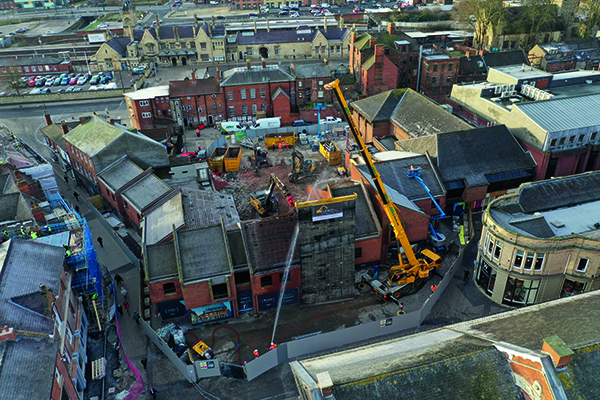
The remainder of the scheme involved the refurbishment of other existing buildings, including some of the rare, original back-to-back housing. In parallel with this, the Council decided to redevelop the 1970s-built bus station and rooftop car park on the eastern end of the Cornhill site, behind the Victorian buildings. A new 1000-space multi-storey car park was built, as well as a new bus station opposite the railway station to create a modern transport interchange. Crucial to the regeneration of the area is the high-quality new public paving, street furniture and lighting.
Keith Neill-Smith concluded: “Currently we are repairing some buildings which are around the edges of the blocks and generally finishing off various elements which we haven’t done so far. A Council-owned market hall at the northern edge of the site is also due to be refurbished soon and will provide a lovely adjunct to the cafes and bars, as well as a great place to showcase the wide variety of food produced in Lincolnshire.”
“So often in the past, town centre regenerations were carried out with a heavy hand, replacing all the old buildings with new and wiping out the town’s character; it is increasingly being recognised that this was a huge mistake. The great thing about this project is that it shows it is possible to regenerate an area by retaining, renovating and bringing to the fore existing historic buildings, whilst also providing the new spaces and services that businesses need in order to enable them to trade successfully.”
“If you can put these two things together in a vibrant open environment, it creates something that is unique and also really robust in terms of its longevity. It is a privilege to be involved with a project that has been approached so sensitively.”