
BAFTA 195 Piccadilly
Originally built in 1883, a major renovation of BAFTA’s iconic London headquarters, located on Piccadilly, has taken place. The build was completed and open for private hire events from November 2021 and the formal reopening of BAFTA 195 Piccadilly, marked by a visit from its president HRH The Duke of Cambridge, took place in January 2022.
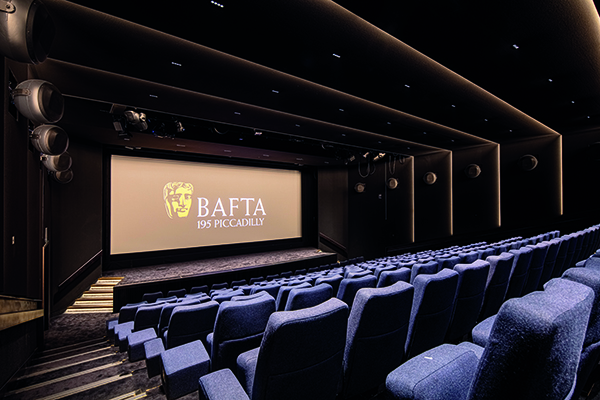
The reimagining of the grand building involved dramatically expanding its capacity and installing state-of-the-art technology throughout the building. Other features of the enormous project included redeveloping multipurpose event and exhibition spaces, a members’ bar and restaurant, roof terraces, meeting rooms, offices, and a cinema, whilst building an entirely new cinema as well.
Before the £33 million project, the building was originally constructed for the Royal Institute of Painters in Water Colours in 1883, created by the renowned architect ER Robson.
BAFTA is a world-leading independent arts charity that brings the very best work in film, games and television to public attention and supports the growth of creative talent in the UK and internationally. Through its Awards ceremonies and year-round programmes of learning events and initiatives – which includes workshops, masterclasses, scholarships, lectures and mentoring schemes in the UK, USA, and Asia – BAFTA identifies and celebrates excellence, discovers, inspires, and nurtures new talent, and enables learning and creative collaboration.
The New Generation
By improving facilities and doubling the building’s capacity, the redevelopment will enable BAFTA to dramatically increase its charitable programme. The creation of a new floor allowed BAFTA to dedicate one of their existing floors to learning and new talent, the primary objective of the project. 195 Piccadilly will be a creative centre for film, games and television and the central hub for BAFTA’s UK-wide, and global, learning and talent development programme. A world-leading independent arts charity, BAFTA works throughout the year to find and promote the next generation of talent and to break down the barriers that can make it hard to build careers in the creative industries. By introducing new facilities and opportunities, BAFTA will be able to provide over 80,000 people with the tools to pursue a career in this working sector of film, games, and television. The extensive work put into producing the new technology and facilities in this building is a testament to the focus put on the creative industry.
“The technical challenge of creating a cinema that is one of the best cinemas in the UK, whilst being in an existing building with many constraints, such as the set volume and size, was a very hard challenge. We, together with the wider team, worked very closely with BAFTA and with Dolby on the Princess Anne Theatre, and I am happy to say it was a success,” said Carla Sorrentino, the Associate Director at Benedetti Architects.
The charity-driven institution will be able to expand new talent initiatives with this redevelopment such as Breakthrough, Young Game Designers, and Elevate; whilst also creating new initiatives to address the skills gap in the creative industry. In BAFTA 195 Piccadilly, there is an intention to provide a regular public programme of scheduled creative and entertainment events in order to deepen the public appreciation and knowledge of the craft involved in the film, games, and television industries.
The Build
In the past, this building has been limited by Victorian architecture as a Grade II listed building. Now, through the potential of the redevelopment, the construction team led by Knight Harwood have been able to make key structural changes within the location that will make it a welcoming and inviting space for all people, including those with access requirements. The BAFTA organisation, alongside Benedetti Architects, were able to devise an access strategy plan in line with the 2010 Equality Act, and the London Plan that allows for more accessible facilities in place throughout the whole building.
Benedetti Architects were recommended to BAFTA by a former client of theirs who was once a chairman for BAFTA and were consequentially shortlisted for the architect position, before winning the ideas competition for the project. BAFTA began the process with an initial brief to create more of everything in the refurbishment – more space, and a greater capacity – before spending two years refining this brief with Benedetti Architects to incorporate their winning idea, alongside their architectural knowledge of how to optimise the building for BAFTA’s purpose.
The main aspect of Benedetti Architects’ idea was to lift the historic roof lights, which have been blocked for 40 years and considered lost, to create a whole new floor, freeing-up much needed space elsewhere for learning and new talents. This is the standout floor, as Renato Benedetti calls it “the floor which combines innovative design with heritage, filled with natural light and views over St. James churchyard.” The architectural team were able to change every square metre of the building that previously existed, and made it far more fit for purpose. Because of the new floor, the building required an entirely new roof, meaning the changes were no longer just internal, but external to the building as well. The street-facing side of the building gained a whole new entrance; the BAFTA building has not had a presence on Piccadilly Street previously, until now when it has a much more inviting and accessible front door. The back of the building is similarly structurally different after the work of Benedetti Architects and their team. It features 24 metres of full height glazing looking onto St James’ Church Garden and its magnificent trees.
“It is all new, but it somehow feels familiar. We haven’t lost the familiarity of the original reason why BAFTA members love the building. The building’s history and Piccadilly address have become synonymous with BAFTA. People associate it with being BAFTA’s home for the last 40 years and its now fit for purpose for the next 40 years and more,” said Renato Benedetti.
At the start of the project, BAFTA’s Chief Operating Officer Kevin Price said, “we are excited by the ideas and scope of the design by Benedetti Architects to fundamentally enhance every aspect of what we do while being sensitive to the character of the building, we are so fond of. They are part of the BAFTA family now and we look forward to working with them to build the project.”
Renato Benedetti formed the architect company in 2016, following 20 years of award-winning success as McDowell + Benedetti Architects. The company considers itself client-focussed, in that they put their energy into an open-minded collaborative approach to projects. They have won many prestigious national/international awards and competitions, dictating their success and quality level as a business.
CinemaNext UK LTD – U20
Providing cinema services for 10 years, CinemaNext are the leading UK and European cinema integrator for cinema sound and projection requirements. They specify, install, commission, service and support cinema projectors and sound systems for all types of cinemas – multiplexes, independent cinemas, boutique exhibitors, educational establishments, and theatres who want to be able to show first run Hollywood content and Live events. The company enjoys a wide customer base – in the UK working with many of the leading cinema operators, and a wide range of the smaller cinemas, while across Europe they work with the majority of the key exhibitors. The engineering team are fully trained cinema professionals and the design team understand the clients’ needs to effectively meet the cinema’s technical, commercial and operational requirements.
On the BAFTA 195 Piccadilly project, CinemaNext helped to design the cinema infrastructure, supply key elements of the equipment and installed the projectors, the Dolby Atmos sound equipment and their infrastructure. They were delighted to be awarded the BAFTA project, as BAFTA demand the highest level of quality in terms of the image and sound in their theatres and CinemaNext were able to demonstrate that they could meet their exacting standards.