
The Tower of Light and the Wall of Energy
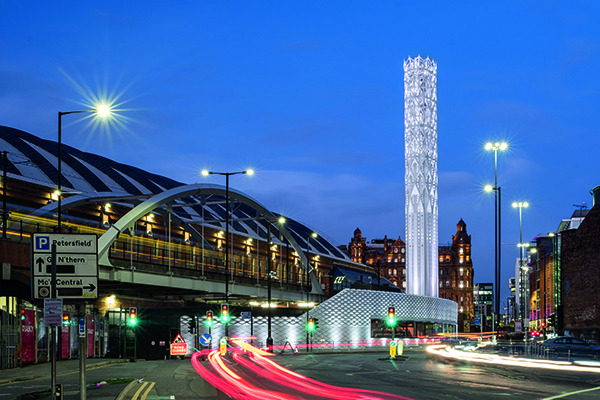
As a collaboration between Manchester City Council and Vital Energy, the Tower of Light and the Wall of Energy encase a new low-carbon CHP energy centre in Manchester’s Civic Quarter. The £20 million energy centre will supply combined heat and power to a collection of iconic buildings across the city’s Civic Quarter Heat Network. The energy centre itself contains a 3.3Mwe CHP engine and two 12MW gas boilers; the technology hoping to save 1,600 tonnes of carbon emission each year, contributing to the city’s goal of becoming zero carbon by 2038.
The design of the exterior Tower of Light and the Wall of Energy was designed by Tonkin Liu for a design competition that sought a creative and cost-effective design with significant architectural merit. The competition was won unanimously with the planning permission supported by Historic England. Tonkin Liu were able to redefine the brief to create a place specific response in the form of an innovative tower structure and a sculptural wall that found inspiration in the subject of energy and movement in nature. The impressive structure won a Future Cities Forum BCIA Award in 2021 in the Net Zero Summer Awards.
Making a statement about the city’s zero carbon ambition, the tower’s 40-metre-tall structure employs Tonkin Liu’s Shell Lace Structure technique, developed in collaboration with engineers from Arup, to make super-light, super-thin single-surface structures
Shell Lace Structure
The Shell Lace Structure technique was discovered by Tonkin Liu in 2009 through empirical experimentation that combined knowledge of mollusc shell geometries with the traditional craft of tailoring. In conjunction with empirical lessons and digital design, fabrication tools make possible a variety of structural types. These active surface structures bring together the conventional engineering fields of shell design and folded plate structures to create strong, ultra-light, free organic forms. The development of the novel technique was carried out through a series of architectural competitions, resulting in several wins, and built structures prior to the Tower of Light. In 2014, a RIBA Research grant was awarded to Shell Lace Structure, and an exhibition was held at the RIBA headquarters with an accompanying catalogue – The Evolution of Shell Lace Structure.
When speaking to PREMIER CONSTRUCTION MAGAZINE, Matthew Burnett, the Project Architect, said: “The Tower of Light follows a technique we have been developing for over ten years, but it is showing it on a new scale. This project continues our reputation for innovative structures, but now at an infrastructural level.”
An urban beacon of light
Minimal energy is used to light the Tower of Light and Wall of Energy. During the day, mirrored gold finished stainless steel reflectors within the tower ripple in the wind, reflecting the sunlight into the depth of the tower’s chambers, filling the tower with a moving kaleidoscope of light. Below, the colour and texture of Manchester’s blue sky and white clouds, the hustle and bustle of the street façade, are captured within the curving form of the reflective facade. The tessellating tiles create their own shadows that become their own pattern of energy and movement throughout the day.
During the night, as dusk sets in, integrated LED lights create animated, programmed light sequence, directed at the Tower of Light’s reflectors and the Wall of Energy. Tonkin Liu’s collaboration with lighting specialist SEAM Design developed pre-programmed sequences every quarter of an hour, marking the passage of time. The Tower’s internal glow spills through its perforations, to illuminate the falling rain. At street level, the movement of the city is captured as red and white headlights of passing cars ripple across the Wall of Energy. On landmark dates across the year, the Tower and Wall are illuminated together with colours to mark cultural celebrations.