
UCL Centre (PEARL)
Penoyre & Prasad have completed the first-of-its-kind research lab to stimulate the urban environment. PEARL, the Person-Environment-Acitivity Research Laboratory, is UCL’s first projected net-zero carbon in-use building for the creation of full-sized environments in order to test how people use infrastructure and cities. The goal of this it to improve urban design for a more accessible and sustainable future. The highly adaptable research and collaborative workspaces in PEARL serve as a prototype for new post-Covid ways of working.
London-based architecture practice Penoyre & Prasad, a studio of Perkins & Will, has completed UCL’s unique research laboratory, PEARL. Life-sized environments – a railway station, high street, town square for example – will be built under controlled conditions to examine how people of all abilities interact with their urban environment and each other.
This highly collaborative project – bringing together engineers, architects, biologists, social scientists, neurologists, artists and public – is leading the way in designing for a more complex, integrated understanding of ourselves and our interactions with our environment.
With a floor area totalling around 4,000m2, a volume of 44,000m3, and ten metres high, the laboratory space has been designed and engineered with 40m clear structural spans to house hugely varied research experiments. Also equipped with indoor ambient environments and sound systems, the laboratory can test the impact of environmental conditions, such as space, colour, lighting, smell, visibility, appearance, touch and sound on people’s behaviour and perception – bringing experiment conditions as close to real-life scenarios as possible. The laboratory interior is black, and the background sound level and reverberation are very low – core aspects of the building’s design – intended to remove people’s sense of ‘being in a building’.
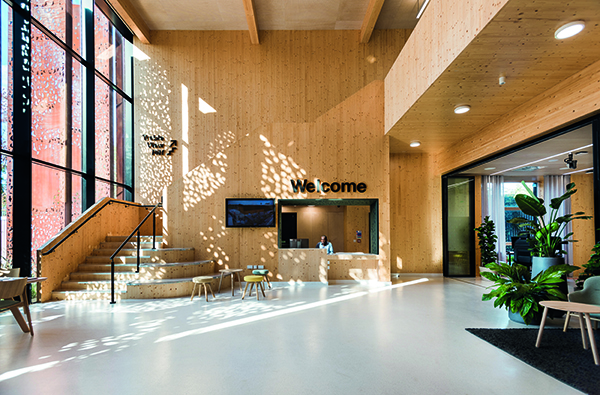
To the north-west corner of the main space is the ‘Groove’, a free-standing two-storey cross-laminated timber structure that houses the public entrance, community-facing facilities, workshops and highly flexible academic workspaces.
Directly connected to the lab space is a workshop and maker space facility for small scale testing, prototyping and manufacturing of experiment equipment, and a sound preparation studio where the soundscapes for experiments can be researched and created.
PEARL includes a pop-up theatre so that the public, researchers, artists, performers and others can see, hear, smell, feel and explore what might be possible in an urban environment before trying it out in public.
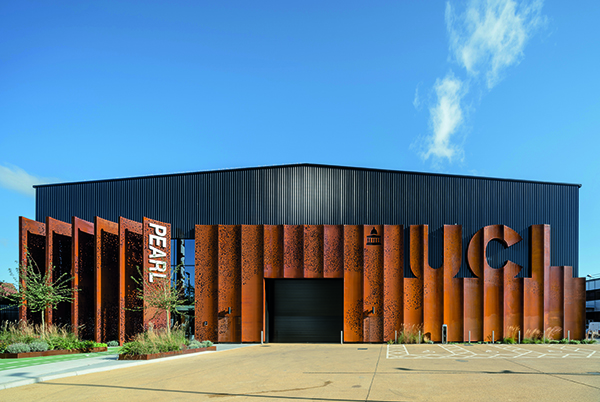
Externally, the building’s form and materials relate to the site’s industrial architectural heritage; crisp detailing and weathered steel provide a contemporary twist. The scalloped west facade references the roof form of its Grade II Listed neighbour, one of the first examples of shell concrete structure in the UK. 9m high, rusted steel panels gradually fan out across the frontage, providing shading to the Groove and signalling the entrance to PEARL.
Perforations in the steel mediate the scale and bring a sense of movement to the façade. Repetitive patterns can cause distressing visual noise for people with sensory or neurological conditions. Working with Professor Nick Tyler and his team we looked to natural, non-linear imagery – people flow and crowd movement – both of which are key areas of research inside the building. The three-dimensional and abstract nature of the perforations also represent the flow of individual and collaborative ideas that swirl together and continue into the building to inspire the research that turns these ideas into innovations for the design of the future environments
A triangular forecourt to the south-west of the building will locate some of PEARL’s larger experiments, including the use of tube/train carriages, and a decommissioned aircraft fuselage which is due to arrive in 2022. The aircraft will be connected to high-level openings in the facade via two-jet bridges, animating the building’s external appearance and helping to create a real sense of identity for the facility.
As UCL’s first net-zero carbon in-use building, PEARL demonstrates the university’s strategic commitment to lead by example and operate in a sustainable way. Pearl has achieved BREEAM Outstanding – the first finished building ever to achieve an Outstanding rating under the new BREEAM standards.
The building is projected to be carbon negative thanks to its highly efficient fabric, services and the production of its own energy from a vast array of photovoltaics covering the entire roof. Built for deconstruction and the circular economy, the design maximises the use of recycled and recyclable materials, whilst minimising waste from site through off-site prefabrication and cut and fill site preparation.
Ian Goodfellow, Principal at Penoyre & Prasad, said: “This has been an incredibly exciting project to work on, not only because of the ground-breaking academic and environmental vision, but also the opportunity to design a building which is itself an integral part of the innovation ecosystem.’
SAFE-door Industries Ltd
SAFE-door Industries Ltd are a UK based specialist door design and manufacture house for special purpose doors. As a door company, they have two very different door specialisms: sound reducing doors and thermal separation doors.
With the SAFE-door factory in Brampton, Cumbria having been in production for over 13 years, the company has provided Sound Solutions Acoustic Doors for film & TV studios, theatres, arenas, music venues, power stations, and energy-from-waste projects in the UK and overseas.
For Project Pearl, the UCL Centre, SAFE-door designed, manufactured, and installed the acoustic vehicle access doors; a Soundsec 30 at the front of the building and a Soundroll 30 to the rear, that were five metres wide by six metres high. The company was particularly pleased to be appointed as subcontractors on this project, working with the architects on the design, as it was their first contract with VolkerFitzpatrick Ltd.
SAFE-door produce innovative, market-leading products, and are continuously developing new designs to provide customers with application-specific solutions. The company leads the field in the development of special purpose doors acoustic, soundproof, industrial steel doors and temperature control insulated doors.