
The Museum of the Future
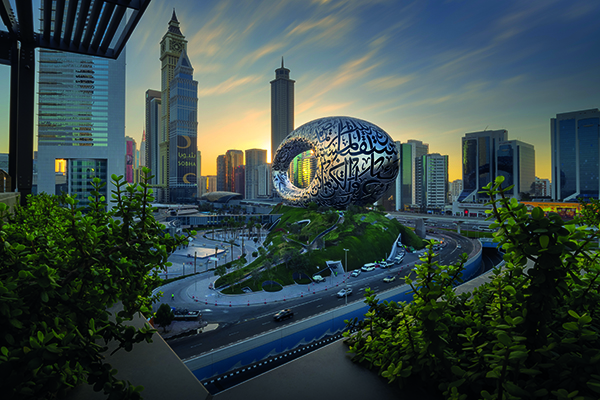
The Museum of the Future is a new global scientific landmark from Dubai and the UAE to the world; a permanent exhibition that showcases different aspects of the future as well as significant technologies from decades to come. As well as this, it is an architectural icon and significant addition to the world of science, architecture and art. The Museum of the Future was classified as one of the most creative buildings on Earth.
Driven by the wise vision of its leadership, Dubai has brought to life a one-of-a-kind hub, for visionaries, talents and great minds from around the globe to shape the future. It opened its doors to the rest of the world on February 22nd, welcoming guests to embark on a journey to the year 2071.
The museum intends to bring together ‘Great Arab Minds’ and direct their creativity and knowledge to shape a better future for humanity, as well as connect thinkers and experts from around the world and highlight the latest scientific changes and discoveries.
It represents active human imagination, creativity and innovation, with content and exhibits that will be constantly renewed, enhanced and enriched with the latest technological achievements and global scientific discoveries. The Museum combines elements of exhibition, immersive theatre and themed attraction.
As described by His Highness Sheikh Mohammed bin Rashid Al Maktoum, Prime Minister of the UAE and Ruler of Dubai, the Museum of the Future is “the most beautiful building on Earth.” Reaching 77 metres in height, with seven floors inside and no internal pillars, the museum is an engineering miracle.
Killa Design submitted the winning design proposal behind the museum in 2015 and was responsible for the design, implementation and structural concept. They decided the structure needed to be on the main spine of Dubai, in other words on Sheikh Zayed Road, because it meant that everyone from residents to tourists would see the museum.
The entire surface of the building is made of developed glass, manufactured with new technologies to improve the quality of the interior and exterior thermal isolation. The façade of the building extends over an area of 17,600 sqm and is made of 1024 stainless steel panels that were produced using automated robotic arms. The specific number of panels represents a kilobyte; each kilobyte is equal to 1024 bytes.
Shaun Killa, Founder and Design Partner of Killa Design, spoke to PREMIER CONSTRUCTION Magazine:
“The construction of the Museum of the Future was incredibly due to its complex geometry and precise interface requirements with various trades, Building Information Modelling (BIM) implementation was vital. It would have been an impossible undertaking without parametric design and BIM.
“The void in the middle of the building is the most powerful part of the museum as it represents what we do not know about the future,” said Shaun Killa. “People who seek the unknown innovate and discover new horizons and ideas that help guide humanity towards a better future. Those people who seek the unknown will continue to replenish the museum over time, and that is the concept of the design.”
Though the Museum of the Future may be one of the UAE’s latest technological and architectural marvels, it also epitomises the country’s diverse natural ecosystem, which boasts a vast range of local flora, fauna, terrestrial and marine wildlife. The green plateau on which the building has been raised is a resplendent garden comprising around 100 species of trees and plants, reflecting the natural diversity that is an integral part of the UAE’s heritage.
The museum employs the latest technologies of virtual and augmented reality, big data analysis, artificial intelligence and human-machine interaction. It also includes a platform for displaying and testing the innovations of the world’s leading technology companies.