
Family Kitchen & Shop, Kew Gardens, London
A brand new multi-sensory Family Kitchen & Shop has opened at Royal Botanic Gardens, Kew, offering families both a place to eat and drink, and also to engage with the natural world and learn more about where food comes from, discovering the important role which plants and fungi play in all our lives.
Situated next to the interactive Children’s Garden, and with a capacity to host up to 250 diners, the restaurant was designed by Mizzi Studio as a space where the wonder of nature combines with an interactive food laboratory.
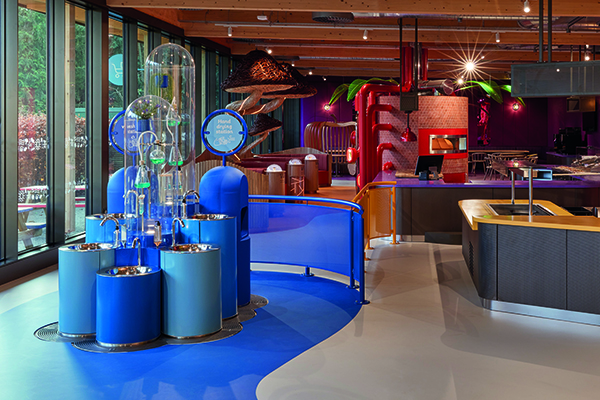
The restaurant has been shaped around a series of colour-coded zones, with seasonal food stories coming to life in each of the different sections. Mirroring the design of Kew’s Children’s Garden, interactive areas include the Spring Garden, the Water Garden, the Autumn Garden and the oversized Enset (otherwise known as the ‘false banana’- a hugely versatile staple crop which has been cultivated for tens of thousands of years in Ethiopia.)
As well as this, a dedicated seating ‘quiet’ zone in the shape of a giant apple provides the perfect space for neurodiverse visitors to enjoy the Family Kitchen in a calm and relaxed way. Larger-than-life sculptures of plants and fungi populate the space, creating a fun and engaging learning experience for visitors of all ages.
At the heart of the space is a stone-baked pizza oven, allowing visitors to create their own custom dishes and see chefs at work. As well as cook-to-order hot food options, there is also a salad bar, artisan sandwich station and ice cream servery, alongside infinity soft drink refills and an espresso bar.
Created with sustainability in mind, the menu for the Family Kitchen also features an array of plant-based offerings, allowing visitors the opportunity to enjoy a selection of eco-friendly food.
Jonathan Mizzi of Mizzi Studio said: “From the start we built a visual story for Kew that placed families at the heart of the narrative. We designed each section of the restaurant with different family members in mind, thinking each step of the way about how every design element would impact visitors across their different ages, physical abilities, and interests.
“Kew was on board with our vision of creating a nature-fuelled ‘imaginarium’ – a world inspired by children’s classics such as ‘James and the Giant Peach’. Our idea was to blow nature up to heroic proportions, so that humans could walk through it on the scale of tiny creatures.”
He added that nature and the wonder of the world’s food cycle were additional cues that drove the design. The beauty and variety of the seasons helped shape this vision – aimed at allowing families to embark on a tour that opens with the sun, rain and seas and then immerse themselves in a space that offers diversity in colour and design features.
This includes a botanical sanitisation unit that stresses the importance of hygiene; lenticular periscopes hanging over a pizza oven to teach children all about food preparation; timber woven mushrooms and an Enset tree and giant apple that brings magic to seating solutions.
In addition, the new venue is certified as BREEAM (Building Research Establishment’s Environmental Assessment Method) ‘Excellent’ and incorporates in its design 71 photovoltaic roof panels generating 30 megawatt hours of electricity per annum.
Approximately 80% of the hot water used across the restaurant is heated using heat recycled from the front of house and the kitchen, reflecting RBG Kew’s commitment to sustainability and target to become Climate Positive by 2030.
Jonathan Mizzi added: “As with all our work, we aim to create spaces that champion low-carbon materials – such as the timber used in the apple seating and hand-woven willow used for mushroom sculptures. We also prioritise modular and prefabricated elements for greater efficiency and minimised carbon impact.”
He concluded: “Kew is an institution that has brought so much value to the entire world. Our goal at Mizzi Studio has been to design a space that celebrates nature and learning, helping to make children and parents excited about food growth, hygiene, and preparation. Through colour, texture, and wild, nature-inspired form, we have created a space that brings families closer to the roles of the elements in nature, to seasonality, and the overall journey from plant to plate.”