
GenZero
The Department for Education (DfE) supported by Innovate UK has partnered with construction innovators to deliver GenZero – a research project to deliver a new ultra-low carbon building standard for schools.
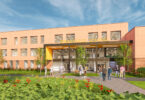
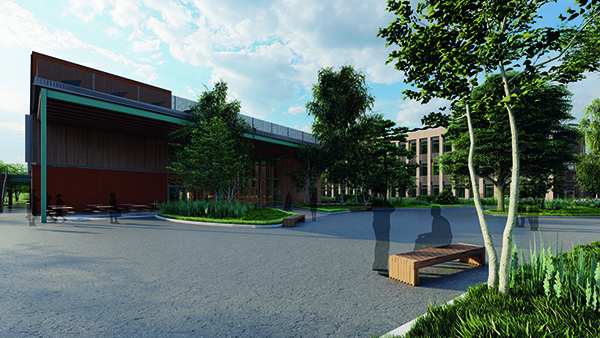
The research driven design concept places nature at the heart of the educational environment; building zero carbon schools designed to promote the wellbeing of children, young people and staff. By putting the preservation and cultivation of the natural environment at the forefront of the design, the schools allow the user to interact with nature and seek the benefits of doing so in a way that is proven to aid in health and wellbeing.
The kit of parts building strategy means simple, standardised spaces that aren’t defined by furniture and fittings, allowing for different curriculum models with little need for change. Constructed with timber, the buildings reduce environmental impact from construction, and this proposed platform for manufacturing within a factory setting will allow building of schools at scale with minimal waste across the UK in the future.
Speaking to Premier Construction Magazine, Neil Young from LBY Architects said: “A wide-ranging four-part brief included requirements for sustainability, high levels of standardisation (in both components and spaces) and how the buildings would be operated and used, as well as digital working methods. A very broad view of sustainability underpins the project brief, in response to the DfEs desire to achieve not only a very low carbon solution over a long building life, but also to offer a safe and secure environment that supports users’ needs and wellbeing.”
This project was conceived to help meet 2050 net zero targets and to inform new design standards, from which future schools will be built and to actively promote more sustainable, reduced-carbon schools. The new design concept promotes active energy buildings that can store, reduce or generate some of their own energy. The kit of parts manufacture and assembly processes can reduce emissions through an efficient supply chain, reduced materials and reduced transport.
The GenZero classroom prototype contains 10t (20m3) of timber. The embodied carbon produced by creating the structural materials and constructing the classroom resulted in 9t of CO2e emissions. However, the carbon stored in the timber during its growth is equivalent to 16t CO2e, meaning the prototype can act as carbon storage during its life.
The 8t (16m3) of glulam and CLT used in this prototype was completely grown and manufactured in Scotland. To produce this much engineered timber requires approximately 27 trees, which would be harvested from an area of around 800m2, or about a tenth of a football pitch. The UK’s certified sustainably managed forests cover 1.41 million hectares, meaning enough timber to produce the prototype is grown every 64s in the UK
Neil added: “A very lean structural solution was developed with an innovative hybrid timber and concrete floor plank. A hard-working corridor spine wall component provides space for a line-loaded structure (reducing foundation mass) as well as a regular zone for running vertical services. All spaces are capable of natural cross ventilation and a solution was developed for acoustically attenuated air paths through the building to serve teaching spaces. Extensive heat recovery and extremely low energy in operation was achieved, in large part due to very low fan speeds in ventilation equipment.
“The focus on user wellbeing brought a high degree of exposed timber to interiors that provides a robust attractive finish, as well as minimising the need for painted plasterboard. The buildings are embedded in a protective landscape that wraps around and between them. This provides opportunities for users to engage with the landscape via carefully considered views out, protected outdoor amenity spaces and useful outdoor learning areas.”
Following its completion, the GenZero research project was named Graphisoft sustainable project of the year and has now been shortlisted as part of the UK Awards Shortlist at the 2020 RICS Award in the category of Public Sector Project.
“The project was very well received by the DfE and praised for the level of collaborative working as well as how far the prototypes and kit-of-parts moving industry thinking along and challenging preconceptions,” said Neil.
“More widely the project has garnered considerable interest from industry for the positive moves the project has made towards greater standardisation. The level of collaborative working and the direct involvement of the DfE (who set the standards for schools) have meant that the project has been able to push forward in ways that manufacturers and suppliers can find hard when working in relative isolation.”