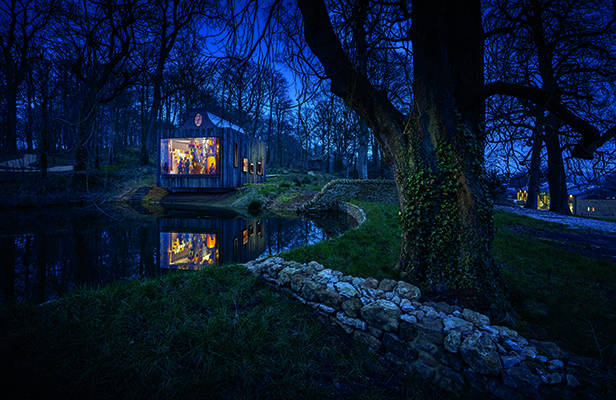

Beezantium at The Newt in Somerset
At Beezantium, integrated architecture and scenography transform what initially appears as a small, wooden building on the outside into a thriving beehive on the inside. Giant honeycombs made of a material mimicking wax surround the visitors. Lights embedded in the honeycomb create a warm glow resembling honey’s golden appearance. In place of honey, Beezantium’s honeycomb stores information about bees’ lifecycle, their hives and humans’ fascinating relationship with bees. Visitors mirror bees flying from flower to flower collecting pollen as they move from cell to cell collecting facts and stories.
The creation of the Beezantium, by the design practise Kossmanndejong, has been nominated as a finalist in the Public Space category of the 2022 SBID International Design Awards.
Contrasting the individualistic society of humankind, the world of honeybees depends on existing collectively. Individual bees fulfil the same role as collaborating cells in the human body – the colony is a superorganism. Similarly in Beezantium, the information embedded in each of the hexagons in the museum’s honeycombs contributes to the larger story.
At the start of the museum experience, visitors familiarise themselves with the bees on a detailed and intimate level, moving outwards to look at the life of the bees on a larger scale as they move through the exhibition. Upon arrival, visitors encounter their anatomical details, how bees communicate and interact with their environment. The exhibit concludes by exploring the relationship between bees and humans. You discover, for example, that while humans rely on bees for our food production, we also use pesticides and stimulate monocultures to produce food, threatening their very existence.
In general, people have always been fascinated by honeybees, whether for the magical healing qualities of honey, their working ethos or their way of cohabitating, and have tried to control them as a result. In Beezantium, visitors can learn about how humans live alongside bees and the history of beekeeping. In this area, you can discover poems and music about bees as well as malpractices in the honey industry.
The scenography in the museum utilises all five senses. Some hexagons are filled with real bees’ wax and smell like a beehive. Visitors can put their hands in another to feel the temperature at which bees regulate in their hives. In the observation hives, you can meet the bees of the estate, listen to them and watch how they organise their lives in the hive. During the summer, the colony is at its largest and visitors will find the bees processing nectar into honey and nourishing larvae into new bees. In the winter, only a small group of bees remains. They live off the honey production from the summer while keeping the queen warm.
In the audio guide, the beekeeper of the estate, Paula Carnell, introduces visitors to her bees. The audio guide was not scripted. Instead, Paula shares spontaneous stories addressed to the visitors of the exhibition. It is as if you are part of one of the bee safaris that she often takes visitors on. These stories also shift in scale from small to large – from the activities in the hive and the division of labour within the colony to the significant problems that threaten bees and what you can do to help them.
The gardens at The Newt in Somerset, where the Beezantium is situated, have been shaped over the last 200 years by successive enthusiasts, including Margaret Hobhouse who elevated them to a Victorian ideal, introducing colour, a greenhouse and many trees of beech, oak, pine, walnut and cedar. Renowned garden designer Penelope Hobhouse gave Margaret’s vision a new lease of life in the 1970s, followed by Nori and Sandra Pope, whose experiments with colour delighted and inspired thousands of visitors in the mid-1980s. The latest incarnation has been created by Italo-French architect Patrice Taravella, who believes a garden should be both beautiful and useful. Mixing ornamental and productive elements, the gardens are a feast for the eyes and the stomach. At their core sits the Parabola, a walled garden concealing an apple tree maze; at their edges, diverse woodland provides a sheltered habitat for native wildlife.
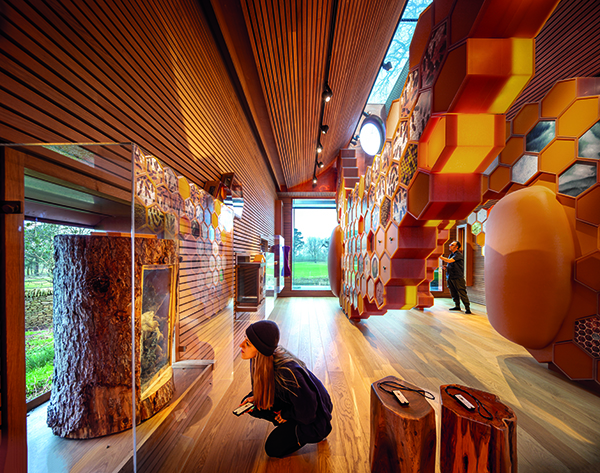
The Newt in Somerset, UK. Beezantium.