
The Park within Elephant Park
The second phase of a new park at the heart of London’s Elephant Park development is now complete. The park acts as the centrepiece to the Elephant Park development, which has revitalised the Elephant & Castle area and created one of the capital’s most sustainable new communities.
The £2.5bn Elephant Park regeneration project by Lendlease and Southwark Council sets the new standard in green city living, providing around 3000 new sustainable homes together with high-quality workspaces, shops, cafes and restaurants. The area’s new park has been shortlisted for a prestigious WAN award in the Urban Landscape Category, which recognises designs that respond to and compliment the urban environment through the creation of engaging, meaningful places which enhance the surrounding buildings and local community.
At just over 2-acres, the spectacular park, which officially opened this summer serves as the green centrepiece to the Elephant Park neighbourhood. The new park is an inclusive and sustainable community space featuring expansive lawns, colourful rain gardens, a water playscape, and walkways nestled within naturalistic planting. Designed by Gillespies, the Park is a celebration of nature and a tribute to Elephant and Castle’s diverse population and existing ecology, offering everyone living or visiting the area unforgettable social and recreational experiences, and an opportunity to connect with nature.
Lendlease’s Project Director for Elephant Park, Kristy Lansdown, said: “We are all aware that forming connections with nature is hugely beneficial for people’s mental and physical wellbeing. We wanted to create somewhere, in the heart of London’s zone one urban environment, which enabled people to step back from their busy lives, to play and to relax.”
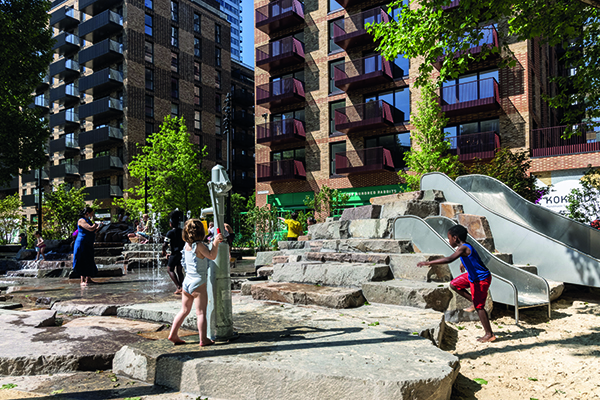
At the heart of the park sits Elephant Springs, a unique watery playscape that feels very much a part of the natural landscape. Gillespies collaborated with Mel Chantrey and The Fountain Workshop on the design of Elephant springs, a rocky, water-world of fountains, waterfalls, slides and sandy beaches. The area is constructed of high-quality Porphyry stone sourced the Albiano region of Italy, chosen for its hard wearing and slip-resistant properties when wet. The playscape is a fully accessible and tactile space designed to delight, challenge and excite children and adults alike. The colourful stone is layered to mimic 2.3-metre-high rocky outcrops and completed with water streams, pumps and activated jets, designed to encourage safe but adventurous play.
The park is shaped around 27 retained, mature trees and a further 19 new trees, chosen for their suitability for conditions, resilience to climate change, and diversity of species to mitigate biosecurity issues and deliver more comprehensive ecological value to the park. The team worked with engineering firm, Buro Happold, and specialist arboriculturists, Tree Work Environmental Practice, to find construction methodologies that would not harm the trees whilst allowing the construction of landscape features within the root protection area. Retaining the 27 mature trees had a huge impact on carbon fixing and storage. Their extensive canopy cools the air, mitigates pollution and provides microclimatic improvements alongside habitats for wildlife.
The Park has been designed to deliver a year-round, multi-sensory experience, featuring multiple plant communities tailored to specific edaphic and light conditions. These plant communities are composed of native and non-native species to maximise diversity and create a spatially complex planting cover that has the most significant impact on supporting biodiversity. All species selected are visually appealing, robust, resilient, and capable of withstanding challenging climatic conditions. The design also focused on maximising planting and reducing hard paving, allowing all opportunities where possible to maximize the carbon sequestering properties of soil. The main paths are paved in self-binding gravel, a material with a lower carbon footprint, and where natural stone paving is used for areas of heavy footfall, such as Elephant Springs, European stone has been selected for its lower shipping impact.
Kristy also explained why sustainability was such an important part of the project: “Elephant Park sets new standards for sustainable city living. In 2013 we committed to be net zero carbon in operation by 2025, at a time when climate change was not as high on the agenda as it is today. We aimed to be among the most sustainable urban regeneration projects in the world. In practice, this meant creating a low-carbon piece of city that improves air quality, which then becomes a healthier place to be and significantly reduces the use of non-renewable resources.”
She Continued: “The space has been inspired by feedback from the community and our commitment to a sustainable outcome. We wanted to create a unique natural environment to delight people of all ages. In this post-Covid world, being outdoors has become more important than ever before, and we are proud to have created a green oasis for everyone to enjoy and hope the community are proud of it too.”