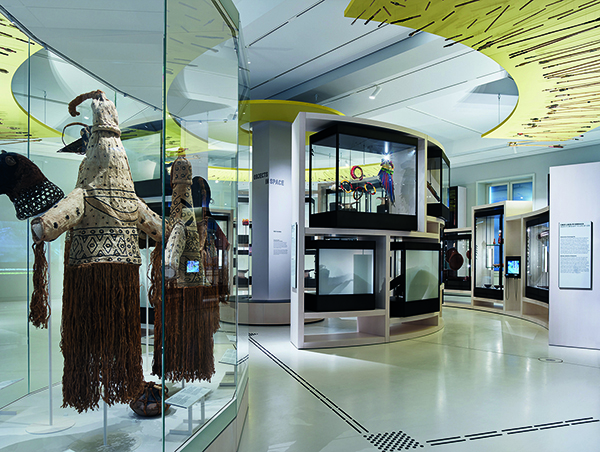

State Ethnological Museum and Museum of Asian Art, The Humboldt Forum
Ralph Appelbaum Associates and partner teufel design, have won a coveted Architecture MasterPrize for their design of the permanent exhibitions in the brand new East Wing of Berlin’s Humboldt Forum.
The opening of the new East Wing marks the completion of a 20-year development at the Humboldt Forum with the collections of the Ethnologisches Museum (Ethnological Museum) and the Museum für Asiatische Kunst (Asian Art Museum) taking up over half of the entire interior of the German institution. Who better to take on the project than RAA, the world’s largest practice for museum design, and Philipp Teufel of teufel design, known for designing for Frankfurt’s German Architecture Museum and German Film Museum.
With around 20,000 exhibits on 16,000 square metres, the collections of the Ethnologisches Museum and Museum für Asiatische Kunst of the Staatliche Museen zu Berlin, offer a diverse view of past and present cultures of Africa, America, Asia and Oceania. The new presentation, which was developed in many areas in cooperation with communities from the various regions of the world, raises pressing questions about the origin of the objects, the conditions under which they were collected and the effects of colonialism up to the present day.
The exhibition features several large-scale artefacts, these have been carefully integrated into the architecture, such as the magnificent Mayan stelae, temple sculptures from Angkor Wat, artworks of the Himalaya, the reconstructed Silk road frescoed “Cave of the Ring-Bearing Doves”, the Palau houses and ancestral poles of Polynesia, totem poles from Haida Nation, and never-before-exhibited artefacts of the cultures of Amazonia. A room full of wave-shaped pedestals displays Central Asian carpets and ceramics, adding a moment of drama to the exhibit. The carpets appear to float against the backdrop of a four-sided video screen featuring films about the cultures of weaving.
Tim Ventimiglia, director of RAA’s Berlin office, said: “The design of the exhibition spaces goes far beyond a purely aesthetic presentation – we conceived it as a dynamic platform for intercultural discourse regarding historical and contemporary events and ideas. These guiding principles posed numerous challenges for the planning and implementation of the exhibition design. From the beginning, it was clear that no single perspective or point of view should exclusively determine how the exhibitions were to be interpreted. Instead, there is natural history and cultural history; there are expressions of both European and non-European systems of belief and knowledge; “source communities,” historians and contemporary artists are all given a platform. We knew that these voices would always make themselves heard, and that it should always be possible to include them.”
This design was unique in that it was created to deliberately leave room for changes, to accommodate future exhibitions, interventions, and public programs. As a result, the exhibition strategy was not to create a singular iconic experience; instead RRA’s design was left deliberately open-ended, allowing for the exhibit to evolve with the needs of the Forum.
Due to the nature of the objects in the collection, RAA were required to design over 530 special display cases. These varied in size and shape, from as small as a mailbox, to as large as a two-story building, designed to accommodate the collection’s diverse conservation needs. These showcases are multifunctional, protecting the items within whilst allowing visitors to examine and appreciate them. These display cases are an integral part of the open ended design, they are designed with flexibility in mind, and allow curators to change the presentation of the objects frequently, keeping the exhibit fresh. More than 12,000 object mounting fixtures can be adapted to the specific presentation requirements of each object. Alongside these RAA have included media stations to provide visitors with more in-depth information about the collection.
On this project Ralph Appelbaum Associates and teufel design have created a series of iconic installations, visual highlights, and eye-catching attractions. They have seamlessly integrated deliberate pauses and interruptions, quiet spots for reflection, and moments where visitors can delve further into the subject matter. The physical exhibit’s intrinsic flexibility allows for spontaneity and for the collection to be restyled with ease, creating a wide variety of interwoven and varied visitor experiences that enable multiple points of entry.