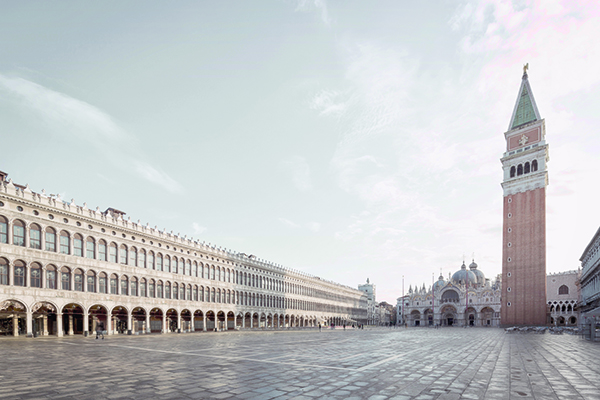

Procuratie Vecchie
David Chipperfield Architects’ and Generali Real Estate’s refurbishment of Venice’s iconic Procuratie Vecchie was selected as a finalist in this year’s MIPIM Awards, in the Best Refurbished Building category. The MIPIM Awards celebrate the industry’s most useful, sustainable, and visionary projects.
Saint Mark’s Square, besides being one of the world’s most recognisable squares, is an extraordinary and explicit demonstration of ordered public space, defined on three of its four sides by the Procuratie Vecchie, the Procuratie Nuove and Procuratie Nuovissime.
The Procuratie Vecchie was developed along the entire North side of the square in the first half of the Sixteenth Century, under the renovatio urbis programme of the Doge of the Republic of Venice, Andrea Gritti. The development involved three architects, Mauro Codussi, Bartolomeo Bon and Jacopo Sansovino; this established the modern ancient language adopted by the subsequent developments of the other Procuratie on the West and South sides of the square.
Generali, which began its life in the Procuratie Vecchie, has now acquired it almost entirely over the years. Generali’s goal with this project was to bring the Procuratie Vecchie into a more engaged relationship with the city of Venice. A large part of the Procuratie Vecchie has been made accessible to the public for the first time in half century, through the activities of The Human Safety Net, Generali’s foundation situated on the third attic floor.
David Chipperfield Architects Milan developed an idea for the project, which was not defined by a single architectural gesture, but instead by a series of Interventions which address the complexity of the work through a flexible approach. This allowed them to interpret and make sense of both historical modifications and the practical adaptations required to be made to the Procuratie Vecchie.
These interventions included the restoration of the first and second floors, where the most prestigious offices of the Generali insurance company are situated. The team also completed a reorganisation of the space, including a new vertical circulation, making the space more accessible and usable. The renovation of the third floor created public access to the exhibition spaces, workspaces, event spaces and an auditorium which is linked to The Human Safety Net.
Cristiano Billia, Associate Director of David Chipperfield Architects Milan commented: “This was a worksite of architectural and cultural discoveries. It was a duty of pleasure to work in this place directly for four years, unravelling the years of history that the Procuratie Vecchie recounts and holds, in order to preserve and enhance it. The utmost respect for architecture guided the careful choices that we made, striking a delicate balance between conservation and integration.”
The interventions made were informed by ancient, local and traditional construction techniques, enhanced by use of artisanal craftsmanship. The flooring, walling and ceiling was completed using pastellone and terrazzo, marmorino and scialbatura, and cocciopesto and cotto. The restoration of all the interior decorative surfaces has been done by the Venetian company Lithos Srl.
The materials were: wall paintings, marble, stuccoes and wooden ceilings both painted and gilded; as well as the external facade in Istrian stone.
Giuseppe Zampieri, Partner and Director of David Chipperfield Architects Milan said: “As an international studio with strong roots in Italy, it has been a great pleasure for us to be able to work with Generali on this significant and prestigious project. Over the last fifteen years, we have had the opportunity and privilege to work on world-renowned historical sites in Padova, Pisa, Milan, Treviso, Verona, as well as Venice itself, and today we are very grateful to have worked with such an eminent company on a site of such architectural, historical and social magnitude.”
He continued: “The Procuratie Vecchie’s location on Venice’s public square, and its humanitarian purpose have combined together to form an ambitious project full of complexity and meaning that has inspired us to work unceasingly as a team with diligence and open-mindedness.”