
Charge Cars, Stockley Close – The Postmodern Factory
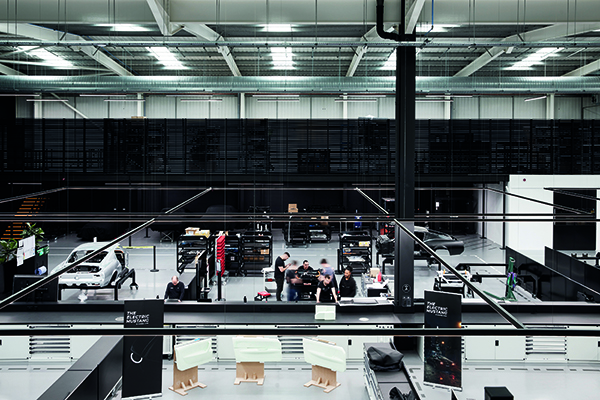
Charge Cars is a manufacturer of luxury electric cars; currently producing 499 vehicles based on the 67 Mustang Fastback. The fit-out of their Research and Development facility in Stockley Close, West London has created a production factory, research centre, sales, and administrative suite, accommodating all aspects of the new start-up’s commercial brief. The design approach required a deep integration with the working practices, and marketing strategies of the organisation. From bespoke entrance lighting to an efficient factory floor, every area has been considered in relation to production ergonomics, branding, worker, and customer experience.
This project is the winner of a 2023 RIBA London Award and saw the refurbishment of an existing industrial building in the Stockley Close estate, a single skin metal warehouse on a 2.5 metre blockwork wall around the perimeter, to provide new production and administrative accommodation for a techno/industrial start-up.
For this project, the client has been the co-designer. Every aspect of the space has required thorough discussion with the owner, their business representatives, technical staff, and managers. Each area has been honed accordingly with great thought being put into the functionality of the space. As there are not too many precedents for bespoke electric car production facilities of this scale, this has required a lot of investigative experimentation, review, and modelling to get right. This is a clean factory space, the black and white aesthetic representing the contemporary simplicity of the construction process, compared to a traditional motor workshop for engine cars.
A first-floor administrative suite provides a clear view of the factory floor through a fully glazed wall, including an open plan office area, with private and incidental meeting spaces. A staff breakout lounge, and large canteen provide opportunities for relaxation and refreshment away from the desk or the factory floor. A completed upgraded and extended WC and washroom area has been designed to a high specification.
The Anamorphic Light is a bespoke feature light for the entrance foyer of Charge’s R&D facility. It was designed by Most Architecture, and made by Esse-Ci Lighting in Italy, to detailed specifications. The system is kinetic, with the four Y-shaped elements of the light in movement, but occasionally coinciding to form the logo of the organisation. For a workplace fit-out project, which combines spaces for design, development, customer journey, prototyping and final assembly, the design of the light borrows from these elements, to offer an object that contains movement and acceleration. The component structure of the light is a reference to its origins in Feynmann diagrams, which describe the behaviour and interaction of subatomic particles. The creation of the anamorphic light was a real collaboration between client, designer, and maker, and the end-result a satisfying conclusion to the project.
“Pushing boundaries to blend performance and aesthetic design is the client’s ethos, and so we embraced these principles to develop a space across varied scales. We developed the existing building envelope to create a novel yet functional mix of spaces; whilst designing bespoke lighting, the entry sequence, detailing structure, and ventilation, seamlessly integrating acoustic finishes, and layering a wide range of functions – from construction and welding, through to coffee bars and DJ booths,” said Olga McMurdo, Project Director, Most Architecture.
Mark Roberts, Chief Creative Officer, Charge Cars added: “Creating an inspirational and functional workplace that suited the mindset we had for design, development and manufacturing was a particularly enjoyable challenge. It really gave us an opportunity to optimise our production methods, as well as offer quality downtime areas for our employees. The result delivers a high-performance environment, enabling us to push the business forward.”
The completed micro-factory fitout for Charge Cars creates a production space that offers an immersive experience for workers and customers alike. It is a contemporary approach to factory/workplace design, helping to forge a workplace culture that is far removed from the intensive, clock-in clock-out condition of post-war capitalist and socialist economies that dominated the modern era, instead merging the boundaries between work, production, recreation, and culture. The result is a post-modern car factory, producing a post-modern product that diversifies both the style and function of the industrial workplace, as well as the market for personal electric vehicles.