
Richard Gilder Center for Science, Education and Innovation
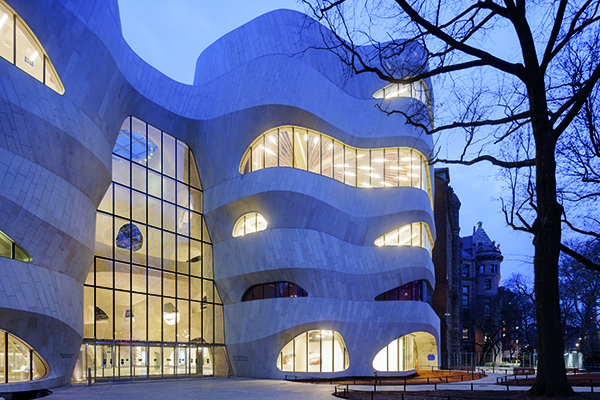
The American Museum of Natural History has opened its Richard Gilder Center for Science, Education, and Innovation – an architectural gem which brings new high-end research facilities, scientific collections, next-generation classrooms, and innovative exhibitionsto the already highly acclaimed New York attraction.
With the objective of giving visitors unprecedented access to the world’s most cutting-edge scientific ideas, innovation and programming, the 230,000 sq. ft project – 40,000 of which comprises renovation work – has been designed by Studio Gang, the international architecture and urban designers, led by Jeanne Gang. With six floors rising above ground and one going below, the architecture is informed by the ways that natural forces like water and wind shape the Earth, casting the immersive feeling that the interior has been carved out of natural rock over a span of millennia. As they enter the light-filled atrium, visitors will find a variety of new features to explore. Exhibition galleries, state-of-the-art classrooms, a research library – the center has been equipped with everything they might need to feel up close and personal with natural history. No feature better encapsulates this sentiment than the Invisible Worlds immersive science-and-art experience, a theatrical new addition which strips away outside distractions and creates a world in which visitors can engross themselves in the vastly complex network of life on our planet. The new center also includes the Louis V. Gerstner, Jr. Collections, designed to show off the diversity of the Museum’s vast inventory.
A focus on education lies at the core of the new center’s purpose-built facilities. Courses are available for visitors to learn about the natural world and universe, and there has also been a big emphasis on incorporating features which inspire young children to take an interest in the sciences. The Susan and Peter J. Solomon Family Insectarium – featuring a range of live insects as well as graphic exhibits and dioramas – and the second floor Davis Family Butterfly vivarium – with nearly 1,000 free-flying species – have been specifically included to excite younger visitors.
Invisible Worlds, designed by Boris Micka Associates with Tamschick Media+Space is an immersive and interactive 360-degree science-and-art experience in the new Richard Gilder Center for Science, Education, and Innovation. It offers a breathtakingly beautiful, scientifically rigorous, and engaging view into networks of life at all scales. This 12-minute looping experience is powered by scientific data and celebrates the richness of life’s diversity and the basic building blocks of life, including DNA, that connect all living things on our planet. The Invisible Worlds experience transports visitors to San Diego Bay, California, to experience the nightly commute of plankton, krill, and jellyfish to the sea surface.
In addition to its educational benefits, the Gilder Center functions to make the overall Museum experience more seamless, establishing 33 new connections between 10 Museum buildings. The Gilder Center eliminates dead ends and creates an interconnected campus. The center will also feature a new restaurant, designed by Bergen Street Studio. With stunning views of the Kenneth C. Griffin Exploration Atrium, the eatery will offer table service and a range of contemporary American cuisine.
The museum holds more than 34 million artefacts and specimens collected since its founding in 1869 and is home to around 175 scientists working to advance research in the fields of human culture, the history of life on Earth, and the processes which continue to shape it today. The opening of the Gilder Center is estimated to increase visitor numbers to the museum by millions each year.