
House of Ming Restaurant, London
With a chic interior creating an elegant ambience subtly influenced by the Ming Dynasty, House of Ming Restaurant has opened its doors within St James Court, a Taj Hotel located in central London SW1.
House of Ming originated in New Delhi and is arguably one of the finest Chinese dining experiences in India.
Offering unbeatable and authentic Sichuan and Cantonese cuisine, the new London restaurant incorporates elements of traditional Chinese design to create a rich and intimate dining space with a focus on bespoke craftsmanship and artistry.
Apart from the cuisine, the Ming nobility also brought botanicals from China, and the restaurant comes alive with intrinsically designed gingko leaves, a sacred concept of yin and yang symbolising longevity and vitality.
The interior was created by award-winning designers Atelier Wren, working with main contractors Phelan Construction and project managers Box.
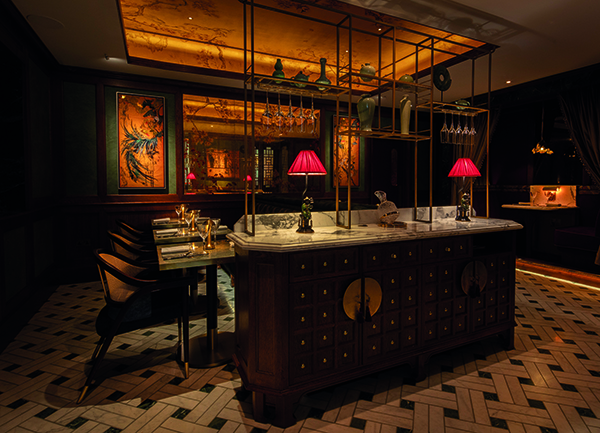
The intimate 56-seater restaurant has a stunning blend of green hues and lush red lacquer. Finishing touches such as antique brass and handcrafted furniture give a sumptuous feel. Ceilings hand painted onto canvas by Lara Fiorentino were inspired by Chinese silk screen painting from the Ming dynasty and feature pine trees, mountains, and ginkgo leaves.
Large, embroidered silk panels featuring pine and ginkgo leaves were created by award winning artist Jacky Puzey, with plum blossom appliqué being added to some panels to create a subtle decorative motif that balances with the drama of the pine shapes and sweeping needles.
A particular striking feature of the interior are the two sets of bespoke love seats nestled around a table, with their own curtain to create a unique intimacy. This romantic two-seater area also features a brass button that discreetly calls the kitchen for a unique ‘surprise’. The golden seats are trimmed in Opium fabric and the marble tables sit under a brass ‘twisted gingko’ pendant light.
Jake Raslan co-founder of Atelier Wren, designers commented: “In bringing the New Dehli House Of Ming restaurant concept to London, we were given the freedom to adjust the design to appeal to a London audience, working to a brief requiring an intimate and romantic ambience. The clients trusted our judgement and were highly supportive throughout.
“The building gave its fair share of surprises when we were stripping out the previous restaurant – including beams and pipes we didn’t expect – meaning that we had to redesign the ceilings and work with the structural and M & E consultants to re-route all the drainage and air-conditioning services.”
The elegant artwork, furniture and architecture of Imperial China were used as subtle influences throughout the interior, without heavily ‘dictating’ the design, resulting in a restaurant that looks beautiful and works well, rather than a museum-grade replica of the Ming Dynasty style.
Design highlights include chairs upholstered in rich deep colours with bespoke designed frames influenced by Art Deco forms. The tight-weave darkened rattan backs are reminiscent of the chairs in members’ clubs of old Hong Kong and Shanghai.
The ‘basket weave’ marble floor designed and supplied by Starel Stones is a nod to both the carpet design of the House of Ming in Delhi, and the rough marble floors of Chinese kopitiams (a relaxed style type of coffee shop). The latticed screens and the feet of the fixed banquettes are reminiscent of Ming Dynasty furniture.
Jake Raslan continued: “Another distinctive element is the scenic artwork hand painted by the talented Lara Fiorentino and her fantastic team, which was designed to compliment the stunning embroidered artwork we commissioned Jacky Puzey to design and produce. It also referenced artwork by the Song Dynasty court painter Ma Linear.
“A further important consideration was the fact that customers need to be able to read the menu when it’s dark outside, but also not feel stuffy on a hot summer lunchtime – and this impacted our choice of colours (light ceilings) and surfaces (the use of marbles).”
The decor is complimented by a lighting scheme which has a dramatic yet ‘fun’ quality. The design was influenced by Wan Kar-wai’s masterpiece film ‘In The Mood For Love’ and his use of shadows and in the lighting of a sumptuous colour palette – which adds extra interest for diners.
The AC system is controlled by sensors dotted throughout the rooms, concealed behind brass studs. The thermal controls are designed to maximise efficiency whilst also keeping customers comfortable.
Jake Raslan concluded: “Phelan Construction and their sub-contractors worked tirelessly to see this project through. They deserve an enormous pat on the back and should be very proud. “We also worked hard with project managers Box to keep the design within an ambitious budget, working together to give a final product that oozes quality without spending the earth.”