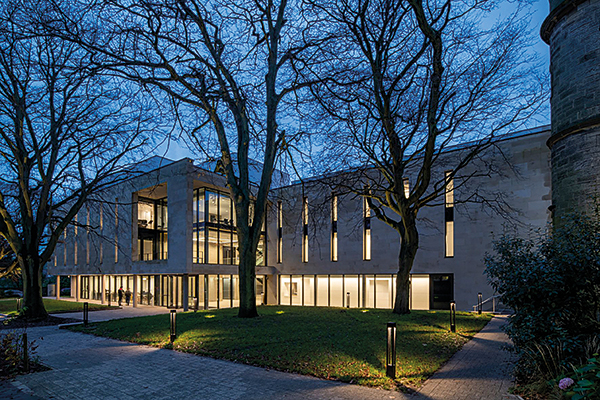

Laidlaw Music Centre
Across the University of St Andrews’ 600-year history, it has never had a building dedicated to music – until now. Offering students and locals unprecedented access to the performing arts, Laidlaw Music Centre has been designed by award-winning architecture studio, Flanagan Lawrence, to be the beating heart of the university’s cultural quarter.
The £12.5 million addition to the St Andrews campus is open to students, staff, and the wider community, offering an all-new intimate performance venue with flexible rehearsal space and cutting-edge recording facilities. After winning the project in 2016, Flanagan Lawrence’s task was to produce a building where professional performances, student rehearsals and undergraduate musical studies could co-exist, and the result is a facility worthy of the world’s greatest performers and recitalists.
Acoustic perfection was a key focus for Flanagan Lawrence, with spaces being fine-tuned to give musical rehearsals and performances clarity and power.
Equalling this precision of design was a consideration of the space’s ease of use. The building’s accessible location and external appearance beckons both the curious and committed inside, and its interior encourages the discovery of its 3 expansive rehearsal spaces, 10 individual practice rooms, recording studio, and music suite.
From the outside, Laidlaw Music Centre commands attention. Featuring 3 wings of differing heights with alternating planes of local sandstone with interstitial glazing, the building slots between its neighbouring structures with a boldness and ease suggesting it has always been there. Gorgeous longstanding trees pop against the sandstone walls backdrop, and bright vertical windows scale the building to permit natural light inside. Jason Flanagan, Project Architect, said the building was intended to be “a response to its context”, interacting with the listed buildings and greenery around it to form a vibrant new quad on the campus.
Drawing a link between the building’s stature and acoustic quality Dr Michael Downes, Director of Music at the University of St Andrews explained: “The footprint of the location was small for what we wanted to achieve, so the way to achieve the acoustic we wanted was to have an acoustic chamber; a very high hall on quite a small space. – It’s the world’s first recital hall with a reverberation chamber.”
Inside, the 3 wings are bound together by the treble-height-glazed central foyer, a bright and welcoming space with transparent connections to the arboretum and Quadrangle. This latter area is particularly interesting as it forms a southern extension of the historic St Mary’s Quadrangle, an area of the university which dates to the 1500s. From the foyer, visitors can ascend the timber board staircase which, alongside the timber walls, establishes a textural consistency with the trees outside and the wooden panelling found throughout the building.
Performers, musicians, and delighted audience members will marvel at the immaculate composition of Laidlaw Music Centre’s rehearsal and performance spaces. In the oak-lined McPherson Recital Room – the world’s first chamber hall with a reverberation chamber – Flanagan Lawrence has executed a design which allows for a reverberation time ranging from 4 seconds to less than 1, facilitating more exact analytical sound work in rehearsal as well as a warm acoustic for concerts.
The Takacs Quartet, who recently performed in the new space commented: “The McPherson Recital Hall is a unique, state-of-the-art performance space. Thanks to its vibrant acoustics and intimacy of design, it is an ideal space to play a string quartet concert. Whether in Haydn, Bartók or Ravel, we felt inspired to create the widest range of dynamics and types of sound. Onstage we felt as if we were inside and surrounded by the sound of the quartet. The variable settings allow for an unprecedented degree of flexibility when adjusting the sound to each individual’s or ensemble’s taste. Simply put, it’s a joy to experience this wonderful hall!”
Large enough to fit a symphony orchestra, the McPherson Recital Room also features a mechanized floor comprised of around 100 platforms which allow it to alter its layout and produce different spatial configurations depending on the needs of each rehearsing group. Innovative and pragmatic, this design feature has never been seen in interior design before.
In creating this room – the new building’s largest – Jason said there was a strong focus on making the space practical for those who would use it: “It had to be big enough, on one hand, for the symphony orchestra to rehearse, but then it also had to work for choirs of 200 singing along with a conductor and organ.” The room’s acoustic and spatial flexibility needed to support a wide range of musical activity, and Jason explained that achieving this came down to “the reverberation chamber and the flexible acoustic treatment, largely facilitated by acoustic fabric that we deployed throughout the space, such as curtains or blinds.”
Lucy Russell, the violinist who opened the hall, enthused: “This space is nothing short of extraordinary. It is like nothing I have ever experienced. It has such a range of possibilities for timbres and articulations. I felt as if, as a violinist playing in here, I could do anything I wanted. It also encouraged me to be more imaginative, and it’s rare to find a space that encourages the music to flow from you in a different way- because it supports you. This will be wonderful for all sorts of musicians, at all sorts of levels. From those who are amateur, right up to world class musicians, can play here and feel supported. That’s a wonderful thing that makes you feel excited about performing music.”
When it came to the building’s functionality, Flanagan Lawrence also sought to tick sustainability boxes. From a displacement ventilation system in the hall to renewable energy from photovoltaics, Laidlaw Music Centre runs with eco-friendly principles at its centre, achieving BREEAM ‘Excellent’ status.
Positioned near the medieval centre of St Andrews, Laidlaw Music Centre is the latest development in the university’s long running passion for performance in its student community and beyond. Folk music has long been a part of the Scottish town’s identity, and the new building means they no longer have to rely on local churches or halls to perform. Michael added that this location was key to the project vision: “We wanted it to be in the town centre so that people could walk to it, and the location we found is brilliant!”
Reactions to the building have been wonderful, with the local Preservation Trust awarding it their Pride of Place Award and RIBA naming it a winner of this year’s National Award. For Jason, it’s a pleasure to be able to complete a project and return to it as a visitor: “I can actually go back and see performances and listen to the space. That’s what’s really wonderful about performing arts projects like this – you can stay engaged with them.”
For students and visitors looking to attend a performance at Laidlaw Music Centre, Michael assures they won’t be disappointed: “First of all, it sounds brilliant. The sound is very warm, immediate, yet clear. And because of the flexibility of the room, it’s a very intimate experience – no one is far from the performance.” After years of talking about the project, Michael said “it’s great to see it as a reality and hear about how excited people are to listen to and make music in there.”