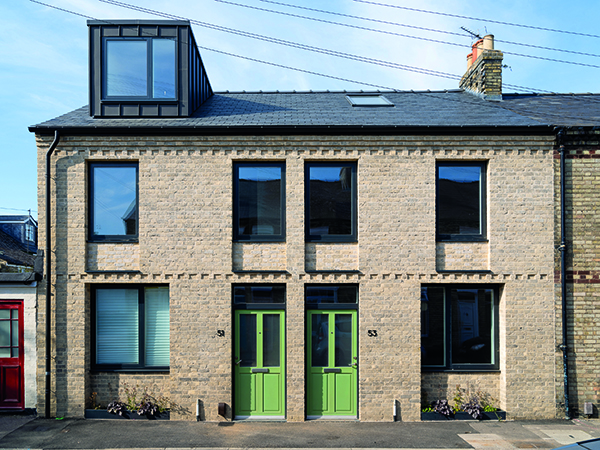

51-53 Argyle Street Cambridge
Shortlisted for a 2024 RIBA East Award, 51-53 Argyle Street is a project which saw two new terrace houses in the Mill Road Conservation area in Cambridge completed for local developers Inti Construction.
The small speculative housing development in Argyle Street replaces a car repair garage, in a tight urban site, removing contaminated soil and reinstating new garden land.
Rather than creating typical ‘two up – two down’ properties, Borough Architects introduced highly sustainable three beds and generous modern ground floor living spaces with light filled kitchens, enjoying front to back views. Both family homes comply with Part M(4)2 accessibility requirements, allowing them to be adapted to generational needs.
The frontages conclude the existing modest terrace with sensitive and crafted details, with Borough Architects hoping to add a small contribution to the existing street of railway worker’s houses.
PREMIER CONSTRUCTION MAGAZINE spoke to Ze’ev Feigis from Borough Architects about the project in a bit more detail.
What where the time scales on this project – when did it start and finish?
“We started the design process in February 2019. Planning was then granted in July 2020 and work started on site in January 2021. The project was completed in May 2022.”
Are there any design features of particular interest as part of the development?
“This project was a modern interpretation of the traditional Victorian terrace façade. We replaced the contaminated soil of the previous garage with large biodiverse gardens, rainwater collection and a future proof speculative development which includes high envelope performance, incorporating open web joists and preparation for ASHP and MVHR.”
Where there any difficulties or challenges with the project?
“The planning and construction took place during the COVID lockdowns, so this added some extra pressure, and the materials sourcing was then delayed due to supply chain setbacks. During the demolition and construction stages, it was necessary to monitor the air quality and noise levels since all the neighbours were at home during the day. We therefore coordinated the work with them.”
Is this the first time you have been nominated for a RIBA Award?
“Yes it is.”
What does it mean to you to be nominated for a RIBA Award?
“It is a great honour to be recognised and included alongside fantastic projects and among very talented practices. However, it is also a bit of a surprise that such a humble project made the shortlisting. We hope this project can be used as an encouragement for speculative developers to seek quality and sensitivity to context, as well as understanding the importance of house building in supporting the natural environment, better streets, and richer cities.”