
Kinkally London
Outstanding in both its unusual food offer and its design, trendy new London restaurant Kinkally (named after the speciality Georgian dumplings it serves), is a formidable contender in the Restaurant and Bar Design Awards 2024.
Designed by DA Bureau and entered in the Standalone category of the awards, Kinkally, in Charlotte Street, offers a menu specialising in ‘khinkali’ – a traditional Georgian dumpling with a striking, twisted form, whilst also adding in influences from across Europe, Asia and the Middle East. These dumplings come with a ‘handle’ at the top and fillings could include langoustines, pumpkin, beef or many more.
Alongside the selection of signature khinkali are small plates inspired by Georgia’s ancient food culture, but with a hint of contemporary minimalism.
The venue also includes Bar Kinky, a nighttime basement bar serving a selection of creative cocktails, accompanied by a techno soundtrack and the same fabulous buzz as the restaurant.
Maria Romanova of DA Bureau said: “The Kinkally logo was the main feature influencing our project’s philosophy. Storytelling is our core value and strength – and here it was important to show the original inspiration from modern Georgia with a twist of Asia, where the concept of dumplings was first invented in China. We looked for common features across these two cultures, which are united by their love of nature.”
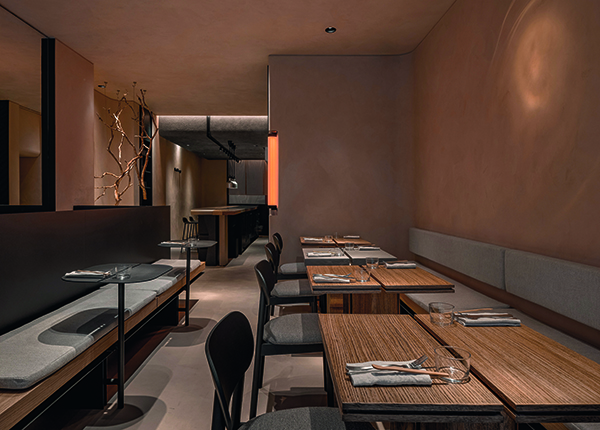
Georgia is represented by more brutal, dynamic and raw forms, such as those of the brutalist open kitchen counter island on the ground floor, and the asymmetrical brutalist tables on the lower ground floor, as well as the textured stone-like suspended ceiling features overhanging them, referencing the forms of the mountains and caves typical of the regions from which khinkali originates.
In contrast, the Asian influenced element of the design includes symmetrical, geometric benches and delicate metal tables surrounded by beautiful walls with soft angles.
Another striking feature of the restaurant design is the tree branches suspended from the ceiling, symbolising a connection with nature and Georgia. These were brought in from Richmond Park and processed by hand. The branches perfectly compliment materials used within the restaurant area, which include wood, concrete and metal.
In Bar Kinky, the first thing that guests see is a bright and striking bar resembling a futuristic space capsule, as well as the additional restaurant area complete with open station for making khinkali.
Maria Romanova continued: “In the bar we created a bright and lively atmosphere, where the stainless steel walls are a key element, reflecting the light and blurring the boundaries of the space.
“In fact, light plays a key role throughout the project. We worked in collaboration with Ukrainian firm Expolight, using atmospheric lighting to create stunning, theatrical effects, including graphic shadows of the tree branches in the restaurant, and narrow beams of light cast across the tables. Warm amber lighting is used to great effect in Bar Kinky, whilst rich purple lighting adds a softer atmosphere and depth within the lounge room.”
She added that one of the greatest design challenges was the layout of the space, which was very complex, and was ultimately divided into two functions – the restaurant and the bar.
She said: “We needed to emphasise and highlight each of those areas, yet at the same time make a smooth visual transition from one space into the other.
Maria Romanova said: “While Bar Kinky strongly features stainless steel (which is very different to anything else in Kinkally) and has a totally unique light design and strategy, its design elements are a logical continuation of Kinkally. For example: the smoothly shaped ceiling in the bar is an ‘alter ego’ of the rough Georgian stone ceilings in the restaurant. The shape of the bar counter is the same as the shape of the open kitchen’s brutalist style counter island.
“This creates a connection between the restaurant and the bar, despite the fact that the mood is completely different. This is our way to refresh and contrast the guest impression visually.”