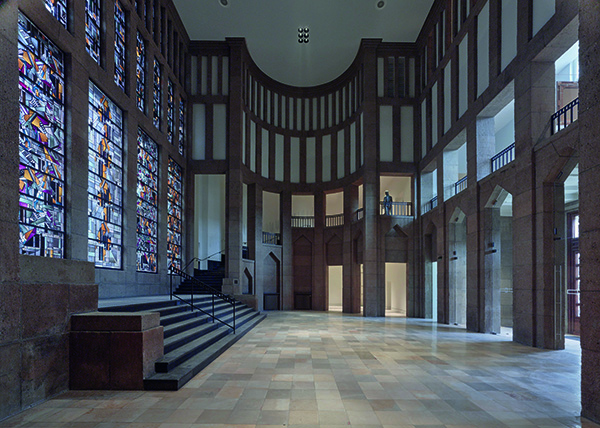

Kunstpalast Düsseldorf Museum
Over the past three years, the Kunstpalast has been completely renovated. When Felix Krämer became general director in 2017, he took the building’s urgent need for refurbishment as an opportunity to totally redesign both the layout and the content of the 5,000sq.m tour of the permanent collection. Thanks to the generous support of the City of Düsseldorf, which has invested over 50 million euros in the renovation project, his vision of a modern, open museum that makes everyone feel welcome – regardless of their age or prior knowledge of art history – has been realised.
Many visitors will hardly recognise the Kunstpalast behind its historic façade and following extensive renovation, refurbishment and modernisation works, the museum’s collection is now presented in an entirely new light in rooms designed to the latest standards.
Speaking to PREMIER CONSTRUCTION MAGAZINE, Joachim Sieber from Sieber Architekten said: “When we began planning the new Kunstpalast in 2017, our aim was to ensure that the building, with its different areas became a single museum in a lively urban location. With the interior appearance of the building, we wanted to regain a unity that is appropriate to the overall ensemble, but without destroying the traces of time. The relationship between the rooms was then given a contemporary, appropriate form.”
Out of the approximately 130,000 objects owned and stored by the Kunstpalast, around 800 works from 11 centuries will be on display here. Whether miniature or monumental works, everyday objects or precious ornaments, plastic or porcelain, drawings or interactive VR installations – the selection of works unites exhibits from all genres.
Joachim added: “The new Kunstpalast is a meandering sequence of clearly defined rooms of different sizes, which repeatedly ensures a change of direction and perspective, in the course of which carefully curated highlights are to be found.”
Across 49 rooms, the chronological tour of the collection encompasses everything from medieval art and the collection’s nineteenth-century highlights through to contemporary art. Alongside big names, works by lesser-known artists are also on display; some of these have never been exhibited before or have only recently been acquired. Works by women artists, who are notably underrepresented in historical collections, are given special prominence here.
The collection on display explores the relevance of historical and contemporary art, establishing connections to current themes and demonstrating the similarities between works that at first glance seem very different although they were created at the same time – beyond categorisations based on historical style and regardless of their origin. This is evident in the selection and presentation of the works: sculptures of the Virgin Mary, statues of Buddha, VW Beetles, Christo’s oeuvre, a Boro kimono and a painting by Max Liebermann are all placed on an equal pedestal.
The new Kunstpalast app adds a digital dimension to museum visits. Developed in cooperation with digital partner ERGO, the free app combines augmented reality features with the functions of an audio guide, as well as providing additional background information and fun extras. A special audio tour of the exhibition, created in collaboration with the Düsseldorf-based company Tonies and playable on a Toniebox, guides children aged three to eight through the collection from one object to the next.
The internationally renowned artist and illustrator Christoph Niemann has exclusively designed rooms for the Kunstpalast that raise questions about perception and illusion for children and adults alike. And in the Palace Studio, visitors of all ages can get creative in workshops supported by the museum’s education partner Lamy.
Joachim said: “Further motifs encompass the strategic placement of thematically defined special rooms, bespoke children’s rooms characterized by their distinct scale and aesthetics, as well as the targeted opening of the façade to the outside and the rooms to the inside. These placements provide visitors with orientation along their route, opens views towards the Ehrenhof and the multi-story foyers, and at the same time increases the buildings complexity.”
The newly renovated inner courtyard, including the restaurant Anna Maria, makes the new Kunstpalast a place where visitors can enjoy spending time.
As part of the project, gbk Teamplan GmbH were responsible for checking the foundations of some of the supporting pillars in the patio. gbk Teamplan GmbH have been active for more than 20 years in the field of subsoil investigation, foundation consulting and contamination investigation in the area of old industrial sites and planned construction projects, as well as carrying out investigations in connection with building demolitions.
Joachim added: “The focus of our interest was to make the Kunstpalast tangible as a building that enters into a dialog with its outdoor space from which the site and the building benefit equally and to find the right balance between existing substance and newly added; to address and answer the question of how to deal with what previous generations left to us, and contemplate the buildings significance for its location and the community in the future.”