
Bath Abbey Footprint project
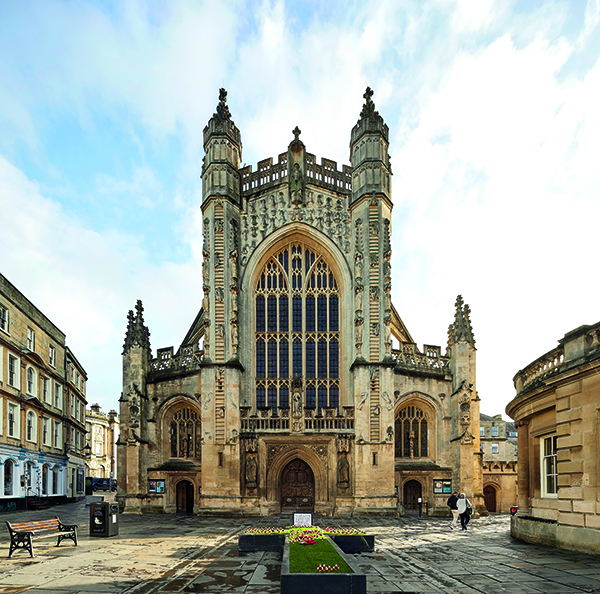
Taking centre stage with a whole string of prestigious RIBA Awards in 2024, the Bath Abbey Footprint Project showcases excellence in conservation, innovation, and inspiration, in the UNESCO City of Bath.
Commended by RIBA as an ‘epic undertaking’ with ‘immaculate workmanship’, the project, started as a collapsing floor repair, before expanding into a £22 million programme of works, whose outstanding results won a RIBA South West and Wessex Award 2024, RIBA South West and Wessex Conservation Award 2024, and a RIBA National Award 2024.
Led by Feilden Clegg Bradley Studios architects, with Emery Brothers as main contractors, and Synergy LLP as project managers and cost managers, this outstanding scheme has helped to secure the future of the Abbey, with building works and restoration that has transformed its buildings. Key elements of the scheme include refurbishment of the abbey floor and installation of a sustainable heating system, the provision of a new Discovery Centre Museum, a Song School, volunteer facilities and a learning hub.
Throughout history, three churches have stood on the abbey site: a Saxon Monastery, a Norman Cathedral, and the present abbey building which was started in 1499. From the early activities of the monastic community to those of the abbey community today, the newly created ‘discovery centre’ tells stories from this rich history.
The Abbey floor is made up of approximately 2,400 stones, and it was the deterioration and consolidation of the burials underneath the site that had caused ongoing subsidence, and subsequent collapsing of the flooring.
During the works, all 891 inscribed ledger stones that made up the floor were lifted, documented, and repaired. Bearing the names of nearly 1,500 people commemorated at this site, the stones represent a cross section of Bath’s society from 1625 to 1845. The research that has gone into the conservation of the floor and repair of the floor stones, reveals a crucial part of the social history of Bath, and this research into the names on the ledger stones will be available for visitors to read.
The floor stabilisation required an extensive programme of archaeology and provided the opportunity to install an innovative sustainable underfloor heating system.
At around 2,000 years old, the Roman Baths, only a moment away from the Abbey, are built on the site of Bath’s thermal springs that currently deposit 1 million litres of water each day into the River Avon at around 37°C. Working in partnership with B&NES Council, the heat of this water is now harnessed to provide a renewable energy source to heat the Abbey buildings and reduce carbon emissions for the future.
The new system utilises Bath’s hot springs via energy blade heat exchangers that collect heat from the thermal spring water flowing through the drain from the Roman Baths and down the river. Heat energy extracted from this water is sufficient to heat not only the historic Abbey, but also the adjacent row of Georgian cottages that house the Abbey offices, Song School and volunteer facilities.
The floor area being heated by the new system is now approximately double what it was previously. In addition, the local council have actually replicated this system within the Roman baths, which they run.
Continuing with the sustainable aim of the project, an energy efficient LED lighting system, designed by Michael Grubb Studio, has been installed. The new lighting is part of a wider representation of the building which reveals the exquisite architectural detail of the abbey, whilst providing flexible scenes for various services and events. This was achieved by allowing each lamp to be individually controlled and programmed.

Further works included introducing structural reinforced concrete frames into the Abbey vaults and linking them together to provide additional space that the Abbey can use long term – for exhibitions, community events and to accommodate male and female WCs, which the Abbey had not been able to provide previously.
Externally, work included refurbishments and major structural alterations to the Abbey’s administrative offices within Kingston Buildings, comprising five townhouses. Within the course of bringing these buildings up to a modern standard, two of them were linked together by removing the party wall at basement and ground level to form a new choir practice space as part of the new Song School – a challenging operation.
These refurbished buildings also include modern, open plan offices, and a break room for volunteers who work for the abbey.
Felix Emery, site manager for Emery Brothers, the main contractor, commented: “Our involvement with the project began in 2012, when we worked on a trial section of the floor stabilization and heating in the North Aisle of the Abbey.”
“We then started work on the Footprint Project in 2018, when I was one of three site managers on the project and spent over three years on site.”
He added that one of the challenges of the project was that until COVID struck, the Abbey was fully operational. Inside the Abbey, works had to stop for various reasons – including organ recitals, communion every Thursday, the odd funeral and tourists streaming in and out all day long.
He said: “The project was a very interesting mix of conservation, refurbishment and structural works to help secure the Abbey’s future in the city of Bath both physically and in terms of what it can offer the wider community. As a Bath based company we have been delighted to be involved in its delivery and everybody involved looks back on it with pride.”
“It is fantastic to get the RIBA recognition for this project – taking it on was a big ambition of ours with a lot of hard work over many years – to see the hard work rewarded is a pleasure.
Nathan Ward, project director for the Bath Abbey scheme, who took over from the delivery phase to completion, after the previous project director retired, added: “This project is unique and has been a huge transformation for the abbey in terms of what it can provide – from being a place of worship, to providing a key visitor attraction and community facilities for the city.
“The scheme has also provided the abbey with a springboard to determine future projects. In addition, it has generated a lot of public interest and is still collecting awards two years after completion.
“These awards provide fantastic recognition for the whole site team – particularly the main contractors who took on what was a very big and complicated project for them – and subsequently did an excellent job.”
The project was also Highly Commended at the 2022 WAF Awards in the Completed Buildings: Religion Category.