Baker Creek Preserve Pavilion at Urban Wilderness Gateway Park
The Baker Creek Pavilion is a celebrated civic anchor that serves as the centrepiece of Phase One of Knoxville’s Urban Wilderness Gateway Park project.
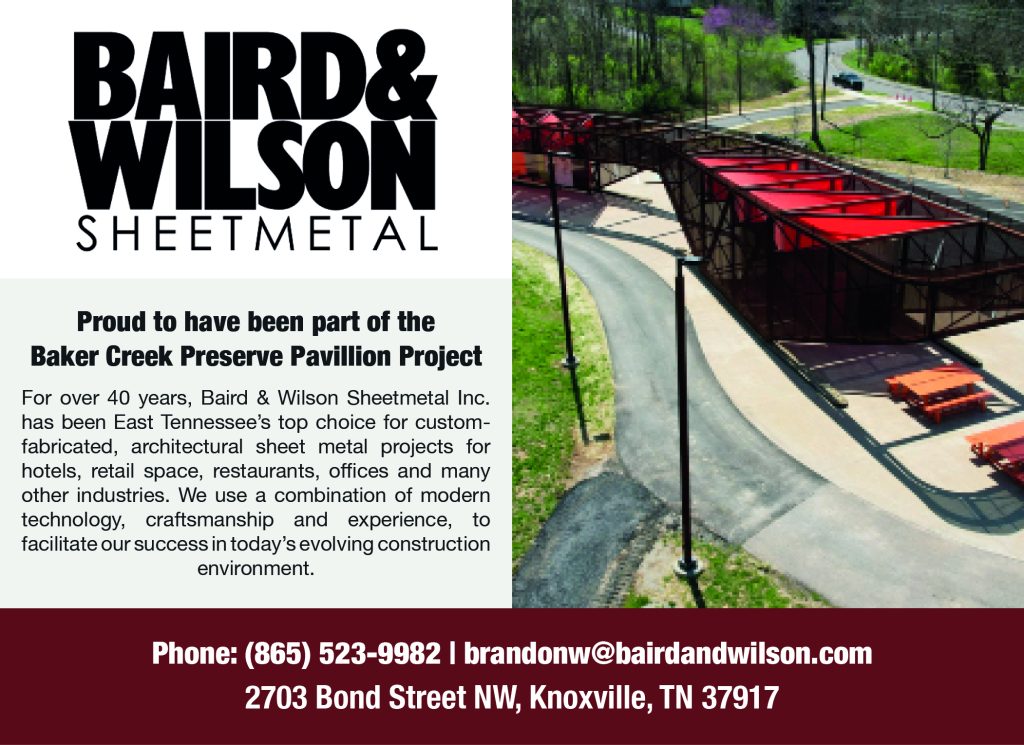
This landmark project sees the James White Parkway transform into a 2.2 mile and 112-acre gateway to the Urban Wilderness, an expansive urban trail system in South Knoxville, Tennessee. The pavilion serves as a shade structure at the entry to the multi-use trails and world-class bike park located at Baker Creek Preserve.
For more than a decade, a number of public and private groups have worked alongside one another to piece together a series of properties, easements, and land use agreements which collectively have become known as Knoxville’s Urban Wilderness. Through collaborative planning efforts, a broad trail and greenway system has emerged, linking a series of important historic and cultural sites to others that serve to re-connect the city while engaging narratives and places that are rooted in Knoxville’s cultural and industrial histories. Now spanning 1000 acres, Knoxville’s Urban Wilderness has become a premier outdoor destination just minutes away from Knoxville’s urban core.
Back in 2015, Mayor Madeline Rogero successfully ceased a planned five-mile extension of the James White Parkway. This agreement was the culmination of a decades-long struggle with the Tennessee Department of Transportation to end the construction of an expressway that would cut through the heart of the Urban Wilderness. In 2017 Knoxville Mayor Rogero announced an agreement with the TDOT which would transfer the terminus of the James White Parkway to the City. With the acquisition of this property, the City envisioned the transformation of this “Highway to Nowhere” as a celebrated Gateway into a natural resource so many had worked tirelessly to protect.
In 2017 the design team was selected by the City of Knoxville and includes architects, landscape urbanists, traffic engineers, ecological consultants, and a graphics team. The team worked together to develop a phased plan to transform an underutilized piece of urban infrastructure into an urban amenity connecting neighbourhoods once divided by a 4-lane highway. The first phase included improvements at Baker Creek Preserve which includes an established and well-known mountain biking trail system located in what was formerly TDOT right-of-way.
After the city successfully negotiated an end to the planned extension of the James White Parkway, the design team provided an initial vision for the project which included data supporting the reduction of traffic along this corridor. In this innovative planning effort, an expressway originally designed for high volume of cars is hacked and adaptively re-used to provide pedestrian and cycling connectivity from Baker Creek Preserve back across the river to the neighbourhoods of East Knoxville and Downtown Knoxville.
The project’s phasing strategy is also innovative. The initial phase focused on improvements at Baker Creek Preserve, the epicentre of the grass roots efforts that originally established Knoxville’s Urban Wilderness which led to the halt of further construction of the Parkway. Momentum established during this phase helped provide further justification for the second phase of the project which will transform the northbound lanes to a 2.2-mile linear park. The pavilion construction is also innovative. The structure challenges the notion of “building” by limiting conditioned area and focusing on shade. The twisting steel geometry of the pavilion is also uniquely innovative.
Phase 1 of the project also included the Baker Creek Pavilion which is envisioned as a central hub for bicycle activities within the Urban Wilderness. The new Pavilion includes bathrooms and family gathering spaces alongside facilities for bicycle storage and repair, and wayfinding and orientation elements associated with the trail system. The building is designed to support daily functions as well as seasonal events such as the Appalachian Mountain Biking Club Fall Festival which brings people to Knoxville from around the US. Overall, the project is representative of Knoxville’s stake in national leadership in design excellence at both planning and architectural scales.