
Jacobs Music Center
National interdisciplinary design firm, HGA, has completed the revitalization of San Diego Symphony’s long-time home, the Jacobs Music Center in downtown San Diego. The renowned venue’s $125 million transformation—led by HGA in collaboration with acoustician Paul Scarbrough of Akustiks and theater planner Schuler Shook—elevates musical and performance experiences for artists and audiences alike and simultaneously honors the history of the former Fox Theatre.
HGA’s redesign of Jacobs Music Center transforms the historic movie theater space that housed San Diego Symphony for 40 years into a modern venue commensurate with other world-class concert halls. Key elements of the design included:
- A state-of-the-art acoustic overhaul transforming the aural experience.
- A complete reconfiguration of the orchestra level seating and enhancement to seating throughout.
- The careful preservation and restoration of most historic features.
- Critical updates to the main mechanical and life-safety systems of the building to improve efficiency and air quality.
The design also captured significant additional areas to create spaces for the San Diego Symphony to engage musicians and the public in new ways.
“We see this new venue as an investment in the artistic ambitions of the orchestra and San Diego at large,” said Martha A. Gilmer, president and CEO of San Diego Symphony.
“Just as an instrument can transform the music-making experience for an individual musician, the reimagined Jacobs Music Center serves as a new, top-of-the-line instrument that all of our musicians can enjoy together, awakening new senses and possibilities for the future of the Symphony and the community for generations to come.”
In total, the project encompassed the reimagining of 70,545 square feet of space, including performance space and back of house support spaces, as well as audience and front of house amenities. The reconfigured 22,787-square-foot audience chamber includes 862 seats on the main level with 894 seats in the balcony. The redesign created 75 additional seats available through a new opportunity above the stage in the choral terrace, for a total of 1,831 seats.
Elevating Artistic Expression
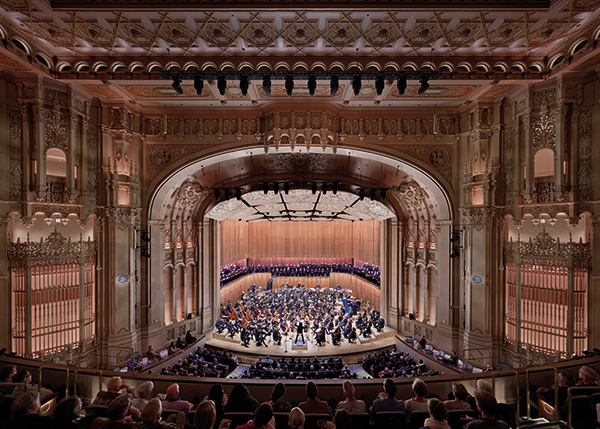
The most transformative changes to the historic hall centered around the improvement of acoustics for optimal playing and listening experiences. A custom-designed permanent orchestra enclosure, ceiling reflectors, and new orchestra risers, all tailored to the new stage, help musicians better hear their own instruments as well as those of their peers. To accomplish this, structural modifications were made to deepen the stage, raise the stage opening and enable the construction of the acoustic enclosure. This enclosure, paired with the series of 20 tunable overhead reflectors, optimizes sound distribution.
This new tunable acoustic canopy is a collaboration of theatrical, acoustic and architectural design, and it comprehensively supports artists across a spectrum of performance expressions. Acoustical “tuning chambers” and “variable acoustic” devices have been added throughout the hall to allow for the venue to be adjustable to accommodate music ranging from small chamber ensembles to full orchestra with soloists and chorus, to amplified performances. The new design also adds a choral terrace affording an expanded repertoire, comfortably accommodating larger works like Mahler’s Symphonies No. 2 and 3. The design’s flexibility also supports more intimate audience experiences for smaller works right on stage. New seating throughout the hall, and a reconfigured orchestra level, enhance the aural and visual connection between the audience and performers.
Updates to the hall’s mechanical systems and re-appropriated square footage that was captured in the shoulders of the stage house have provided space for essential musician amenities, including new small ensemble rehearsal rooms, an expanded music library, dressing rooms, visiting artist spaces, a fully redesigned artist reception room and climate-controlled instrument storage.
Enhancing Experiences for Patrons
New seats have been installed throughout the hall in a reconfigured format that improves universal access and circulation, offers better sightlines, and completely reshapes the main seating level to remove acoustic shadowing and enhance the connection between the performers and the audience. By addressing accessibility and resiliency both universal access and programmatic capacity have been greatly improved throughout the hall. The new seating layout also allows the hall to be configured in more flexible ways, supporting a greater range and scale of varying musical works and ensemble sizes for the public to enjoy. Additionally, the overall concert-going experience has been improved with enhanced stage lighting, an improved sound system and an integrated video display system to broaden the range and quality of amplified productions in the hall. Through reshaping the audience seating, the orchestra gained a new suite of rooms for pre-show events, recording, recitals and community education programs to better engage the public. By establishing new, dedicated ancillary spaces, the San Diego Symphony is now enabled to provide intimate music and music education for more students and families.
Preserving a Rich Legacy
HGA’s thoughtful redesign respects, rejuvenates and enhances the hall’s historic character, integrating and highlighting the imaginative and inspiring collection of Spanish Baroque details throughout the space. Meticulous care accompanied every aspect of the renovation to achieve these aspirations with a design logic that celebrates the hall’s legacy. New architectural elements added to support the acoustical and technical performance draw from the cadence, characters, profiles and colors of the myriad of details that envelop the hall as conceptual and formal inspiration, creating a dynamic dialogue between their respective eras. For example, the stage and hall are each lined with a custom-formed, woven metal mesh that functionally supports acoustic excellence, while visually connecting to other historic ornamentation throughout the space. Similarly, the acoustic tuning panels are embossed with a pattern harmonious with figures and patterns found throughout the hall. Key historic elements of the space were painstakingly preserved both on and off-site, such as the original chandelier that was cleaned and repaired. Various ornamental plaster castings upon the ceiling and walls were also faithfully restored. Original materials were replicated or, as necessary, updated with modern equivalents.