
The Joslyn Art Museum
The expanded and transformed Joslyn Art Museum celebrated its civic dedication ceremony on September 10th 2024, welcoming the public for the first time to a complete reinstallation of its distinctive collections, including numerous recent acquisitions, a full restoration of its original building (one of the finest Art Deco achievements in the United States), and the debut of its 42,000-square-foot Rhonda & Howard Hawks Pavilion designed by Snøhetta.
Open to all free of charge, The Joslyn has increased gallery space by more than 40 percent for its wide-ranging and fast-growing collections, reoriented its entrance sequence through three acres of redesigned and rejuvenated public gardens, and created a dazzling new visitor experience, highlighted by an elevated entry garden featuring Mark di Suvero’s Bodacious, 2001, one of dozens of works in the Phillip G. Schrager Collection. The expansion and renovation project has taken place at the same time as billions of dollars in new investments are being made in the downtown and riverfront of Omaha, where The Joslyn is a vital resource for the city and a cultural landmark for the entire Great Plains region.
Jack Becker, Executive Director and CEO of The Joslyn, said: “We are delighted to welcome everyone back to a Joslyn Art Museum that is both true to its proud history and thoroughly transformed. Snøhetta’s sensitive and innovative approach for reimagining The Joslyn enhances our existing buildings to give our ever-expanding audience a new experience while preserving our most cherished spaces, to reveal 5,000 years of human creativity from the world’s diverse cultures.”
Craig Dykers, Founding Partner of Snøhetta, said: “Honouring The Joslyn’s historic character while creating a fresh expression for the Museum’s future has guided our design. Our comprehensive reconsideration of the Museum grounds, the existing interiors, and the newest building all work together to create a more inviting entry for the growing spectrum of people that visit the Museum. Our goal has been to provide a harmonious place for guests, art, and gathering that will become a vessel for inspiration and creativity to flourish.”
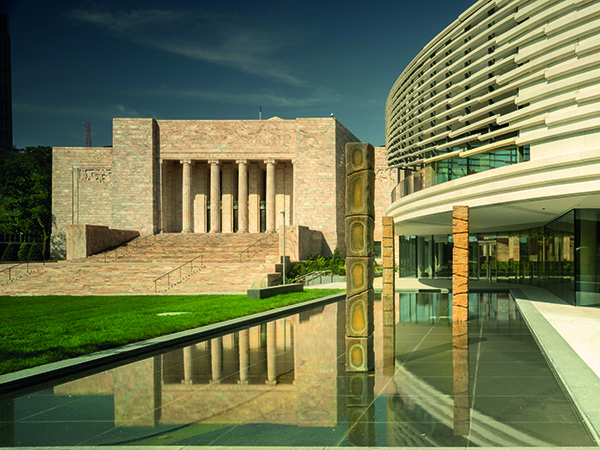
The 1931 Joslyn Building, designed by father and son John and Alan McDonald, stands side-by-side in the Museum’s public gardens with the 1994 Suzanne & Walter Scott Pavilion, the first commission in the U.S. by Norman Foster. The new Hawks Pavilion, designed by Snøhetta in partnership with Alley Poyner Macchietto Architecture, grows outward from an atrium that joins these two earlier buildings. In contrast to their rootedness, the Hawks Pavilion seems to twist and rise as it emerges, floating atop a transparent first floor that encloses the new main entrance, the Phillip G. Schrager Atrium, the Museum shop, and a multi-function community space. These main level areas ascend gradually to the existing buildings along a gently sloping, ADA accessible walkway. A striking, curved set of steps leads directly to the gallery level. The effect of weightlessness recalls the striking cloud formations above the Great Plains, as well as the deep overhangs and horizontal expression of Prairie School architecture.
The horizontal texture of the Hawks Pavilion’s façade takes its cue from the stacked stone of the 1931 building’s Grand Steps. The façade’s light-coloured precast panels are embedded with vibrant pops of pink aggregate that reflect the rich Etowah Fleuri (Georgia Pink) marble of the existing buildings.
The three acres of grounds at The Joslyn, redesigned by the Snøhetta landscape architecture team, establish a new entrance sequence for the Museum while providing sculpture gardens conceived as a sweeping collection of outdoor “rooms” that wrap around the site, weaving the landscape and architecture together around a reflecting pool, The Omaha Riverscape (2008-09), by sculptor Jesús Moroles. A new Great Lawn framed by native grasses and vibrant meadow plantings creates colourful variation throughout the seasons. The existing Discovery Garden is reconnected to the site by a new landscape for pedestrians, with paths that reveal sculptures and native plantings along the way.
To mark the opening of the sculpture gardens, The Joslyn has acquired a significant work by Hank Willis Thomas, The Embrace (Reflection), 2023, and commissioned a work by Alison Saar, Little Big Sister, 2024, made of cast stainless steel treated with heat-applied paint. Offering a nod to the students at the Museum’s neighbouring Central High School, Saar’s sculpture depicts a girl standing in a classic pose of defiance. Bottle-like forms cap the climbing tendrils of her hair, evoking the Congolese tradition of bottle trees.
Upon reopening, The Joslyn has launched a new, free digital guide for both in-person and online visitors on the Bloomberg Connects cultural app created by Bloomberg Philanthropies. Content includes information about more than fifty works from The Joslyn’s collection, including the Phillip G. Schrager Collection, plus exclusive audio content highlighting the architecture of The Joslyn’s three buildings.
The Bloomberg Connects app platform is part of Bloomberg Philanthropies’ longstanding commitment to supporting digital innovation in the arts. With dynamic content exclusive to each partner organization, the app provides a range of features including video, audio, and text; expert commentary; and way-finding maps.