
The resurrection of Notre Dame, Paris
Magnificently resurrected by a massive five-year restoration project following a devastating fire, Notre Dame Cathedral, Paris’s Gothic masterpiece, stands proud once again, having regained its world-famous opulent splendour.
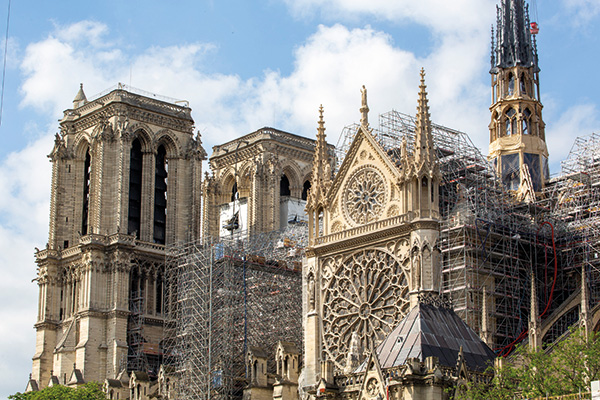
The blond stone, the colours of its painted chapels and the luminosity of its stained-glass windows are restored, the cathedral’s badly damaged roof has regained its familiar silhouette, and the replacement of the original Viollet-le-Duc designed spire rises again into the Parisian sky.
It was a different story on Monday on 15th April 2019, when the whole world had its eyes glued to Notre Dame beset by raging flames and fears that it would collapse. In the end, the cathedral stayed standing, but the wooden framework, much of which had been built in the 13th century, as well as the roof, was destroyed.
In addition, the collapse of the spire built by Viollet-Le-Duc in the 19th century led to the destruction of part of the vaults. Gables were also threatening to fall, as well as some of the statues.
Involving approximately 2,000 craftspeople and 250 companies in one of the world’s most prestigious and challenging reconstruction projects, the scope of the works needed to restore Notre Dame was vast.
These included the reconstruction of collapsed vaults, as well as the consolidation or replacement of stones weakened by the fire, the restoration of the large attic and the identical reconstruction of the spire of Viollet-le-Duc.
In the North Tower, the restoration of the partially damaged oak belfry was carried out, together with the cleaning and restoration of the bells. All interior spaces, stone elevations and painted decorations of the choir chapels were cleaned and restored where needed, as were the choir enclosure, floors, funerary monuments, the vow of Louis XIII, stalls, choir grilles, and all the artistic furniture in the cathedral and the sacristy.
Other works included the workshop restoration of the stained-glass windows of the upper bays of the cathedral and the on-site cleaning of the other stained-glass windows, as well as the cleaning of 22 large paintings.
All of the cathedral’s technical installations were completely overhauled, including a completely redesigned fire protection system.
The choir organ instrument was completely replaced, and its case was preserved and restored, ready for planned reinstallation in 2025. In addition, new liturgical furniture to replace that lost in the fire was installed, as well as new chairs for the congregation, and new lighting and sound systems.
Skills needed to complete these works included: quarrymen; edge-tool makers; carpenters and woodcarvers; roofers; masons and stonemasons; sculptors and sculpture restorers; ironworkers; gilders; coppersmiths; locksmiths and patiners; master glassworkers; paint and painting restorers; tapestry returners; organ builders and scaffolders – just to name a few. More than 140 contracts for services and work were awarded following calls for tenders.
One of the most challenging and perhaps spectacular elements of the construction works was the replacement of the cathedral’s destroyed oak frameworks and the lead roofing of the nave, choir, and transept, which were reconstituted identical to the originals.
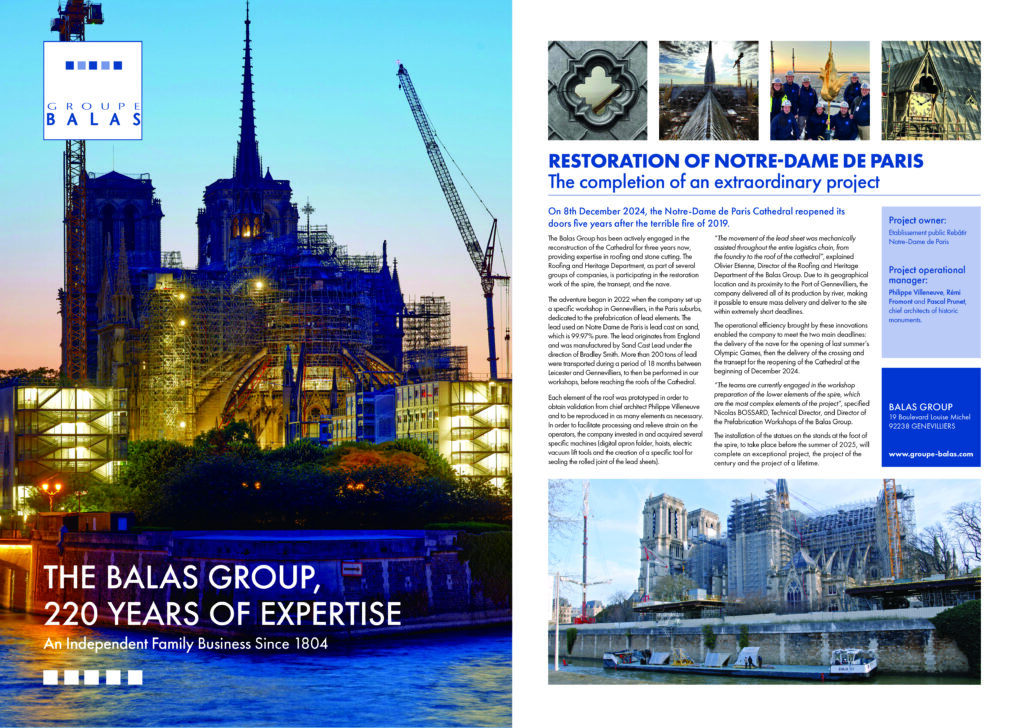
This involved two distinct operations – firstly the reconstruction of the spire and the main attic of the transept, erected between 1859 and 1864 by architect Viollet-le-Duc – and secondly, the reconstruction of the main attic of the nave and choir, whose frameworks dated from the early 13th century.
For the reconstruction of the spire and transept, a scaffold was installed just under the future spire in autumn 2022. On reaching the beginning of the vaults, at a height of 26 meters, carpenters mounted four wooden half-arches destined to reconstruct the arches of the vault.
Once these had been constructed, the scaffold was raised progressively as the framework of the spire was constructed, until it reached a height of 100 metres.
A modern take on the original, the new spire was designed by architect Philippe Villeneuve and incorporates both modern and traditional materials. Made of oak and copper, and 96 meters (315 feet) high, it is slightly taller than the original.
One of the biggest challenges was the weight of the new spire. The original weighed approximately 750 tons, while the new spire weighs only 250 tons – thanks to the use of lighter materials and optimising the design.
Another challenge was the spire’s height which makes it one of the tallest structures in Paris, and required careful engineering to ensure that it could withstand the wind loads and other environmental stresses which it would be exposed to.
Once the spire was erected, its scaffold was dismantled, and the vault of the crossing was then completed.
Lastly, the 16 copper statues forming the college of Apostles and Evangelists, which survived the fire because they had just been sent to be restored, and which had recovered their original appearance, were again installed at the base of the spire.
At the same time as the spire and frameworks of the transept were being erected, the carpenters in charge of the frameworks of the nave and choir accompanied foresters to select the necessary oaks required for this part of the restoration.
The logs arrived in workshops where they were squared, with the carpenters removing material to obtain a usable beam corresponding to the heart of the wood. To respect the methods applied in the early 13th century (when this part of the frameworks was constructed), the squaring was finished off with an adze or carpentry axe.
Medieval carpentry was based on a ‘trussed rafter bracing’ system, where the main trusses with complex shapes alternate in the framework with simpler rafters.
Once the trusses were raised, they were covered with a sheet of sand cast lead to protect the cathedral from bad weather, then surmounted by a lead ridge crest on an iron frame.
Notre Dame reopened on 7 December 2024, following completion of the restoration work five years after the fire.
The reopening ceremony was presided over by the archbishop of Paris, Laurent Ulrich, in the presence of the French president, Emmanuel Macron, and other dignitaries, including present and former heads of state and government.