
The Grand Egyptian Museum
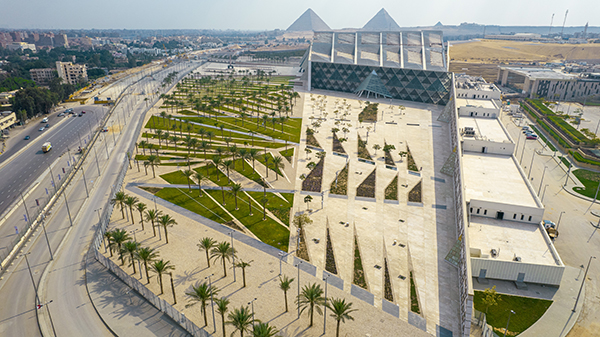
The Grand Egyptian Museum has officially opened in Giza, situated just 2 miles away from the Pyramids of Giza. Heneghan Peng Architects, an Irish architect firm, created the museum’s building whilst Atelier Brückner were the team behind the exhibition design and developed several key experiences, including the Tutankhamun Gallery, the Grand Stairs and the Atrium.
With over 90,000 sq. m of space, the museum is the world’s largest museum dedicated to Egyptian culture, and a testament to the longevity and scale of ancient Egyptian civilization and its enduring influences.
There to witness the grand-opening were Federal President Steinmeier and Shirin Frangoul-Brückner, Managing Director and Co-Founder of Atelier Brückner. Shirin said: “The Grand Egyptian Museum is a project of global significance. It was a privilege to contribute to something that will endure for generations to come. Knowing that our work has become part of this cultural legacy fills me with great pride. It was deeply moving to witness this historic moment.”
Serving as a central hub, allowing visitors to access the museums various areas, the Atrium features a statue of Ramses II, standing at over 11m high. The Grand Stairs, spanning up six-stories, acts as a prologue, showcasing around 90 statues and objects from different dynasties. Alongside this, Atelier Brückner designed the Children’s Museum that covers 3,465 sq. m of exhibition space. Outside, Heneghan Peng Architects collaborated with landscape architecture firm West 8, to create the Thematic Gardens, Welcome Plaza and Grand Hall, to provide the local community with green space.
However, the focal point of the museum is located on the second floor where The Grand Egyptian Museum is allowing the public to view, for the very first time, the complete burial treasures of the legendary boy king, Tutankhamun. The Tutankhamun Gallery spans 7,500 sq. m and consists of two parallel wings, each 180 meters long and up to 16 meters tall.
The gallery’s design points to life, death and the afterlife with the Curatorial Path, a continuous black floor panel on which all the objects featured in the exhibition are placed, and the Path of the Sun, a light band along the ceiling. Inside the gallery visitors will find displayed, all 5,600 objects from the pharaoh’s tomb including around 3,000 that have never been shown publicly before. One highlight from the display is Tutankhamun’s world-famous funerary mask, illuminated by 14 distinct light sources and presented in a space of its own.
The exhibition is organized around five central themes: the person of Tutankhamun, his everyday life, burial, journey to the afterlife, and the discovery of the tomb. Visitors can take one of two paths, chronological or reverse. The chronological path leads visitors through the exhibition, from Tutankhamun’s ancestors to the tomb’s discovery, beginning with the young king, featuring his gilded throne, followed by his life, death, and mummification.
The reverse, offers a scientific perspective, following archaeologist Howard Carter’s process of discovery. Visitors making this choice, will start with the opening of the tomb, a life-size 1:1 model of the burial chamber, illustrating that all the artefacts in the exhibition were once contained within this 35-square-meter tomb in the Valley of the Kings along the Nile.
No matter which route visitors choose, they will find architecture, scenography, lighting, materials, graphics, and interactive media that culminates to create an overall emotionally powerful experience.