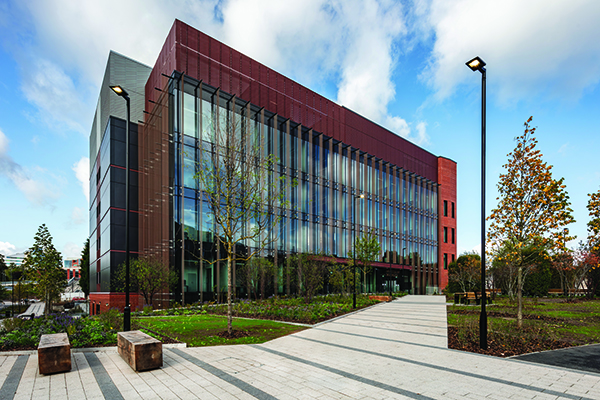

Molecular Sciences Building University of Birmingham
The University of Birmingham opened their new flagship facility, the Molecular Sciences Building in October 2023. Since opening, the building has been shortlisted for the Digital Construction Project of the Year 2026, due to the architects sustainable, thoughtful and futureproof build.
Associated Architects, a firm whose aim is to transform the way people live, work and learn for the better through the projects they undertake, were behind the facilities design and build. The firm created the Molecular Sciences Building to become a base for over 500 scientists, working across different disciplines.
To date, the Molecular Sciences Building is the university’s largest development, spanning 11,000sq-m and costing £60million. Having become a base for world-class research to be carried out, the facility was designed to offer the best possible laboratory spaces and maximise energy efficiency throughout.
The site’s façade features high performing thermal and airtightness, while the roof has a solar power system employed to generate renewable energy at the facility. To provide wildlife opportunities and contribute towards the university’s biodiversity programme part of the roof was designed to be a biodiverse green roof.
Achieving BREEAM Excellent, the building features state-of-the-art air source heat pump technologies that decarbonise the facility’s energy supply, while recycling waste energy. LED lighting with smart controls was also implemented into the site to help enhance light functionality and energy efficiency.
Improving sustainability at the site, innovative methods and materials were used within the flooring, ceiling materials and suspension systems. These methods helped save over 150 tonnes of Carbon Dioxide during the construction.
The interior of the building is split between 35% of office and meeting spaces, associated infrastructure, and specialised accommodation for over 500 researchers, while the other 65% is laboratory space.
The Molecular Sciences Building has provided a designated, sustainable hub for the School of Chemistry and provided facilities for the School of Geography, Earth and Environmental Sciences and in-turn helped staff and students collaborate, innovate and tackle challenge-led research.
Professor Neil Champness, Head of the School of Chemistry at the University of Birmingham added: “The co-location of researchers will enable us to tackle challenges in fields as diverse as making materials to trap carbon dioxide, discovering new agents for biomedical imaging, or developing sustainable approaches to manufacturing molecules and materials. The opportunities are many and diverse and the collaborative environment of the building will serve to nurture new approaches to tackle the world’s grand challenges.”
The development was part of the University of Birmingham’s multi-phase scheme, to provide world-class academic facilities and accommodation to facilitate greater collaborative working between university academics and schools, as well as with industry and partner institutions.
By working closely with stakeholders and specialists, Associated Architects have designed the Molecular Sciences Building as a long-life building with ‘built-in’ flexibility, that has met the university’s wider aspirations for the multi-scheme project.
After opening the Molecular Sciences Building in 2023, Phase 1 of the scheme is now complete. By the end of the scheme, the University of Birmingham hope to have technologically advanced, Net Zero Carbon, sustainable and accessible spaces across their campus, to ensure they meet the diverse needs of their students, staff and alumni communities.