NHS National Rehabilitation Centre, Loughborough
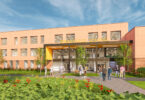
Heralding a new era for rehabilitation, the country’s first NHS National Rehabilitation Centre (NRC) has been completed in a £105m project at Stanford Hall Estate, Melton Road, Stanford on Soar, Loughborough.
The 70-bed, state-of-the-art specialist rehabilitation centre is designed for NHS patients who have experienced a life-changing illness or injury and will be run and staffed by Nottingham University Hospitals NHS Trust (NUH). The new centre will cover the East Midlands Major Trauma network which comprises four and a half million people.
NUH can currently only provide neuro-rehabilitation support to just over 100 patients each year at its current 25-bed rehabilitation unit Linden Lodge on the City Hospital site. The NRC will be able to take 750 patients a year – seven times as many patients than previously.
The NRC will primarily receive patients from across the East Midlands, many of them anticipated to come through the East Midland’s Major Trauma Centre – the busiest in the UK and based at NUH.
The new facility was delivered by Integrated Health Projects (IHP), the joint venture between VINCI Building and Sir Robert McAlpine. Capital funding for the construction of the NRC was provided by the government’s New Hospitals Programme.
Offering groundbreaking technology, earlier access and more intensive treatments, the NRC will help more people to regain their ability following serious illness or injury. Home to the most comprehensive robotics suite in the NHS and the first 360 degrees hoist in Europe, it is co-located on a site with the Defence Medical Rehabilitation Centre (DMRC) and will share some of the DRMC facilities.
These include a full hydrotherapy suite, an advanced gait lab, a Computer Assisted Rehabilitation Environment (CAREN) – a 360 degrees immersive virtual reality experience – and X-Ray and MRI machines.
NRC patients will also have access to the 365-acre countryside of the Stanford Hall Estate – including a 5km trim trail, a hand-cycle track, a fishing lake, and a pitch and put golf course. The estate is, in itself, a rehabilitation asset and every bit as important as the buildings in the overall effort to return people to health and fitness. In addition, each patient bedroom has unobscured views across the estate.
The national aspect of the NRC is that it will lead rehabilitation research and innovation, as well as providing training and education through an NRC Academy, all in collaboration with a consortium of 26 Universities throughout England. Patients at the NRC will have the opportunity to take part in research during their stay, with the aim of significantly reducing the time between identifying effective new treatments and these benefitting patients. Clinical staff will also all be encouraged to take part in research and educational activity.
What happens at the NRC is anticipated to be of international significance too – the research, innovation and evolution in rehabilitation technology and treatment is anticipated to be global in its impact and future potential.
The building is also the NHS’s first operationally carbon neutral building, featuring solar panels on the roof and four air source heat pumps in the adjacent energy centre.
The long-term ambition for the NRC is to be the national ‘hub’ in a future ‘hub and spoke’ model, or a single model multi-site service, with regional rehabilitation units (‘spokes’) established across the country to widen impact and benefit as many patients as possible.
Anthony May, Chief Executive of Nottingham University Hospitals NHS Trust, said: “We are proud to be at the point of preparing to open the doors of this pioneering facility to our first patients. The difference the NRC will make to patients and families cannot be underestimated.
“The NRC has been 15 years in the making. I should like to thank all those who have been involved for their perseverance, dedication and determination to make it a reality. I should like to pay a particular tribute to the Black Stork Charity for their considerable and unwavering support since the vision for the centre was first conceived.”
“This is a significant moment for NUH, for rehabilitation medicine in this country, and for the many NHS patients whose lives will be changed and restored in this groundbreaking facility, set in a unique location.
“Moreover, the innovation, research and knowledge generated from the NRC will help develop rehabilitation nationally and internationally.”
The aspiration for the NRC is that it will return more people (in total and as a percentage of those seriously injured or ill) to wellness and work, giving more people back a quality of life and a quality of opportunity that may not otherwise be possible. Currently, UK figures for returning people to work post rehabilitation are significantly lower than most countries in Europe and North America – where 60% is often achieved.