
Home2 Suites by Hilton
Hilton’s Home2 Suites has made its European debut in Dublin’s City Centre on Marlborough Street, offering spacious accommodation with thoughtfully designed home-like amenities.
Home2 Suites by Hilton was launched in 2009 and has since become one of the fastest-growing brands within the Hilton’s portfolio. The brand has over 800 hotels and a further 750 in development, all of which focus on providing the ultimate home-away-from-home experience.
Stephen Cassidy, senior vice president, UK & Ireland, Hilton stated: “The opening of Home2 Suites by Hilton Dublin City Centre is a major milestone for Hilton, bringing the brand to Europe, the Middle East and Africa for the first time.
“This opening reflects the growing demand we’re seeing from both business and leisure travellers for flexible, apartment-style accommodation with the comfort and quality you’d expect from Hilton.”
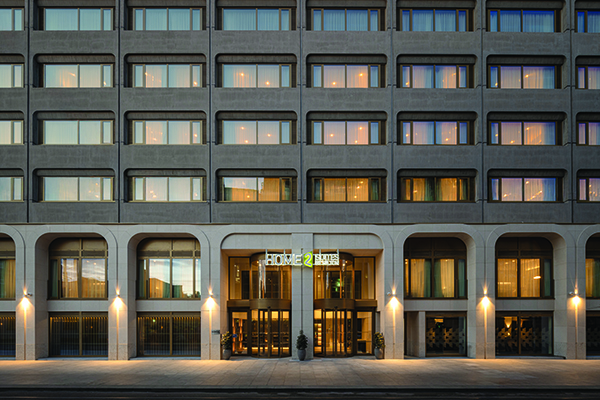
Led by JFA Architect’s Project Directors, Conor Daly and Ger Kelly, Telephone House one of Dublin’s most significant landmarks was thoughtfully transformed into a hotel with 290 spacious studio and one-bedroom suites.
Conor Daly, Project Director at JFA Architects commented: “Seeing a project evolve over several years from initial sketches to a completed building is always immensely rewarding, particularly when it begins to be occupied and enjoyed by the public.
“[For Home2 Suites, Dublin] there was an added sense of satisfaction in extending the life of a significant Brutalist building and reinventing it for a contemporary civic purpose. It demonstrates how robust 20th century architecture can be thoughtfully adapted to meet changing urban needs while preserving the qualities that made it architecturally significant in the first place.”
JFA Architect’s key ambition was to activate the Marlborough Street frontage and contribute positively to the public realm, while celebrating and retaining much of the original building designed by Brian Hogan.
The building was originally constructed with beautiful, board-marked precast concrete panels that highlight the sites strong craftmanship and rich texture. Deciding to retain this, JFA Architects took an approach to reinterpret the existing language, utilising contemporary additions that draw upon the architecture to create a cohesive composition where historic and modern elements sit comfortably together.
For the site to accommodate more guests, a two-story rooftop extension was carefully constructed along with the addition of a new rear wing both complementing the architectural language. Through preserving much of the existing building, the practice also delivered significant environmental benefits by conserving the existing buildings embodied carbon. Ultimately, this reduced the overall projects carbon footprint, as opposed to a full redevelopment.
Internally, the suites were designed to feel like modern city apartments that allow guests to maintain their daily routines. Each space includes a full kitchen, home-like amenities such as a toaster, coffee maker and cooker, a complimentary hot breakfast, and the brand’s signature Spin2Cycle, an integrated laundry and fitness centre.
A 24/7 self-service retail area was designed to allow guests who are coming back from a night-out, working late or just can’t sleep a place to grab snacks and drinks. Home2 Suites by Hilton Dublin City Centre welcomes four-legged companions too, so guests can feel completely at home.
Conor added: “The success of [this project] is a testament to the strength of the project team. Stewart Construction demonstrated exceptional technical expertise and a clear understanding of both the architectural vision and the realities of working within an existing structure. Their proactive approach, combined with the collaborative efforts of the engineers, Barrett Mahony and the wider design team, ensured that challenges were addressed early and resolved without compromising the integrity or quality of the design.
“The response [to the transformation] has been overwhelmingly positive. Having stood vacant for several years, there is a genuine appreciation that Telephone House has once again become an active part of the city.”