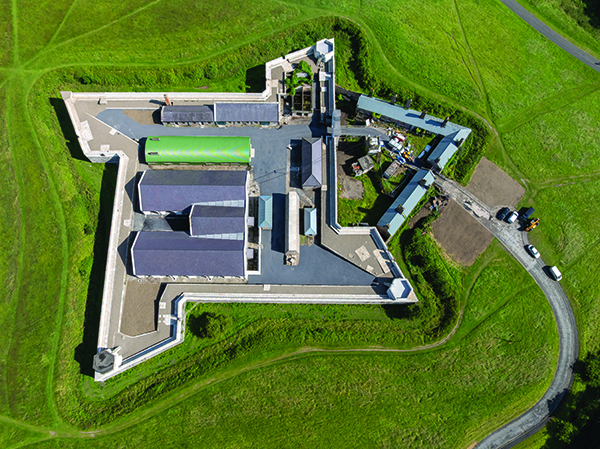

Magazine Fort, Phoenix Park
After a two-year long restoration project, The Magazine Fort, one of Ireland’s most significant military sites located in Dublin’s Pheonix Park, has reopened to the public.
The Magazine Fort is one of the oldest surviving structures within Pheonix Park and was originally built between 1734 and 1736 and designed by military engineer John Corneille. Constructed as a secure ‘magazine’ to store and supply gunpowder and ammunition to British Government forces, the site was handed over to the Irish State Army in 1922.
By 1988 the fort was decommissioned from the Irish Army after decades of military use, and was transferred to the current owners, the Office of Public Works who funded and led the restoration project.
Kelbuild Ltd., an award-winning construction firm that specialise in heritage, education and healthcare sector projects were acquired to deliver the complex conservation works. Understanding that the fort’s significance lies not only in its military function but in its architectural form, that represents a rare example of early defensive infrastructure within an urban park setting, the firm carefully balanced structural stabilisation with the preservation of the building’s original fabric and historic character.
The restoration involved a range of specialist works to preserve the fort’s historic fabric while ensuring its longevity. One of the most complex tasks was the restoration of the defensive rampart walls due to structural issues. The banquettes (stone steps built into the walls) were sinking and separating so the firm had to carefully number, dismantle and reassemble each stone after installing new geogrid reinforcement footings to rectify the issues.
Extensive masonry repairs were undertaken including renewing the roof, repairing the timber windows, and applying a new lime render and repointing to ensure the building was weather-tight.
Located at the entrance of the Magazine Fort is the Duke of Dorset Gate, which was partially dismantled in the 1970’s to allow military vehicles access into the site. Before the project, only the gate’s piers remained so the project set out to restore the gate to its former glory.
However, as there were no historic drawings, the team faced a significant challenge until the discovery of a photograph depicting the fort’s caretaker, Mr. Larry Cunningham, and his daughter on her wedding day. The picture showed the gate’s Wicklow granite and Portland stone façade, which meant architects Audrey Farrell and Angela Rueda, structural engineer Liam Keogh, and master stonemason Gavin Conlon were able to recreate the missing elements.
Throughout the project, archaeologists from Archaeological Plan supervised the restoration, documenting artefacts and conducting safety surveys. In doing so, they found suspicious soil containing degraded plastic explosives that were safely removed by the Irish Army’s Explosive Ordnance Disposal unit.
The archaeologists unearthed many exciting artefacts including metal detonator tops, grenade fragments, and an Irish Republican Brotherhood uniform button which showcases the fort’s turbulent history.
Due to the site’s heritage constraints, Kelbuild Ltd. and the Office of Public Works worked collaboratively with conservation specialists as well as the archaeologists to ensure each requirement was met.
For their respectful conservation work, Kelbuild Ltd. and the Office of Public Works was awarded the Heritage/Restoration award at The ICE Awards 2026 alongside winning the Conservation category award at the 2026 RIAI Architecture Awards.
The Magazine Fort in Phoenix Park has been given a new lease of life, ensuring it can withstand the test of time to allow future generations to learn about its unique, complex and rich past.