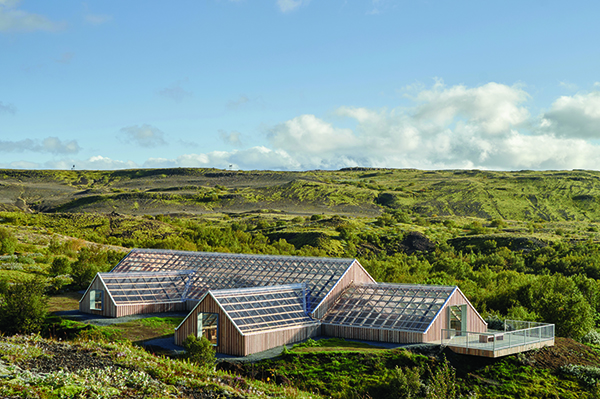

Stöng – (Re)interpretation
One of Iceland’s most renowned and frequently visited archaeological sites, Stöng í Þjórsárdal has been meticulously restored and reinterpreted; prioritising the preservation of its long heritage, while improving on-site accessibility and sustainability.
Located in the Þjórsárdalur Valley in the southern region of the country, Stöng was home to approximately 20 settlements and an estimated 400–600 inhabitants during the 11th century. By 1939 a team of Nordic archaeologists excavated the site, revealing exceptionally well-preserved farmsteads buried beneath layers of volcanic ash. Later, in 1957 a protective shelter was erected over the ruins, marking the transformation of Stöng into one of Iceland’s earliest designated public heritage sites.
Today, Stöng is a prominent example of preserved domestic architecture from the Viking Age and is regarded as one of the most complete of its kind globally. However, in 2012 the Cultural Heritage Agency of Iceland, in collaboration with the Association of Icelandic Architects held a design competition with the aim to reconcile the sites fragility and permanence.
Winner of the competition, SP(R)INT STUDIO, a Reykjavik-based practice, engaged in architecture, urbanism and spatial analysis, set out to address three key challenges: the protection of fragile archaeological remains, the adaptation to a severe climate and the improvement of visitor accessibility.
By 2017, when the project officially began construction, the practice’s original design strategy evolved into an adaptive reuse of the original 1957 shelter, rather than new construction.
Unfortunately, with time, the existing shelter had considerably deteriorated, but SP(R)INT STUDIO was able to retain and re-clad the original timber frame, reinforcing it as the primary structural system. In doing so, the practice was able to minimise resource use and conserve the site’s embodied carbon.
To allow natural durability, dimensional stability, and resistance to decay without chemical treatment, the practice employed untreated larch for all new cladding and structural elements.
Another key aspect of the project was to ensure the building sat thoughtfully within its landscape. Respecting the original topography of the shelter, while ensuring the landscape and excavations remained the focal point, the practice aligned the building along a natural slope and opened it in all directions to the valley.
Intentionally neutral, the architecture also reflects Þjórsárdalur valley’s characteristics; lightweight timber walls and translucent polycarbonate were introduced to evoke the original dwelling and its natural surroundings.
The shelter’s only entrance was conceived as floating volume, evoking temporal transition. This continues inside, as visitors hover above the excavations upon the suspended interior balcony that offers both overview and intimacy. Above, a transparent roof offers an abundance of natural light and modulates the atmosphere according to the changing weather.
Internally, SP(R)INT STUDIO choreographed visitor circulation with the intention to minimise impact; a network of pathways and elevated platforms guide movement without compromising the archaeological integrity of the site. These pathways form a sequence of experiences, allowing visitors to choose how they encounter the ruins, each showcasing a new perspective.
Central to the project, accessibility and inclusivity were meticulously introduced throughout the shelter. Each intervention was particularly designed to accommodate visitors of all ages and abilities, with a specific goal to foster children’s curiosity about Iceland’s cultural and natural heritage and increase public interest and investment in archaeological research and preservation across the country.
The project, named Stöng (Re)interpretation has been shortlisted for a Cultural Award at the World Architecture Festival 2026 (WAF) for the undeniably holistic, sustainable and thoughtful preservation of the heritage site.
SP(R)INT STUDIO has fostered a dialogue between heritage, materiality, and landscape at Stöng. The practice’s adaptive reuse and reinterpretation of Stöng offers a renewed understanding of the site; preserving its rich history, while allowing visitors to learn more about one of Iceland’s key archaeological sites.