
By Ben Hancock, Managing Director, Oscar Acoustics
The Covid-19 pandemic caused deep disruption to the hospitality industry but thankfully with restrictions now easing, a return to normality is within sight. With restaurants, bars, and pubs becoming hives of activity again, and ‘Freedom Day’ (July 19th) now upon us, an age-old problem is making diners lose their appetite — noise. A loud and uncomfortable space can make or break a great dining experience, impacting customers, staff, and repeat business.
Nightmare for the ears
Although restaurants may be struggling with COVID-19 re-opening issues such as table distancing, lower takings, and employee recruitment, investing in acoustic solutions should not be overlooked. Thinking about acoustic comfort can pay dividends and reduce unnecessary stress to workers as well as paying customers.
But here’s the thing: loud restaurants aren’t just irksome — they’re a public health threat, especially for staff. Our Oscar Acoustics research[1] found that 30% of UK workers feel stressed because of noise, and 19% have poor sleep as a result. Being exposed to noise levels above 70 and 80 decibels can also cause hearing loss over time. For restaurant workers, this can present significant risks to their health, causing an occupational hazard.
Acoustics matter to customers
No doubt, restaurant culture is a sensory affair of scents, sounds, and flavours but even a delicious dinner can leave a bad taste. This view is supported by the University of Oxford report on ‘Noise and its impact on the perception of food and drink[2]’. The findings show both background noise and loud music can impair our ability to taste food and drink.
In line with this, the Action on Hearing Loss survey indicates that 79% of people have experienced difficulty holding a conversation while eating out, while 91% said they would not return to venues where noise levels were too high. Not only is excess noise annoying to guests, it harms a restaurant’s profitability and bottom line too.
For the ideal ambient volume for comfortable conversation, audiologists suggest a decibel of 55 to 65 dB[3]. But when sound passes the 70 dB threshold (the equivalent to the sound of a moving truck), it becomes difficult to maintain a conversation. Some restaurants have even recorded noise levels as high as 95 dB or louder – the same as a jet plane taking off a mere 305 metres away.
While some diners may have been willing to put up with that level of noise pre-pandemic, restaurant owners will need to be mindful that many returning customers will be unaccustomed to overtly loud, public settings. What’s more, acoustics can also play a major role in ensuring proper social distancing measures. With the correct acoustic solution in place, both staff and customers can be easily heard, so there’s no need to shout (even through masks), or get too close, making it a more hygienic approach for everyone involved.
Goodbye to sour taste
Fortunately, hospitality venues don’t have to be this way. There is some consolation for restaurant-goers who cringe at the cacophony.
Acoustics sprays and plasters that absorb sound energy instead of reflecting it can help control overall noise levels to create a calmer atmosphere whilst still retaining an atmospheric buzz. Importantly, they also allow for greater clarity to speech and music, allowing everyone to be heard. Their seamless and decorative finish enables restaurant owners to achieve excellent acoustics without compromising on design.
Available in a range of finishes from exceptionally smooth to flat, lightly textured surfaces, a good quality acoustic spray can be applied to nearly all substrates, be it wood, steel sheet or concrete, making it a highly versatile option for modern hospitality interiors. What’s more, installation is quick and easy and requires very little in terms of upkeep. It’s also a good idea to look out for fire certifications. Some of the best acoustic spray products on the market will be A2-s1, d0 and Class 0 fire rated to BS476. It’s a solution that some of UK’s top restaurants use with great success, such as The Ivy, Dishoom, HIDE and Ottolenghi’s range of restaurants, to name but a few.
Many restaurants are also installing ‘infinity knife edge’ trims for dramatic transitions between ceiling heights, elegant, recessed lighting channels, perfect corners and a seamless slim line ceiling finish. These hide bulky ceiling constructions and minimise unwanted shadows and reflections. Look out for razor edge trims that can be used with both conventional and acoustic plasters to ensure your restaurant sounds as good as it looks.
With lockdown behind us, hospitality businesses can finally focus on what they do best and entice customers into their venues again. Investing in acoustic comfort puts guests at ease, and by driving up repeat business, can help to recover some of the reduced revenues of the last 18 months. If you present a haven for relaxed social mixing, diners will keep coming back for more.
[1] https://www.qubeonline.co.uk/sonic-battlefield-britain/
[2] https://flavourjournal.biomedcentral.com/articles/10.1186/2044-7248-3-9
[3] https://www.soundoflife.com/blogs/experiences/progressive-dining-how-sound-is-changing-the-way-people-eat
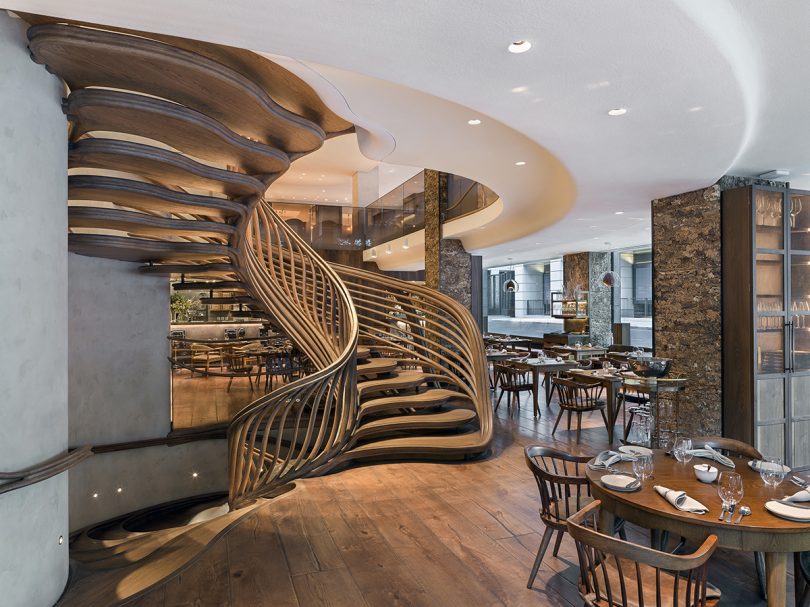
Photo: Credit to HIDE restaurant, Oscar Acoustics, Lusted Green Architects. Andrew Meredith photography.