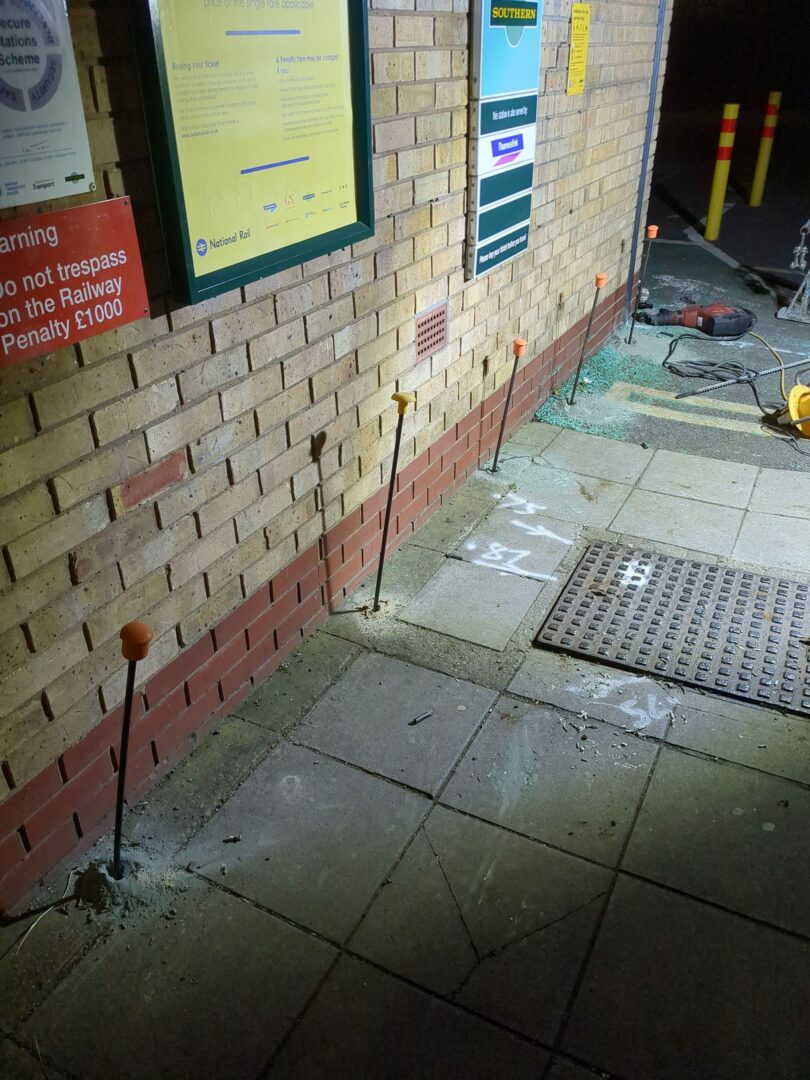

Specialist ground engineering company Geobear has successfully stabilised the foundations of a subsiding extension at 158-year-old Hackbridge Station in Wallington, South London. Using its non-invasive geopolymer injection technology, Geobear strengthened weakened ground beneath the historic station building without the need for excavation or external work alongside the operational railway.
First opened in 1868, Hackbridge Station continues to serve passengers travelling between central London and Surrey through Southern and Thameslink services. As part of a wider refurbishment programme to maintain the station’s infrastructure, movement was identified within an extension to the existing building. Investigations revealed that damaged drainage had allowed water to penetrate the ground beneath the foundations, creating very soft, waterlogged clay that weakened the supporting soils and caused differential movement.
Site investigations identified that the existing foundations were bearing onto affected clay at depths of approximately 1.3m to 3.3m below ground level. The drainage system was repaired before ground improvement could begin, addressing the source of the water ingress.
Traditional underpinning would have required significant excavation around the station building, increasing construction time, disruption and risks associated with working close to operational railway infrastructure. Access was also restricted by the proximity of station platforms, pedestrian routes and existing utilities.
Enjoying this article? Sign up for our FREE newsletter!
Geobear was appointed to develop an alternative approach that could strengthen the underlying ground while allowing the wider refurbishment programme to continue. Its solution involved injecting a specialist geopolymer material directly beneath the affected foundations, improving the bearing capacity of the weakened clay without vibration or extensive excavation.
Working entirely from inside the station building, Geobear installed more than 30 injection points at one-metre centres beneath the affected wall. Small-diameter holes were drilled through the existing floor before steel injection tubes were inserted to deliver the geopolymer at three treatment depths, reaching a maximum depth of three metres.
As the geopolymer expands, it fills voids and densifies the surrounding soil, improving its load-bearing capacity. The staged injection process allowed engineers to target the weakened ground at different depths while maintaining control over the treatment and minimising the risk of unwanted movement to the existing structure.
“Projects like Hackbridge demonstrate why understanding the cause of ground movement is so important before deciding on a remediation approach,” said Stephen Farr, UK rail manager at Geobear. “In this case, repairing the drainage was an essential first step, as stabilising the ground alone would not have addressed the source of the problem. Taking a considered approach to both the underlying cause and the ground conditions is key to achieving an effective, lasting solution.
“Many existing railways are facing the challenges of ageing infrastructure, and having different approaches available to address ground movement is increasingly important,” continued Farr. “Finding the right solution means considering not only the condition of the building, but also the practical constraints of the surrounding environment and the how disruption can be kept to a minimum.”