
TÉRÉ Pavilion
A secondary-home type of residence, TÉRÉ Pavilion is located in Assinie-Mafia, an idyllic environment, surrounded by palm trees and water in the Ivory Coast, a tropical region of West Africa. Located 100Km away from hectic Abidjan, Assinie-Mafia has become a favourite destination for the Abidjanese on the weekends. Inspired by its context, for the TÉRÉ Pavilion, the aim of the project was to emphasize the meaning of local and sustainable, through specific choices in design and construction techniques, namely rammed.
Program
The site is made up of a 29 x 51m plot hosting different rooms for family members and friends; a living room, a kitchen, a swimming pool and a service area including parking space for six vehicles. The plot is located in an ideal spot, in front of the Aby Lagoon, with an islet in front and a low water level where water vehicles can move slowly; a place that prioritizes canoes and the sound of nature. Benefitting from this sumptuous panorama, the intention was to maximise and make the best out of this location.
Design
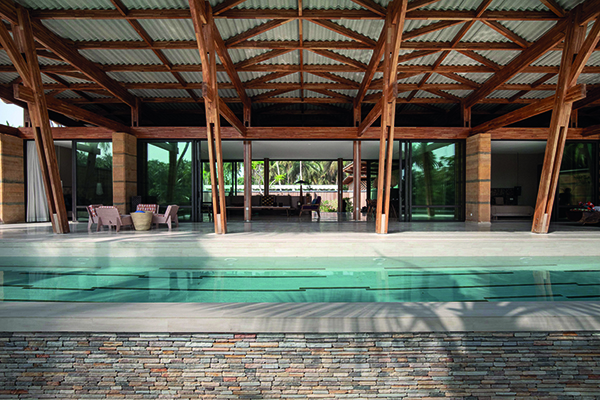
Designed to accommodate a large family, the house offers a clear organisation between the main pavilion composed of a living room, two bedrooms and a kitchen; the secondary pavilion accommodates guest rooms and the service area. The main volume, a rectangle of 6x24m, with rammed earth walls at select spots, has one room on the East side, one room in the West side and the living spaces in the centre. This allows privacy for each room and highlights the living room as the centre and key living space. The main volume, with its large openings, allows natural ventilation and breaks the boundaries of inside and outside, a privilege of living in the tropics.
Orientation
The long side of the main pavilion is in a North/South orientation and faces the lagoon. The 6 meter side faces East and West and walls are made in rammed earth to avoid sun insolation and high temperatures. The sliding windows allow the house to be open and an air flow in dialogue with the wind direction of the region. The swimming pool also benefits from the orientation, increasing the sunlight’s time. At Koffi & Diabaté Architectes, the philosophy is to work with passive solutions respecting the principles of bioclimatic construction.
Construction
As part of a sustainable approach, the identity of the TÉRÉ Pavilion is resolutely local – both architecturally and in terms of the building material chosen: earth.
A soft and warm material, the use of rammed earth allowed Koffi & Diabaté Architectes to explore a new construction technique, through the production of walls at strategic locations (East and West) of the house. Indeed, the rammed earth walls protect from direct sunlight and allow effective thermal inertia, while offering beautiful aesthetics through variations in colour pigmentation.
A sloped and high roof is designed in order to allow thermal comfort. The space between the roof and interior volumes (faux plafond) acts as a buffer through which air circulates and the warm air is evacuated.
In a constant search to achieve a local identity, the wood (for structure) and local stone terazzo (for the floors) were carefully chosen. The furniture was designed to fit perfectly with the house’s elegant and sophisticated style, completing it with an ethnic touch and pieces made of noble exotic woods (Amazakoué essence) and sculpted panels. Fabrics such as Guinea Indigo, Kouba from Congo, prints from Côte d’Ivoire and Bogolan from Mali were used for the furnishings.
Koffi & Diabaté Architectes both selected and designed some of the furniture, making TÉRÉ Pavilion a complete project, from architectural design to the lifestyle details of the residence.
WAF Award
Following its completion, TÉRÉ Pavilion has been shortlisted for a 2021 World Architecture Festival (WAF) Award in the category of House & Villa (Urban/Suburban) Completed Buildings. All shortlisted architects and projects will now go on to compete in front of a live judging panel and an audience of their peers at the festival in Lisbon in December.