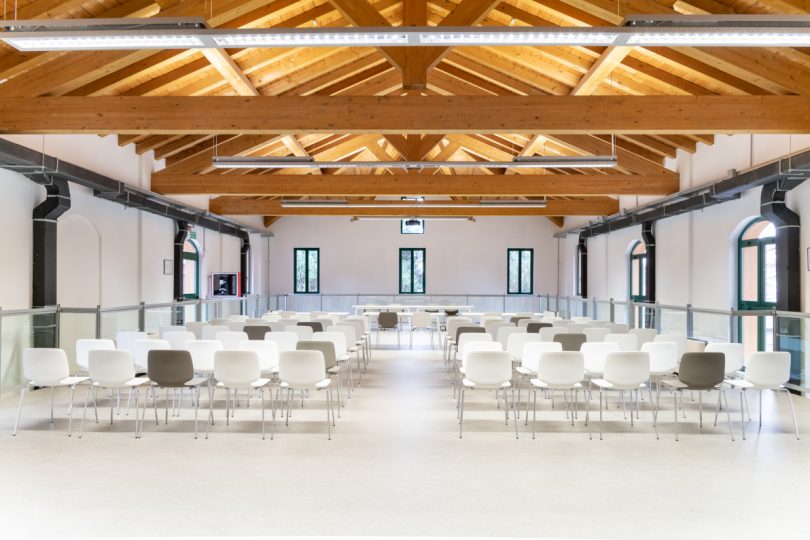

Learning spaces are being redesigned to be increasingly flexible and functional more and more often. Today, schools, universities, campuses and libraries are conceived as fluid, dynamic spaces with no real boundaries, guaranteeing a variety of different uses in line with the activities envisaged at different stages of learning.
In designing these spaces, furnishings play a key role as they can lend themselves to various configurations and, with their flexibility and modularity, they support different activities, making it possible to set-up continuously changing educational environments.
With their modern and functional design, Pedrali collections meet the need for dynamic and continually evolving spaces, while also delivering on the durability and quality that such spaces require.
The new educational spaces are devised for studying but also for meeting and interacting to promote the wellbeing of their users. These multifunctional spaces feature various formal and informal areas for learning or relaxation that are also often open to the external public.
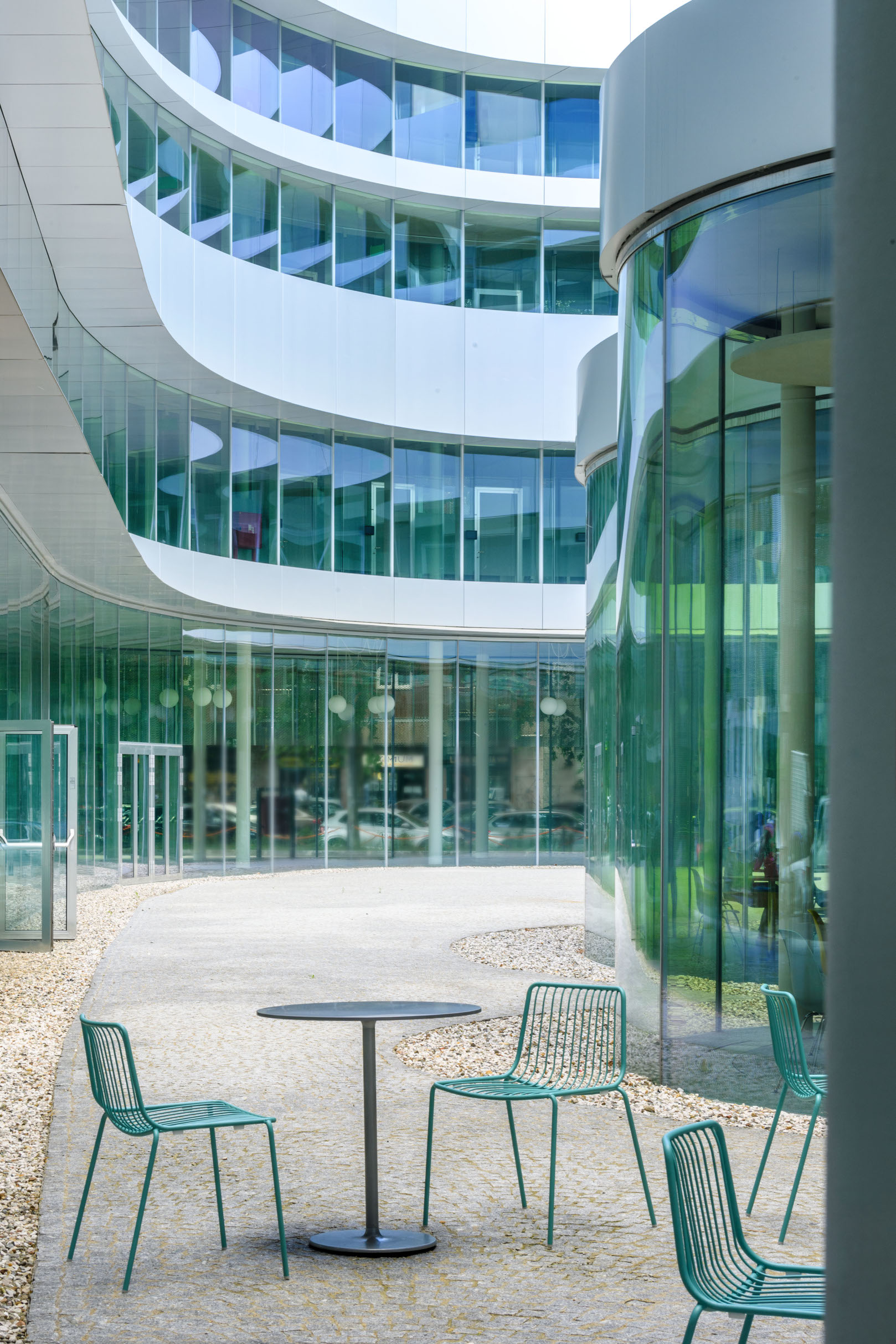
A case in point is the new SDA Bocconi School of Management campus. This innovative complex, situated in Milan’s former “Centrale del Latte”, is a technologically advanced and sustainable futuristic structure designed by the two Japanese archistars Kazuyo Sejima and Ryue Nishizawa from the SANAA architectural firm.
Pedrali has contributed to the “Materia” restaurant and the “La Centrale” bistro, managed by the company Compass Group Italia – with the brand AD Arte Food – in collaboration with the executive chef Daniel Canzian.
The project behind the La Centrale bistro aims to attract not just university staff and students, but also external guests, to whom the venue is open. The environment is characterised by expansive internal and external spaces and large perimeter windows, and offers all-day dining, from breakfast to lunch but also evening drinks.
The bistro is furnished with Nolita chairs, designed by CMP Design, and Stylus tables.
The à-la-carte Materia restaurant is split into two distinct areas, separated by an open kitchen. The cosier dining area is reserved for internal users and their guests, while the larger space is dedicated to students. The latter, marked by large glass walls along which the tables are arranged, features the Tivoli and Inga chairs, with their simple, essential lines and their neutral hues reflecting the architectural setting and seemingly almost float inside the large space flooded with natural light.
Another campus which makes use of Pedrali’s furniture is POLI.design, an international point of reference for post-graduate learning located in the Bovisa district of Milan, and more specifically in one of the city’s historical industrial landmarks.
POLI.design joins forces with the Politecnico di Milano School of Design and Department of Design, to form the Politecnico Design System, a world-leading aggregate of resources, competences, structures and laboratories.
The Snow polypropylene chairs designed by Odo Fioravanti stand out in the training room and break out area, while the Malmö armchairs and small tables give life to comfortable relaxation corners.
The outside terrace, instead, features chairs and tables from the Nolita collection by CMP Design.
The Italian company’s furnishings have also been selected for the cookery school of Associazione Maestro Martino, one of the most important cookery schools in the world, headed by renowned Chef Carlo Cracco. It is located in Villa Terzaghi, in Robecco sul Naviglio, a splendid early-18th century villa – a real training workshop for new generations of chefs and restaurateurs, but also a restaurant open to the public in which the school’s students put their teachings into practice.
The restaurant is furnished with Remind chairs and armchairs, designed by Eugeni Quitllet, paired with Fabbrico tables. The Jamaica armchairs by CMP Design and the Arki-Table create private niches for special dinner occasions. The Volt stools by Claudio Dondoli and Marco Pocci furnish the lounge bar, while the Dome stools by Odo Fioravanti are placed at the service of the chef’s workstations in the cookery labs.
For the outdoor area, the Tribeca armchairs and small sofa by CMP Design, the Ara Lounge chairs by Jorge Pensi, the Wow poufs in polypropylene, and the Ikon tables by Pio and Tito Toso offer maximum comfort for relaxing moments in the open air.
The role of libraries in contemporary communities is also being reinvented. This is certainly true of the House of Wisdom in Sharjah, in the United Arab Emirates. Designed by Foster + Partners, the library is conceived as a social learning hub supported by innovation and technology. The book consultation and coffee break areas feature Malmö stools by CMP Design and the Allure and Ester armchairs by Patrick Jouin, paired with Arki-Base tables.
Seoul’s Starfield COEX Mall, the largest shopping centre on the Asian continent, features the prestigious Starfield Library, designed by the Gensler architectural firm. Split across two floors for a total surface area of 2,500 sqm, the facility holds over 50,000 books and 600,000
international magazines, offering book and culture lovers a highly unique and varied experience.
This great space features the Ara polypropylene chairs designed by Jorge Pensi, marked by an aesthetic, refined and well-balanced language.
In Italy, in Robecchetto con Induno, the Alda Merini Library, designed by the Milanese architectural firm Alterstudio Partners, is marked by highly functional interiors. Built on the site of a former spinning mill, the library features a large open space on two floors. The ground floor hosts the actual library services, as well as relaxation and socialisation areas. These are furnished with Odo Fioravanti’s Babila armchairs in two versions, one with a polypropylene shell and a high-comfort version with a large shell and polyurethane foam padding. These are arranged around Ypsilon tables by Jorge Pensi. The Babila chairs, instead, feature on the first floor, in a multi-purpose space that is used for conferences and meetings.