

Paul Terry, Managing Director at Roofspace Solutions, rose from an apprentice to an MD in just over 20 years, starting his career at a builder’s merchants before spending time in construction, contracting and at large installation firms. Here, he looks at how MMC firms should be working collaboratively to overcome the challenges of the construction industry and increase housing stock.
A report by the Home Builders Federation says the Government’s target of 300,000 homes a year by the mid-2020s looks unlikely due to shortages and planning delays. Unsurprisingly, the pandemic has done nothing to solve the lack of available housing in Britain, further compounded by materials and skills shortages. Yet one area of construction that is moving in the right direction is the growing demand for off-site manufacturing (OSM) and modern methods of construction (MMC), which rose 6% in 2021.
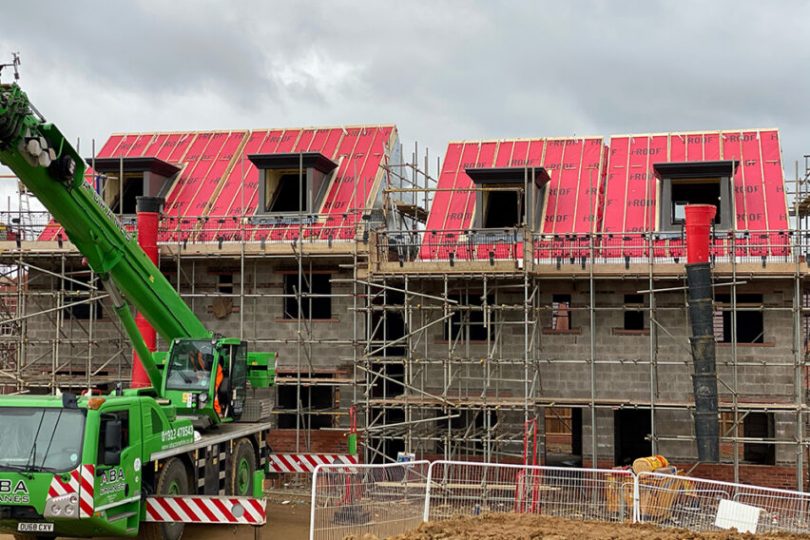
For a long time now, many have agreed that new OSM and MMC techniques are some of the best ways to tackle the chronic undersupply of housing in Britain. As such, housebuilders have been slowly ditching the traditional ways and investing in or trialling new technologies. For example, we have developed an off-site structural system that can speed up construction to the watertight stage by 35-40 per cent. It has already been implemented 1,100 times by national housebuilders across the country, including Barratt Homes, Lovell Homes and Vistry.
But, despite having so many new technologies and methods that have simply not been available before, the industry is still falling short of targets. This poses the question: do we need a more radical approach? Or is it a case of construction companies working not harder, but smarter?
Collaboration is key to progress
Following the simple premise of achieving economies of scale, I believe that instead of treating MMC as a single solution that can be plugged into a traditional build, the real benefits come from combining different solutions. We’ve experienced first-hand the difference it makes by combining off-site solutions and working in partnership towards the same goal – whether that’s alongside innovators in other industries or leveraging the skills and experience of our sister companies within the Saint-Gobain Off-Site Solutions division.
Collaboration between different companies and brands not only helps us share skills, but it also allows us all to fully use our strengths in the best possible way – while weaknesses are compensated by others – so we can get the best possible results.
Wide-ranging benefits of MMC
With the advent of modular, factory-based production of component parts, construction now has more consistent quality in the components that are used within a build. This brings benefits to both developers and customers, with better quality homes that are built faster. These components are also less likely to have defects, as quality control is much easier to manage in a factory environment as opposed to a construction site that’s exposed to the elements!

Other new technologies can lead to more reliable timescales for construction projects, with adverse weather, incompatible parts and other potentially disruptive things able to be surpassed thanks to MMC. It also allows companies to find problems before they happen, something that would have previously caused huge delays and difficulties for those involved in the projects.
Ultimately, we need to shake up the way we implement MMC to achieve the best results. If companies are slow to invest they risk falling behind – and consequently we as a sector fall further behind the 300,000 new homes a year target. So while MMC is revolutionising the way that construction happens, we still need to find the best and most efficient way of doing so.
For more information, visit roofspacesolutions.co.uk






