Olympia is the £1.3 billion project transforming a collection of privately owned exhibition halls in London into a publicly accessible landmark. Spanning 14 acres and consisting of 7 distinct ‘plots’, the site will encompass a 550,000 ft creative office space, live music venue with a capacity of 4,400, 1,500 seat theatre, creative arts school, two hotels, an array of food and drink outlets, and public sky garden.
PREMIER CONSTRUCTION spoke to Project Manager, Yvette Aunger, to catch up on its progress.
Prior to commencing construction in 2021 – two years after securing planning permission – the Olympia project underwent a series of enabling works. These included removing the existing MEP plant and equipment which remained on the roof of the existing exhibition space and creating a new energy centre to power the development.
Upon completing these preliminary works, Yvette explained that main construction could then begin:
“Firstly, we had to demolish some of the existing buildings whilst retaining their historical facades. In some instances it was necessary to undertake structural interventions around and through the existing Grade II Listed structures. The new structures are completely independent of the existing ones to ensure that there is no impact on the existing structures from the new works.”
2021 and 2022 were spent demolishing what was no longer required and establishing a foundation for fresh construction. This year, the priority has shifted to building the structures across the site plots and installing new facades.
Site restrictions and the adjacent position of Grade II listed buildings and live exhibition businesses has meant that the Olympia project must utilise specialist equipment which can operate in tight spaces and emit low vibration and noise outputs.
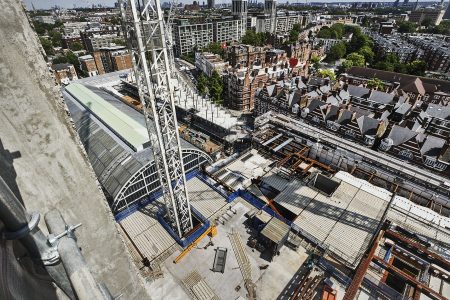
The Olympia project is surrounded by a series of Grade II listed heritage buildings.
Yvette expanded on the other construction methods being used on the Olympia site:
“Our construction partner [Laing O’Rourke] operates a fully integrated delivery solution with a focus on prefabrication. Examples include utilising precast twin walls to form core walls, precast lattice slabs to form slabs, and prefabricated MEP modules. All of the above have significant environmental, quality, health and safety, and programme benefits as the amount of on-site works are significantly reduced by works being pre-fabricated off site in factory conditions.”
As well as long trusted and efficient construction practices, the Olympia project is also utilising advanced, industry-leading technologies. All electric crawlers cranes are in use along with battery storage devices, an alternative to generators as a method for powering tower cranes.
Digital engineering has a strong presence on the construction site. It has proven effective in highlighting clash detection and helping the wider team and stakeholders visualise the complex relationships between what existed before and what is being built.
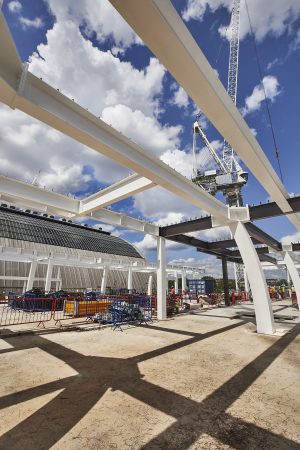
2023 has seen construction and the facade installation become the project’s priority.
While progress is positive, the Olympia project is throwing up its fair share of obstacles. Overseeing such a large construction and navigating the heritage structures surrounding are presenting a consistent challenge, as is working around those still using the existing buildings without causing a disturbance.
Yvette confirmed that: “The careful management of site logistics has been key to the safe and successful delivery of the project.”
She added: “Working on a project that will be enjoyed by so many is the best and most satisfying part of working in the construction industry.” Looking ahead, she is looking forward to, “handing over the completed buildings and then watching as they take on a whole life and bring joy and opportunity to many people for years to come. Knowing that I have made a small contribution to that is hugely rewarding.”
The Olympia project is due for completion in 2025. Next year, work will primarily focus on fitout and commissioning.