
Written By Kaitlyn Skov, Hospitality Concept & Experience Developer, STUDIO SKOV
There is a new paradigm of sustainability expectations emerging for businesses today. Evolving standards for corporate responsibility present challenges for hospitality leaders, but also open new doors of opportunity to be responsive to changing market demands and investor opportunities. Simply put, sustainability has never been a more critical and complex landscape to navigate.
S3.0 : A New Phase of Sustainability
Over the last four decades we have witnessed two distinct chapters of the sustainability movement. The first phase, Sustainability 1.0, came in the 1980’s as the environmentalism movement entered into the realm of business. This phase largely focused on foundational environmental efforts like reducing waste, recycling and initial diversity and inclusion programs.
Two decades later, the emergence of ESG drove the evolution of Sustainability 2.0, presenting companies with a new set of expectations and challenging them to demonstrate stewardship of positive environmental, social and governance impact. ESG investments have quickly grown to more than 25% of total managed investments today.
Today we stand in the wake of the third evolutionary chapter; Sustainability 3.0. This latest phase is driven by a new paradigm of expectations created by the confluence of three major psychographic trends:
Positive Impact: What was ‘good’ sustainability efforts five years ago is no longer considered ‘good enough’. While Sustainability 1.0 and 2.0 phases were anchored in the aspirational goal of “do no harm”, 3.0 raises the bar, challenging businesses to “do good” or to make a positive impact in the world.
Not Just Environmental: To date, the majority of sustainability efforts have focused on the “E” or environmental component of ESG. There’s a growing demand for businesses to drive positive impact beyond the environmental realm to include social, cultural and individual benefits with sound corporate governance practices.
Expanded Stakeholder Lens: The definition of stakeholders is expanding within the realm of sustainability.. Sustainability 3.0 challenges businesses to broaden their stakeholder lens to include the world, investors, the local communities they enter and the individual lives of the guests, staff and locals they touch every day. The confluence of these three trends are raising the bar for businesses to drive a net positive impact in the world. Brands are quickly feeling the pressure to move beyond well-intentioned words and to begin showing measurable, meaningful results across the ESG spectrum.
Sustainable Hospitality 3.0
The hospitality industry has been challenged by sustainability, especially with an early myopic focus on environmental impact. The industry has aspired to reduce environmental impacts with varying degrees of success.
Becoming “net positive” is an aspirational challenge. Groups like the Sustainable Hospitality Alliance (SHA) are leading the conversation through the development of sustainability roadmaps, best practices and encouraging industry-wide cooperation, navigating towards the greater goal of global “Net Positive Hospitality”.
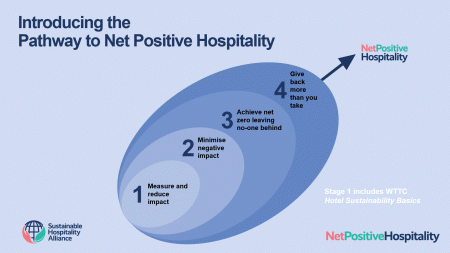
Source: Sustainable Hospitality Alliance
As expectations increase and broaden, tolerance for hollow words without demonstrated efforts – “greenwashing” – has worn thin. Brands preaching without practicing are increasingly being called out.
In terms of sustainable efforts, consumer focus is moving beyond appearance and towards driving real impact that can be measured and experienced. Consumers increasingly want to ‘feel’ the benefits of their positive lifestyle choices and experience a deeper sense of reward. A growing number of consumers are seeking opportunities to directly contribute towards the positive efforts they value. This demand presents a new market opportunity for hospitality brands to expand their experience offerings and drive positive impact.
“Consumers aren’t just who we answer to as brands, but also our partners in driving change and achieving the positive impact desired today”
Hospitality brands that rise to meet new sustainability expectations and offer opportunities for guests to participate and feel connected to their sustainable impact efforts will enjoy significant, potentially lasting brand value. Attracting the best staff, partners, investors and generating positive community relationships will equally position these companies for long-term success.
Leading the Way
While metrics and solutions for achieving the goals of Sustainability 3.0 are still developing, multiple visionary hospitality brands and leaders have taken initiative and identified first-mover opportunities. The following platforms and brands are creating remarkable sustainable experiences and programs that drive positive impact, ESG value and deliver the meaningful participation opportunities consumers are seeking.
Positive Social Impact: The Ivens, Lisbon – Marriott, Autograph Collection
The Ivens, an independent hotel within Marriott’s eclectic Autograph Collection, plays an important part in Lisbon’s travel resurgence. Beyond employment opportunities and local tourism taxes, The Ivens contributes to the social fabric of Lisbon by being a champion and vessel of Portuguese culture. The Ivens integrates Portugal’s rich cultural narrative of exploration into every element of the guest experience, from its historic brand identity and repurposed building to the matrix of local partnerships it leverages to deliver its interior design, culinary programs and service culture. The Ivens has successfully brought genuine Portuguese hospitality and history back to Lisbon’s tourism market.
Positive Environmental Impact: Le Barthélemy Hotel and Spa, St. Barths
A champion of environmental preservation on its local island, Le Barthélemy Hotel and Spa (LB) has extended its passion for preservation to its locals and guests. Partnering with Coral Restoration St.
Barths, LB has created a unique hands-on sustainability experience and education program focused on regenerating and protecting the island’s coral habitats where guests and locals can participate in snorkel or diving sessions alongside conservationists and replant coral around the island. LB donates all proceeds of the experience program with the intent of driving real long-term change between people and the environment.
Positive Governance Impact: Small Luxury Hotels of the World (SLH) Being responsive to growing demand and expectations for sustainable hospitality experiences, Small Luxury Hotels of the World (SLH) has created the Considerate Collection, a portfolio of small, sustainably-operated luxury hotels. Representing roughly 1 in 10 of their total portfolio, these properties achieve the highest level of alignment with the GSTC framework, a comprehensive set of global sustainability management standards. The Considerate Collection brand assures guests seeking the next level of sustainable travel that their properties are genuinely invested in making a positive impact.
Looking Ahead
There is no perfect equation for solving for Sustainability 3.0. Early movers and leaders like SHA and SLH are setting an example for initial best practices and programs, but the real key to success is embracing sustainability as a mindset and a foundational brand value to drive towards. As they say, Rome wasn’t built in a day.
STUDIO SKOV: https://www.studioskov.com