
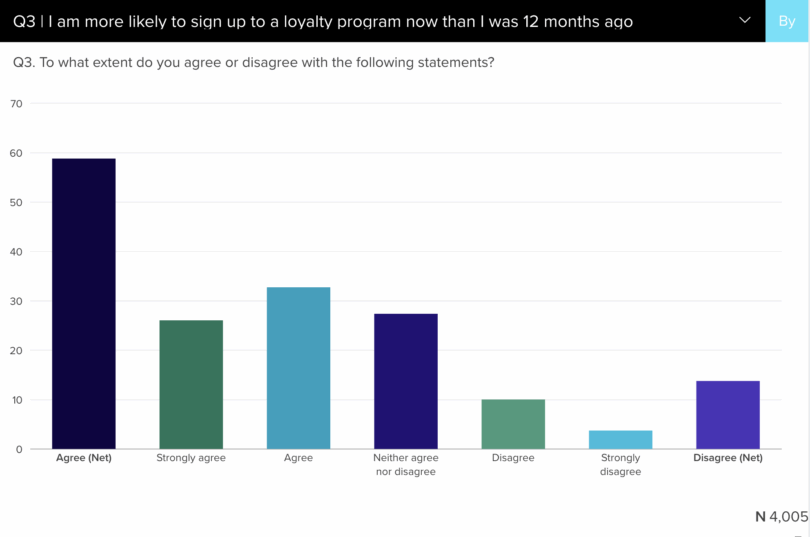

- 55% of UK shoppers are more likely to join loyalty programs now than they were a year ago.
- 64% say they are more likely to join a loyalty program in times of economic uncertainty.
- 71% of Gen Z and 72% of Millennials in the UK say they’re more likely to join a loyalty program now than twelve months ago.
- 70% of Gen Z would pay to join a loyalty program.
A new study of over 2,000 UK consumers, commissioned by the data-driven loyalty and engagement platform LoyaltyLion, reveals that 55% of UK shoppers are more likely to join loyalty programs now than they were a year ago as economic uncertainty continues to shape spending habits. Younger generations are leading the way – 71% of Gen Z and 72% of Millennials say they’re more likely to join a loyalty program now than twelve months ago.
UK consumer confidence rose slightly in June but remains negative at -18, far below the -12 recorded a year ago, according to the GfK Consumer Confidence Index. Analysts say households are still cautious under the dark shadow of inflation and worries about rising petrol prices due to Middle East tensions. Despite a slight rise, views on the UK’s economic situation remain bleak, with the past year still deeply negative at -43 and expectations for the year ahead at -28, both far worse than this time last year.
Loyalty as security in uncertain times
Amidst cost-of-living pressures (the Consumer Prices Index (CPI) rose by 3.4% in the 12 months to May 2025) and market unpredictability, loyalty programs are becoming more than a marketing tool – they’re a safety net for brands and shoppers alike.
Over six in ten (64%) UK consumers say they prioritise shopping with brands that have loyalty programs during economic uncertainty. For Millennials, that rises to 75%. And done well, a loyalty program increases repeat purchases – 82% are more likely to shop with a brand whose loyalty program they are a member of.
Younger shoppers want more than discounts
In times of economic uncertainty, trust and customer experience are just as important as financial gain in purchasing decisions. Financial rewards do matter – 84% of UK shoppers say discounts motivate them to join loyalty programs. But adding experiential perks, ways to connect emotionally, and rewards that make consumers feel valued increases a brand’s ability to build a truly loyal community. Seven in ten (73%) Gen Z and Millennials say experience-based rewards like early access to products, exclusive events, or opportunities to contribute to new product development motivate them to enrol.
Enjoying this article? Sign up for our FREE newsletter!
And consumers are seeing value, both financially, and for their lifestyle. Over half (53%) say loyalty programs are more financially rewarding than they used to be, showing how brands are stepping up to deliver what matters to consumers. Slightly more, 55%, say the programs are offering more experiential rewards than before. This may go some way to explain why a third (32%) would pay to enrol in a program – an average of £14.56 – rising to seven in ten (a huge 70%) of Gen Z.
Personalisation remains a missed opportunity
In uncertain times, shoppers are looking for value wherever they can find it. 78% are willing to complete a quiz or profile in exchange for loyalty points, showing they’re ready to share data if it helps them save money or get more out of their purchases. Yet only 59% of UK shoppers feel loyalty programs actually deliver personalised experiences, and just 55% feel loyalty emails are tailored to them. For brands, that’s a huge missed opportunity to create meaningful connections and deliver the personalised value shoppers are craving right now.
Omnichannel loyalty is a must
When money is tight, convenience matters. Seventy-four percent of UK shoppers say a consistent loyalty experience online and in-store is important to them, and 69% value being able to access loyalty programs on their mobile. In economic uncertainty, making it easy for shoppers to access rewards and benefits wherever they are can be the difference between a one-off purchase and long-term loyalty.
Driving smarter marketing and deeper relationships
Charlie Casey, CEO of LoyaltyLion, says: “This research shows that loyalty is about more than discounts. In uncertain times, shoppers are looking for value and security. Brands that treat loyalty as a relationship rather than a transaction will stand out. Consumers want to feel part of a brand’s journey. Get it right and they’ll keep coming back, spend more, and advocate for you. It’s about creating a space where customers feel understood, valued, and excited to return.”






