
Glasgow Queen Street Redevelopment
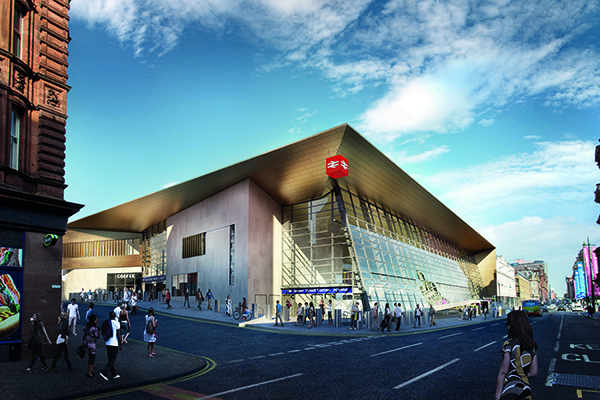
Continuing to make steady progress, the redevelopment of Glasgow’s Queen Street station will deliver a modern and fully accessible transport hub at the city’s gateway to Scotland.
The £120m transformation will provide customers with significant improvements and includes:
- A contemporary building both internally and externally
- An expanded concourse
- Improved, fully accessible, entrances on Dundas Street and George Square
- New station facilities including accessible toilets, lost property and ticket office as well as space for retail
- Extended platforms to accommodate longer trains of up to eight carriages
Glasgow Queen Street station is Scotland’s third busiest railway station, providing rail connections to and from the city to the wider Glasgow area as well as throughout the country.
Popular amongst commuter and leisure travellers, the number of people using the station is set to increase by 40 per cent to reach 28m by 2030. To manage this growth in passenger numbers, the redevelopment is to create a spacious and accessible transport facility that has been carefully designed to be a positive and prominent addition to Glasgow’s historic George square.
Work on the project began in 2017, with engineers working around-the-clock to transform the station with minimal disruption to passengers. More than 14,000 tons of material – 94 percent of which was recycled – had to be removed from the site as engineers demolished redundant 1970s buildings in front of the station to clear the way for the redevelopment
Since December 2018, the steel frame of the iconic new station building has been under construction with engineers completing the installation of 310 glass panels on the new station frontage in September.
The lengthening of platforms 2, 3, 4 and 5 was successfully completed in 2019. This involved engineers undertaking 26 metre extensions, which involved removing 2000 tonnes of material, installing 100 metres of new platform walls, 200 metres of new track and connecting it to the existing infrastructure, as well as extending the overhead power lines by 50 metres. Extending the platforms allows longer electric trains to use them, meaning more seats for passengers.
It was scheduled that work would be completed earlier this year but this was hampered by a three-month pause due to the COVID-19 lockdown. Construction restarted at the end of June 2020, where activity has focused on the internal fit-out to the staff management suite, Travel Shop and basement area, as well as the new entrance near the corner of George Square.
During lockdown, Network Rail has completed a range of projects across Scotland’s Railway – including laying new tracks and replacing bridges on the West Coast Mainline, improving drainage systems on the Highland Mainline, and upgrading platforms, station roofs, level crossings and other infrastructure across the network.
Michael Matheson, Cabinet Secretary for Transport, Infrastructure and Connectivity, said: “Efforts across Scotland’s Railway, from frontline staff running day to day services to those in planning and maintenance roles behind the scenes, have played a fundamental part in ensuring key workers are able to get to where they are needed during this pandemic.
“While many non-essential projects were rightfully paused, our continued investment in maintaining vital rail infrastructure has given reassurance at a difficult time.
“As we now make the transition through the Routemap to Recovery, it is important we step up work where we can. This will enable us safely to resume key projects such as the new Kintore station and Queen Street station improvements, bringing investment at a time when the supply chain and its workers need it most.
“I look forward to seeing these significant projects make progress because their completion will bring benefits to passengers, workers and the economy alike.”