
Lund Tramway
The tramway in Lund has won the Swedish Transport Administration’s 2021 Architecture Award.
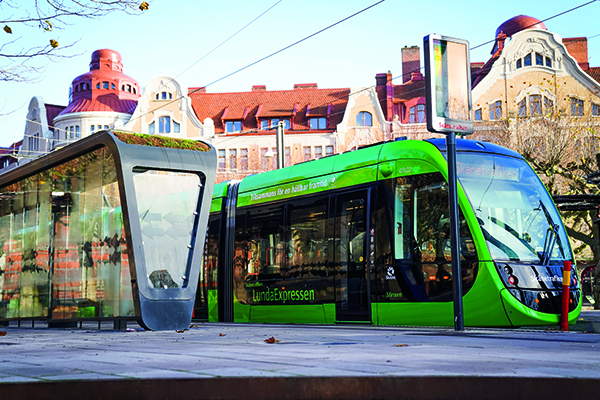
According to the jury, the tramway between Lund Central and ESS is ‘a green urban feature that connects the past with the present, which already has become a natural part of the cityscape.’
“The people of Lund are to be congratulated for their tramway which has received the highest marks in design from the trade union Architects Sweden. All those in the municipal administration who make sure that the tramway works in a constantly evolving urban environment should also be delighted,” says Municipal Commissioner Jan Annerstedt, Chairman of the Technical Committee.
The tramway in Lund forms the backbone of a new route that represents knowledge and urban development, as it runs between the historic city centre and the new ESS research facility in Brunnshög. Inspired by modern European tramway systems, the design is open and integrated into the urban space. Aesthetics, safety and function have all been combined in the design and creation of the public space. The tramway reuses and redefines existing streetscapes and adds beauty to the environment along its route.
The jury of Architects Sweden states in its motivation: “With a simplicity of design and an awareness of Lund’s historical qualities, the tramway has been successfully integrated into the urban environment. With a thoughtful design – from paving and pathways to street lights and weather protection – the tramway has been made visually distinct enough in the urban space that no disrupting barriers have been required.”
Pernilla von Strokirch, the municipality’s Project Manager, explains that the project created a clear vision for the design of the tramway and its adjacent streets at an early stage, which was then actively worked towards throughout the project. Strong construction materials have been selected that can stand the test of time:
“We have worked carefully and purposefully on the design of the tramway and the urban spaces along the route throughout the entire process. Our guidelines for the design of the tramway – which were already drawn up at the detailed development stage – have been an important basis which we have worked towards in our choices throughout the project, both in the planning and construction phases. They have guided us in our choice of materials and the detailed design of both the technical equipment and the surrounding urban space.”
The guidelines for the design of the tramway have been developed by the municipality of Lund together with Atkins.
For the project, Rockdelta by Lapinus acted as the project’s solution provider.
Building a new tramway in a lively city centre with narrow streets is challenging in many ways. As part of the project, in two locations specific challenges had to be overcome concerning ground-borne vibrations. Ground-borne vibration and noise is caused by the contact between the wheels and rails when a tram or train passes over a track causing dynamic forces in the substructure. This is propagated in wave form in the ground and can be transmitted into foundations of nearby buildings. Also, structure-borne noise (audible sound waves) may be produced by resonance generated in walls and ceilings. In these two areas Rockdelta stone wool mats have been applied for the attenuation of the vibration. In some area’s specific requirements even necessitated several layers of mats – “they tuned that track like a piano,” one of the constructors observed.
Commenting on the work, Julien Giraud from Lapinus said: “Being part of this project means we contribute to the city’s strategic plan for establishing a sustainable public transport system (with the aim of completely pollution-free traffic by 2050).
“Rockdelta is made of stone wool, a natural product which can be fully recycled without performance loss over and over again. From an environmental view, we fit into this sustainability ambition very well. The mats have an extended lifetime with retained functional performance even under extreme conditions. And they contribute to the well-being of the urban population, by reducing ground-borne vibrations.”
The roughly 5.5-kilometre-long tramway starts at Lund’s Central Station and continues along Kunskapsstråket, which covers 60% of all workplaces in Lund, including the hospital, LTH, Ideon Science Park and Medicon Village. The tramway then continues to the expanding district of Brunnshög and the international research facilities MAX IV and ESS. The municipality of Lund has developed the track work and the adjacent car, pedestrian and cycle paths. Skånetrafiken has purchased carriages, built service depots and fitted the stops. The tramway was inaugurated in December of 2020.