
By Keith Prowse
It looks like flexible working is here to stay. Whether it’s the public or private sector, banking or marketing, employees across industries seem keen to strike a balance between working from home and being present in the office. Also, the evidence suggests that businesses are embracing this working pattern, with passenger levels on the London Underground still lower than their pre-pandemic level[1] and bosses indicating this as the new ‘normal’. But, while flex ible working can cut lengthy commutes and offer workers more headspace to tackle tasks that require serious thought, it can leave many devoid of social contact.
This leaves businesses with some big existential questions. Chiefly among these are how to encourage social contact and foster a company culture that brings co-workers together. Day-to-day, video calls have become a mainstay for most organisations seeking to redress the working from home gap and connect colleagues who, in some cases, are spread over hundreds of miles. But, while this can help businesses function, and people no doubt still enjoy seeing colleagues and friends even on a screen, nothing can replace face-to-face interaction.
This is where hospitality can really step in to fill the void, by bringing the most important part of a business, its people, together. At a recent Customer Advisory Board hosted by leading hospitality provider, Keith Prowse, one senior industry representative referenced that “60% of their UK & Ireland workforce had joined since the pandemic due to acquisition, business growth and natural attrition”. They also revealed that hybrid working has proven to be challenging for corporate culture and will therefore focus on bringing teams together via corporate hospitality in the coming months.
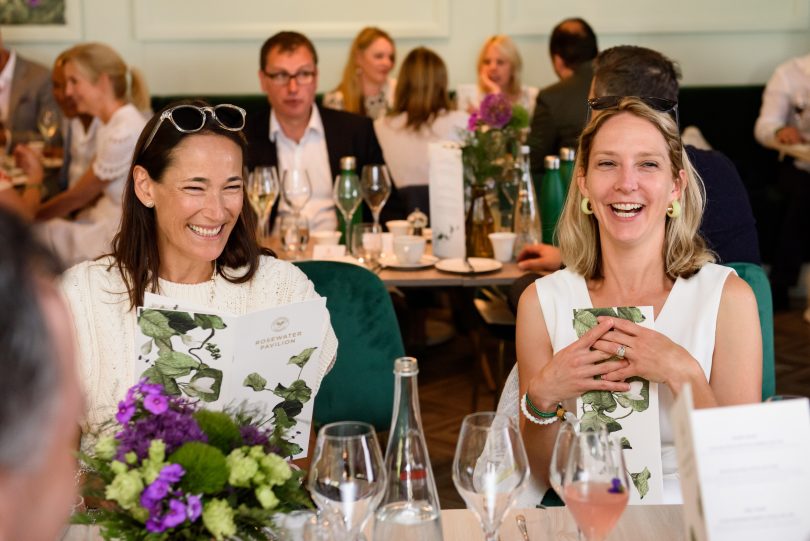
With employees spending less time in the pub together after work, it’s a great time for businesses to re-evaluate what the ‘company social’ looks like. Perhaps, it is no longer a case of little and often, but rather about bigger, and more memorable, away days that bind a workforce together through shared experience. Hospitality can offer business marquee moments that not only unite them in one setting, but also create unforgettable memories; No one will forget watching their first tennis match at Wimbledon’s Centre Court, or experiencing the incredible atmosphere at Twickenham during the Six Nations.
When considering how hard it has become to maintain social interaction within a business, it might be even more difficult to imagine how to build external working relationships with other organisations. As the old maxim goes, people buy people and the bedrock of this philosophy is trust, which can again only be truly built by human contact. Hospitality has always been a setting for building lasting relationships – our research before the pandemic indicated that a quarter of corporate customers used hospitality as a means of networking. Moreover, 33% indicated that they use hospitality and sporting events as a way to build trust with clients and colleagues. The association between relationships and hospitality is due to the fact that it provides so much interaction time. Award winning venues serving fine wine and ales, and food from Michelin starred chefs, are an unparalleled opportunity to get to know or catch-up with your guests. All before, bonding over exhilarating sport from some of the world’s top athletes.
In a post pandemic world, where many people will likely be socialising with colleagues less, it seems prudent to suggest that ‘buying people’ alone may not be enough. Instead, we need to also consider buying experiences to help our people interact and knit them closer together. And, the case for hospitality to be the vehicle for those interactions is pretty strong – as premium experience specialists, we’ve been bringing the memorable ‘wow factor’ for decades.
[1] https://uk.finance.yahoo.com/news/tube-passenger-numbers-return-levels-091750570.html